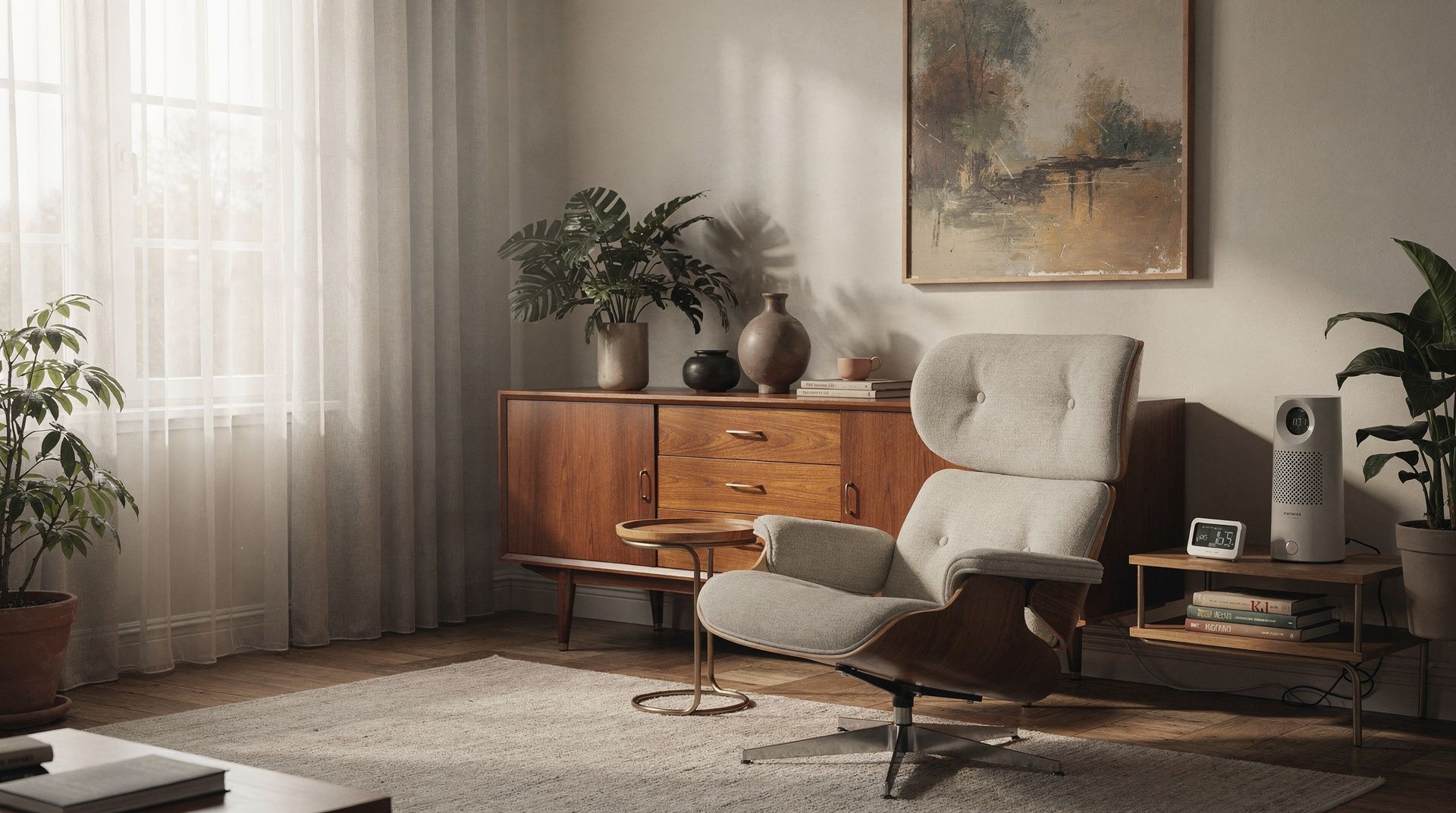
Light, Climate and Environmental Protection: What Really Ages Vintage Furniture
Mid-Century furniture consists of functional objects that have served their purpose for decades. Their survival to this day is owed to the material honesty of their era: solid timbers, oiled surfaces, natural fibres, and vegetable-tanned leather. Yet these very materials are sensitive to three factors frequently underestimated in modern living spaces: ultraviolet light, fluctuating humidity, and excessive temperatures near radiators or window surfaces.
Conservation in this context does not mean museification. A Finn Juhl armchair is meant to be used; a teak sideboard by Omann Jun is meant to stand in the dining room. What matters is calibrating the ambient conditions so that natural ageing processes are slowed and mechanical stresses within the material are reduced. Reference values from conservation practice provide a reliable framework: relative humidity of approximately 45 to 55 percent, room temperature between 18 and 22 degrees Celsius, illuminance on sensitive surfaces kept below 150 lux wherever possible, and consistent protection from direct sunlight. Adhering reasonably closely to these values in everyday life extends the lifespan of a vintage piece by decades.
Characteristic Materials and Their Sensitivities
The classic Mid-Century materials each require their own interpretation. Teak, rosewood and walnut respond to UV radiation with colour shift: rosewood (Dalbergia) can darken or bleach under direct light, teak loses its warm honey tone and turns grey, walnut fades towards a flat grey-brown. The patina itself is not the problem — uneven exposure is. A sideboard whose right half receives daily sun will develop a visible tonal difference within a few years that can no longer be corrected.
Veneers are particularly susceptible to humidity fluctuations. If relative humidity drops below 30 percent in winter due to heating air, the substrate contracts, and the veneer cracks or lifts at the edges. If it rises above 65 percent in summer, glue joints swell. Solid wood panels move within themselves and can cup if one side is more ventilated than the other.
Leather from the 1950s and 1960s, such as that found on pieces by Børge Mogensen or Illum Wikkelsø, is typically vegetable- or semi-vegetable-tanned. It dries out below 40 percent relative humidity and loses elasticity as a result. Direct sunlight visibly bleaches aniline leather. Textiles by weavers such as Lis Ahlmann or from the Kvadrat collections react to UV with fibre breakage, not merely colour loss. Plastics and foam cores of the era — found in early-edition Panton Chairs or original upholstery — age independently of external conditions, but can be noticeably slowed by cool, dry storage.
Regional Schools and What Their Construction Demands
The Scandinavian school around Hans J. Wegner, Finn Juhl, Arne Jacobsen and the workshops of Johannes Hansen, Niels Vodder and Fritz Hansen worked predominantly with solid timbers, oiled surfaces and exposed mortise-and-tenon joints. These pieces tolerate stable interior climates well, but react sensitively to underfloor heating: the rising dryness can loosen tenons. Keeping a distance from the heat source and, where possible, using a rug as a buffer both help.
The Italian school — particularly Gio Ponti, Ico Parisi, Osvaldo Borsani and the production of Cassina or Tecno — frequently employed lacquered surfaces, brass details and marble. Lacquer layers yellow under UV, brass patinates regardless, and marble is pressure-sensitive and prone to staining. Direct sunlight on polished lacquer surfaces leads to micro-cracks in the finish.
The American school around Charles and Ray Eames, George Nelson, Florence Knoll and the early production of Herman Miller and Knoll International relied heavily on moulded plywood, fibreglass and early plastics. Moulded plywood shells react to moisture with delamination; fibreglass shells from the first Eames generation become brittle under sustained UV exposure. The German school of the Ulm School of Design and designs by Dieter Rams for Vitsœ are characterised by powder-coated metals and precise wood surfaces that are climatically unproblematic but demand precise mechanical handling.
Authenticity and Condition from a Collector’s Perspective
For the market, the condition of a Mid-Century object is inseparable from its conservation history. An even, settled patina on teak or rosewood is a quality marker and adds value. Uneven light damage, cracked veneer edges, darkened repair spots or later clear lacquer applied over originally oiled surfaces significantly reduce value and are often only partially reversible.
When purchasing, always examine the backs and undersides: this is where manufacturer and model stamps are found — such as the branded marks of Johannes Hansen, the paper labels of France & Søn, the metal plaques of Fritz Hansen, or the early Herman Miller labels. These areas also reveal how the piece has lived climatically: foxing indicates damp storage, fine longitudinal cracks indicate sustained dryness, and flaking veneer indicates severe fluctuations. Original upholstery is rarely preserved; a professionally executed, materially faithful reupholstery is accepted, while a stylistically foreign one is difficult to reverse.
For everyday living, a few measures often suffice: UV-protection film on heavily sunlit windows, a hygrometer in the room, a humidifier during the heating season, a distance of at least one metre from radiators, curtains or blinds in south-facing rooms, and regular re-oiling of oiled surfaces with hard wax oil or the manufacturer’s original care oil. Ceramics and glass from the same era are less susceptible, but benefit from vibration-free placement.
Every piece in the inventory of mid-centurydesigns.com is assessed prior to listing for provenance, manufacturer marking, original substance and condition. Where conservation interventions were necessary, they are documented and identified. This means that for every object you can trace what condition it arrives in and under what conditions it will continue to age in your living space — without losing substance.
This article was generated automatically by an AI system. Disclosure pursuant to Article 50 of the EU AI Act.