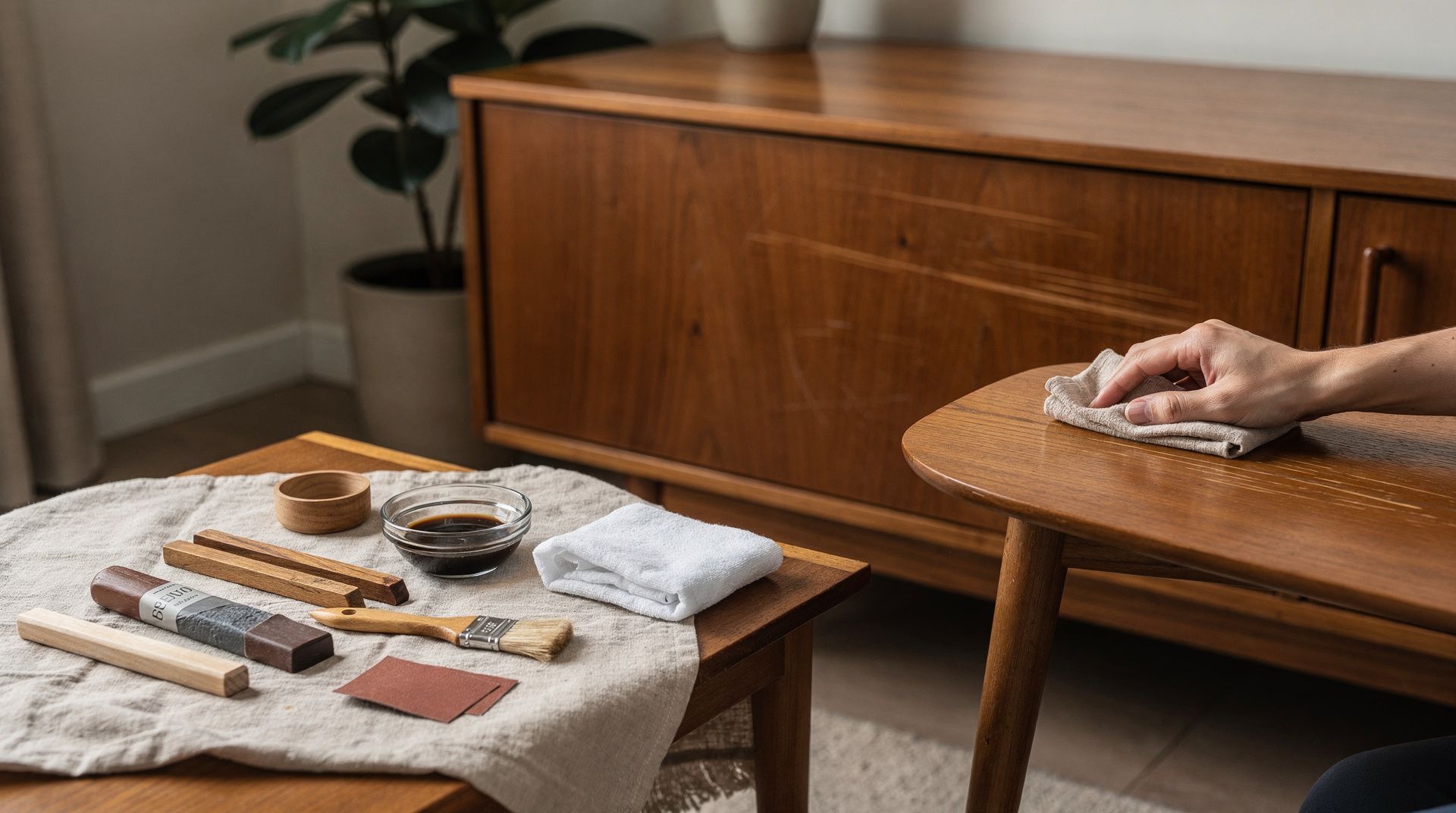
Concealing Scratches and Dents in Wood Surfaces: Methods for the Visual Repair of Surface Damage on Oiled and Lacquered Vintage Furniture
Signs of wear are part of the biography of a mid-century piece of furniture. A fine scratch on a teak sideboard, a pressure mark on a walnut rail, a dull patch on Danish rosewood: such marks tell of decades of use and are often part of the appeal for collectors. Nevertheless, every piece raises the question of where restorative refreshing ends and where a restoration begins that overwrites the character. The basic principle is: the more restrained the intervention, the better for the material substance and value. Oiled surfaces respond differently to repairs than lacquered ones, and distinguishing between the two is the most important first step before you reach for a cloth, wax or touch-up pen.
With oiled surfaces (typical of Scandinavian teak, rosewood, wenge and oiled oak), there is no closed film on the wood. The oil has penetrated the grain and cures within it. Small scratches can often be reduced simply by applying a targeted re-oiling with hard oil or a classic furniture oil: rub in sparingly with a lint-free cloth, allow to soak briefly, remove excess, polish with the grain. Zones that have turned dull benefit from a full-surface refresh that brings the colour tone back in line with the surrounding area. Shallow dents in open-grained wood respond well to the classic steam-ironing method over a damp cotton cloth: the fibres swell back without a lacquer film cracking. Afterwards, re-oil locally. Deeper defects are retouched with hard wax in a matching colour tone, melted in with a heated spatula and drawn level with a felt pad.
With lacquered surfaces (common in American mid-century, Italian pieces from the 1950s, but also in numerous German production furniture), the logic is different: you are working on a film, not on the wood fibre. Very fine hazes and micro-scratches can be reduced with a mild polish and cotton wool pad, sometimes also with a walnut kernel, whose oil optically closes fine lines. Clear-lacquered walnut or maple surfaces from the USA are sensitive to solvents: alcohol, acetone and aggressive cleaners are off-limits. With pressure marks, steaming is risky because the lacquer film can crack or turn milky. Here, alcohol-based touch-up pens, shellac sticks for professional use, or a targeted re-lacquering by a restorer are the appropriate approaches. Before any measure, a test on a concealed spot is recommended – for example on the back or beneath a plinth panel.
Characteristic Materials and Their Behaviour During Retouching
The material palette of mid-century modern is manageable, but each wood behaves differently. Teak from Danish production is oil-rich, medium-hard and open-grained; small scratches often disappear simply through re-oiling with classic teak oil, while the colour tone darkens over the years, meaning retouches should never be applied too dark. Rosewood, particularly Rio rosewood (today protected under CITES and only tradeable with appropriate documentation), is denser, more resinous and strikingly grained; wax retouches must be applied in multiple colours to avoid painting over the characteristic striping. Walnut in its American form (American Black Walnut) was frequently clear-lacquered or given a thin stain; here, film maintenance is what counts. Oak, often soaped or oiled in Danish pieces, tolerates steam treatments well. Veneers deserve particular care: mid-century furniture works almost exclusively with veneer on a more stable substrate, and aggressive sanding almost invariably means the loss of the original surface. With metal and brass details (handles, feet, rail trims), a light patina is generally desirable; polishing it away is an aesthetic decision, not a restoration necessity.
Regional Schools and Designers: Why Provenance Determines the Repair
How a piece should be treated depends significantly on its school of origin. Danish Modernism around Finn Juhl, Hans J. Wegner, Arne Vodder, Kai Kristiansen or Poul Cadovius worked predominantly with oiled or soaped surfaces; workshops such as Johannes Hansen, Niels Vodder, France & Søn or Fritz Hansen relied on a craft finish culture that can still be reactivated today with careful oil care. Swedish works from the circle of Josef Frank for Svenskt Tenn or by Carl Malmsten are often lighter, with waxed or soaped surfaces that call for a different approach. American icons by Charles and Ray Eames, George Nelson or Edward Wormley for Herman Miller, Dunbar and Knoll more frequently used clear lacquers, which is why film-oriented retouching techniques apply here. Italian positions by Ico Parisi, Gio Ponti or Osvaldo Borsani show a wide spectrum from high-gloss nitro lacquer to matt oil finishes; consulting catalogue raisonnés and catalogues (such as the Cassina or Tecno archives) is advisable before any intervention. German production furniture from the circle of WK Möbel, Wilhelm Knoll or the Ulm School is often clearly structured and lacquered; here, careful film maintenance can achieve a great deal.
Authenticity and Condition: What Collectors Should Consider When Dealing with Surface Damage
For the value of a mid-century piece, two factors are decisive: verifiable provenance and honest condition. Originally preserved surfaces have commanded higher prices on the collector market for years than fully refinished pieces. A lightly re-oiled sideboard that is otherwise untouched in its substance is generally preferable to one that has been sanded down and re-lacquered, even if the latter appears flawless at first glance. Collectors therefore check: Is the veneer preserved at its original thickness? Are edges and profiles sharp or rounded through sanding? Are stamps, brand marks or labels (such as those from Fritz Hansen, France & Søn, Cado, Herman Miller, Knoll, Cassina) still legible, or have they been obscured by restoration? Is there a former lacquer finish beneath the oil, which might indicate a change of finish? For particularly significant works – such as signed cabinetmaker pieces from the Danish Snedkerlaug exhibitions – any substantive retouching should be coordinated with a specialist restorer before proceeding. Documented, minimally invasive care increases value; a well-intentioned full restoration can permanently diminish it.
At mid-centurydesigns.com, we curate original mid-century furniture with a clear eye for precisely these questions. Every piece is assessed for provenance, originality of surface, veneer thickness, fittings and markings before being accepted into our inventory. Where a careful refresh is appropriate, we work with restorers who respect the handwriting of the respective manufacturer rather than overwriting it. We document condition and interventions transparently, so that you as a collector or designer can make a well-informed decision.
This article was generated automatically by an AI system. Disclosure pursuant to Article 50 of the EU AI Act.