MATERIAL · COGNAC LEATHER COLOUR LOSS OXIDATION LEATHER DYE

Refreshing cognac leather: preserving patina, controlling colour loss

Between aniline, oxidation and proper colour care

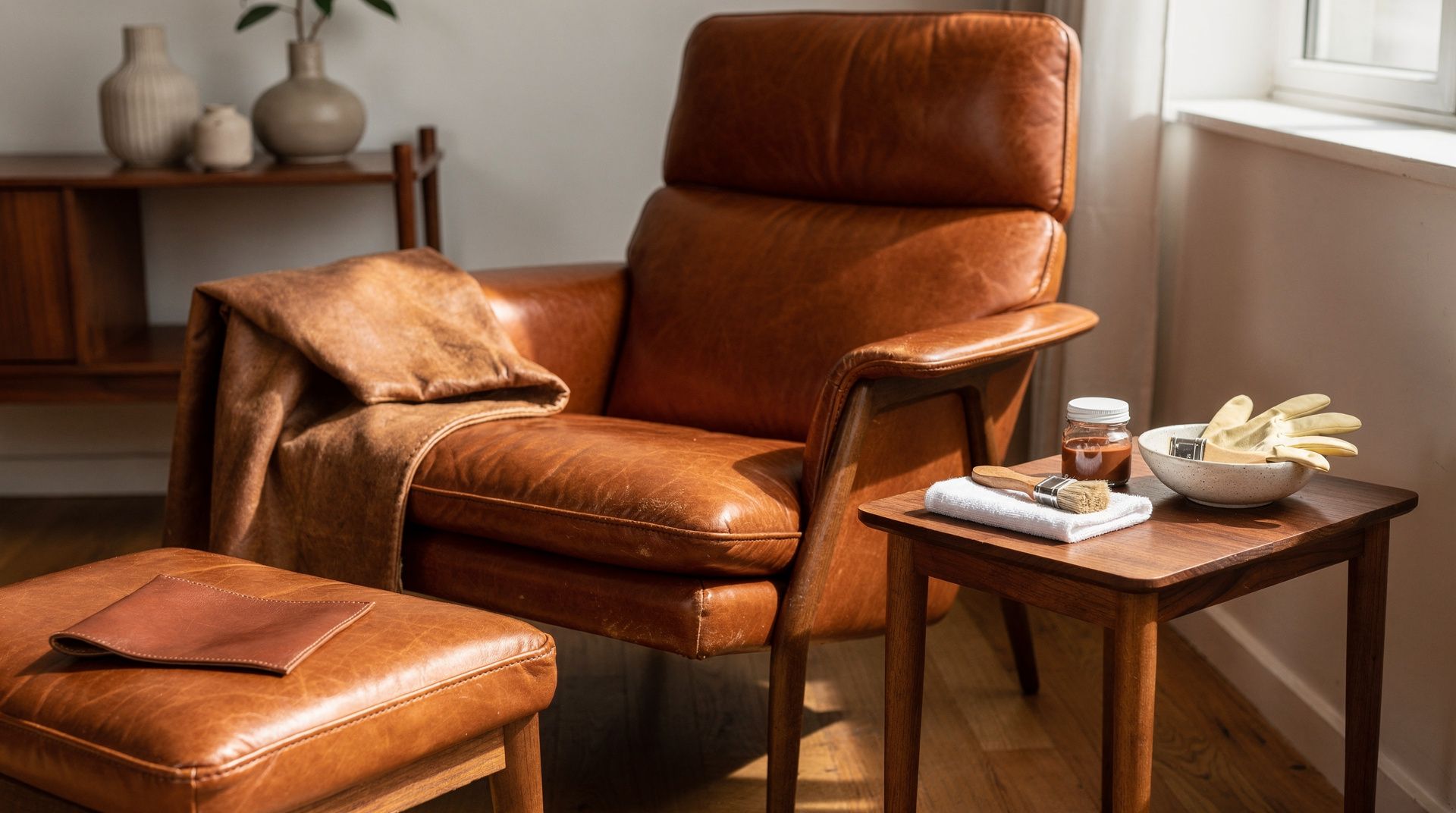
Cognac-coloured vintage leather derives its depth from decades of light exposure, oxidation and skin contact. Anyone looking to re-dye should first identify the leather type: full aniline responds differently from pigmented or semi-aniline leather and requires correspondingly tailored dyes rather than opaque pigments. Here you will learn how to gently refresh original cognac tones, which products respect the open fibre, and how to protect seat surfaces, armrests and edges from further fading in the long term.

mid-century·designs

cognac leather colour loss oxidation leather dye

ESSAY · 01

Work & Context

mid-century·designs

Understanding cognac leather before reaching for colour

Cognac leather is one of the most sensuous surfaces of Mid-Century Modernism. Its warm, reddish-brown tone is created not by pigment alone, but through the interplay of vegetable tanning, fat liquoring levels and decades of light exposure. This is precisely what makes every intervention delicate: what at first glance appears to be mere colour loss is frequently a grown patina that defines the very value of a chair by Børge Mogensen, a Danish daybed collection or a Safari Chair by Kaare Klint. Oxidation, UV radiation and dried-out fats alter the surface slowly but continuously. Reaching for leather dye too soon obscures the history of the piece and often shifts the tone into a flat, lifeless brown.

The following overview clarifies which types of leather were actually common in the Mid-Century context, how to distinguish aniline from semi-aniline and pigmented leather, and where the boundary lies between serious conservation and a restoration that becomes problematic from a collector’s perspective.

1. Characteristic materials: aniline, semi-aniline and vegetable-tanned saddlery leather

The classic cognac leather of the 1950s to 1970s is, in most cases, a vegetable-tanned cowhide that has been through-dyed with transparent aniline dyes. Aniline means: the dye penetrates the fibre without sealing the grain with an opaque pigment layer. Pores, scars and growth lines remain visible, the leather breathes, absorbs fat and develops its characteristic shimmering patina. Semi-aniline leather carries an additional thin pigment or finish layer that provides greater light fastness but ages less vividly. Pigmented leather is fully opaque and rarely found in high-quality Danish or Italian Mid-Century pieces.

You can identify the difference with a simple water drop test on a concealed area: if it is absorbed within a few seconds and temporarily darkens the spot, you have aniline. If it beads off, a finish layer is present. Also relevant for cognac tones are saddlery and full-grain leathers used by Klint, Mogensen or Arne Norell. These leathers are thicker, vegetable-tanned and naturally oxidise towards deeper, more reddish tones. What appears to be colour loss here is often colour gain.

2. Regional schools and their approach to leather

The Danish school around Kaare Klint, Børge Mogensen, Finn Juhl and later Arne Vodder worked almost exclusively with vegetable-tanned aniline leathers, sourced from tanneries following Danish tradition or from Swedish production. The Safari Chair frame by Klint, the Spanish Chair by Mogensen and the classic Fredericia models rely on leather that is deliberately left unprotected and becomes softer, darker and more distinctive with age. The rule of thumb here: as little intervention as possible.

The Swedish line around Arne Norell, particularly the Ari and Sirocco models, used thicker saddlery leathers that age with exceptional robustness. Oxidation manifests here more as drying out than as colour loss. In Italy, with manufacturers such as Poltrona Frau or in the circle of Scarpa and the Castiglioni, semi-aniline Pelle Frau dominated — more light-fast, retaining its cognac nuance longer, but requiring a different care logic. French Mid-Century designs by Jacques Adnet or Jean-Michel Frank frequently employ saddlery leather in the context of metal or wooden frames where the leather is stitched rather than upholstered. Each of these schools responds differently to colour refreshing, and applying a universal leather dye across the board is, in every case, a decision that affects market value.

3. Authenticity and condition from a collector’s perspective

For serious collectors, original leather — even with visible signs of ageing — is generally more valuable than a clean re-dyeing. A through-dyeing, nourishing treatment with colourless or very lightly pigmented leather balms based on lanolin, beeswax and high-quality fats is considered conservatorially acceptable. It replaces lost fats, slows oxidation and visually restores the cognac tone without adding material. Problems arise when opaque leather paints, acrylic finishes or spray pigments are applied: they seal the grain, distort the play of light and are immediately recognisable under UV light or close inspection.

Before any intervention, it is worth documenting the current condition with daylight photographs. Localised dry patches can often be re-nourished locally without treating the entire surface. Cracks in the grain pattern are generally irreversible and should not be concealed, as they belong to the biography of the piece. Anyone wishing to sell or insure should keep a written record of all interventions. An honestly documented vintage leather with patina reliably achieves better results in curated trade than an optically perfect but unclearly restored surface.

At mid-centurydesigns.com, leather pieces from this era are assessed for their material composition before being added to stock, evaluated with regard to original upholstery, tanning method and previous treatments, and documented with corresponding condition notes. This allows you, as a collector or designer, to decide whether to acquire a piece consciously in its grown patina or to opt for a conservatorially guided care treatment that preserves the cognac tone long-term without altering the substance.


This article was generated automatically by an AI system. Disclosure pursuant to Article 50 of the EU AI Act.

FAQ · 02

Frequently asked about cognac leather colour loss oxidation leather dye

5 Answers

01
Why does my cognac leather discolour over time, and how does this process differ from aniline leather?
Like all natural leather types, cognac leather is subject to oxidation, particularly when a pigmented or semi-aniline finish is present. In pigmented leathers, the colour sits in a surface protective layer that UV radiation and atmospheric oxygen attack over time. Pure aniline leather, by contrast, is undyed and absorbs moisture and oils, causing it to darken naturally without any pigment layer oxidising. Cognac tones typically fade towards yellowish-brown hues, while aniline leather develops a deeper, more even patina. High-quality vintage cognac leather with semi-aniline treatment offers a compromise: more natural development with partial pigment protection.
02
Can I safely refresh the colour intensity of my faded cognac leather with a leather dye?
Yes, with the right methodology. Use only specialised leather dyes on a water or alcohol base — never shoe polish or universal paints. Before application, you must thoroughly clean and degrease the leather with a leather cleaner. Apply the dye thinly, evenly and in several thin layers rather than one thick coat, to avoid patchy results. Test on a concealed area first. Once dry, seal the surface with a transparent leather protector to stabilise the new colour layer and slow further colour loss.
03
How do I tell whether my Mid-Century cognac leather is originally pigmented or aniline leather?
Pigmented leather shows a velvety, uniform surface structure without visible natural colour variations and can easily be tested with a white, slightly dampened cloth: it will transfer colour or show discolouration. Aniline leather, on the other hand, displays natural colour irregularities, visible pores and a smoother feel, and transfers only minimally in this test. Semi-aniline leather falls in between: light pigmentation with still-perceptible natural characteristics. In high-quality vintage pieces from the 1950s–1970s, semi-aniline was standard in order to combine durability with authenticity.
04
Which storage conditions most effectively prevent colour loss through oxidation?
Store your cognac vintage leather in a cool (15–20°C), dry place with a constant relative humidity of 40–50%. Direct sunlight and UV light are the primary drivers of oxidation: keep your furniture away from south-facing windows or use UV-filtering curtains. Avoid artificial heat sources such as radiators immediately adjacent to the furniture. Occasional ventilation prevents moisture build-up. Apply a thin leather conditioner with a lightly pigmented oil every 6–12 months to regenerate the protective layer and slow oxidation. This regularity is more decisive than any single measure.
05
Are there differences in conservation between different cognac shades, such as light vs. dark cognac?
Yes. Light cognac leather oxidises more visibly, as discolouration towards yellowish-grey-brown tones becomes more apparent. Darker cognac shows colour loss less conspicuously, though the chemical process is identical. With lighter cognac, more preventive investment is warranted: stricter UV control and more frequent colour refreshing every 12–18 months. Darker cognac allows longer maintenance intervals of 18–24 months. Both benefit from the same basic care. When refreshing your leather, choose a dye that recreates the original shade rather than simply dyeing darker, in order to preserve authenticity.

GLOSSARY · 03

Related Terms

9 Entries

Cognac leather
Through-dyed leather with a warm, amber-brown to golden-brown colouring that develops through the leather's own oxidative processes. The dyeing penetrates the full leather structure, allowing visible colour gradation at scratch or wear points without exposing undyed undersides.
Aniline leather
Surface-dyed leather in which soluble dyes penetrate the outermost fibre layers without permeating the leather body entirely. Offers the highest tactile softness, but reveals the undyed leather reverse at points of abrasion or ageing.
Leather dye
Specialised colouring agents based on water, alcohol or oils, formulated to adhere to leather surfaces. Differs from paints for other materials in its permeability, flexibility and compatibility with leather finishes.
Oxidation
Chemical reaction of leather with oxygen, leading to colour change. In cognac leather, oxidation can result in yellowing, darkening or a grey haze. Accelerated by UV radiation, heat and humidity.
Patina
Visible surface changes in leather caused by time, use and environmental influences. In high-quality cognac vintage leather, a distinction is drawn between desirable age character and unwanted colour loss or damage.
Leather finish
Protective surface layer on leather (transparent or pigmented), consisting of polymers and waxes. Determines abrasion resistance, UV protection and receptiveness to colour refreshing. Must be analysed before re-dyeing.
Colour refreshing
Preservation measure to restore lost or faded leather colour through targeted application of leather dyes. Differs from complete re-dyeing through minimal layer thickness and retention of existing patina and surface structure.
Provenance leather
Leather with a documented history of origin and use, typically from Mid-Century furniture or designs by well-known manufacturers. Its authentic ageing and colour development are considered a value attribute during conservation.
UV protection
Protective measure against ultraviolet radiation, which accelerates leather oxidation. Encompasses UV-absorbing finishes, surface agents or conservatorial storage in dark rooms to slow colour loss.