Understanding Aniline Leather Before You Care for It
Aniline leather is the most honest form of leather finishing. It is through-dyed exclusively with soluble dyes and carries no opaque pigment layer that would conceal the grain, growth marks or fine scars. This is precisely what makes the surface so vibrant and yet so sensitive: every drop of water can dry leaving a ring, oils penetrate deeply, and UV light permanently alters the shade. Pigmented leather, by contrast, has a closed, usually polyurethane-based finish layer on the grain. This layer is more robust, wipeable and uniform in colour, but loses the iridescent, patinating character that collectors prize in mid-century upholstery from Fritz Hansen, de Sede or Cassina.
Anyone taking on a vintage piece with an original aniline cover should therefore approach care in a fundamentally different way than with a modern pigmented sofa: less water, no surfactant cleaners from the household shelf, no silicone sprays. Instead, what is needed is a sober understanding of the fibre, suitable pH-neutral products and patience. The following text organises the most important points for collectors and interior designers working with original mid-century upholstery.
1. Characteristic Materials: What Distinguishes Aniline from Semi-Aniline and Pigmented Leather
The exact type of leather is decisive for any care decision. A simple water-drop test on a concealed area gives clues: if the drop is absorbed within a few seconds and the area visibly darkens, you are dealing with open-pored aniline or lightly oiled pull-up leather. If the water beads for longer, the finish is semi-aniline or pigmented.
Typical mid-century leather types include:
- Pure aniline: through-dyed, open-pored, visible natural characteristics. Frequently found on the upholstery of high-quality Danish lounge chairs from the 1950s and 1960s.
- Semi-aniline: a thin pigment glaze over the aniline dye, somewhat more even and less water-sensitive. Used on many production models by German and Italian manufacturers from the late 1960s to the 1970s.
- Pull-up or oiled leather: heavily filled with oils and waxes, lightens when pulled or bent. Distinctive on some Swiss club upholstery.
- Pigmented leather: opaque coating, easy to care for, but without deep patina.
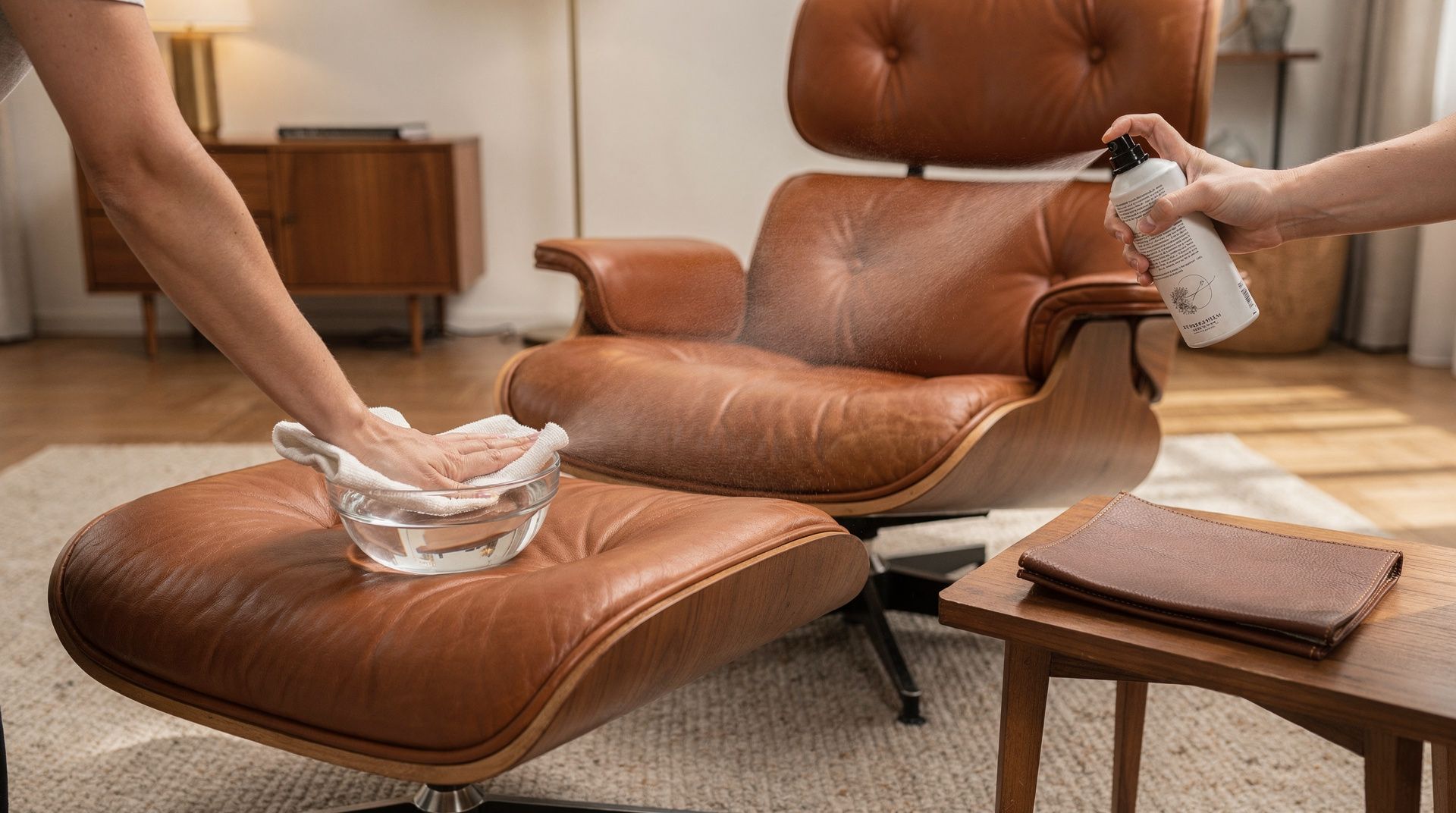
For wet cleaning aniline: do not rub, do not flood. Remove dry soiling with a soft brush and microfibre cloth, then work across the whole surface evenly with distilled water and a pH-neutral aniline cleaner. It is essential to treat the entire cushion or panel, not just the stain, otherwise water rings will form at the drying boundaries. After complete drying at room temperature, apply impregnation with a fluorocarbon-based or modern fluorine-free leather waterproofing spray approved for aniline. Two light passes with intermediate drying are preferable to a saturated application. Silicone-containing care products and conventional leather fats do not belong on aniline, as they clog the surface and accelerate darkening.
2. Regional Schools and Their Leather Practices
The leather choices of mid-century modernism can be broadly read along regional schools, and this has direct consequences for the care of an original cover.
Denmark and Scandinavia. Designs by Finn Juhl, Hans J. Wegner or Børge Mogensen were often upholstered in vegetable-retanned, only lightly oiled aniline leathers. The surface ages warmly to a honey colour, but reacts markedly to UV radiation and moisture. Here, consistent sun protection is often more important than any impregnation.
Switzerland and Germany. De Sede, Walter Knoll or COR used partly thicker, more richly oiled aniline and semi-aniline leathers in the 1960s and 1970s, corresponding to the familiar voluminous seating feel. These leathers tolerate slightly more care, but equally demand a restrained impregnation so that the characteristic darkening of the grip marks is preserved.
Italy. Cassina, B&B Italia or Zanotta opted, depending on the model, for smooth aniline leathers with high colour depth, where pure appearance was paramount. The finishes are thin; scratches here tend to become part of the piece’s legibility rather than a defect.
USA. Knoll and Herman Miller offered both aniline and pigmented leathers for designs by Eames, Saarinen or Nelson. The classic lounge chair covers in particular require precise material identification before any cleaning agent is used at all.
These differences are not a detail: what works on a Swiss cover from the late 1960s can permanently stain a Danish aniline cover from the same decade.
3. Authenticity and Condition: What Collectors Should Look for in Aniline Covers
An original aniline cover is in many cases a condition-relevant value carrier. Before any care and especially before any post-treatment, a sober condition assessment is worthwhile.
Check in particular:
- Grain pattern and patina: Is the grain consistent across all surfaces? Unusually smooth, matt or evenly coloured areas indicate later re-pigmentation or overspraying that reduces the original character of the cover.
- Colour gradient at seams and edges: Original aniline covers show a typical lightening or darkening in heavily used areas. Hard colour edges suggest retouching.
- Smell: A pungent solvent odour may indicate fresh external treatment with unsuitable products.
- Reverse side and concealed areas: These reveal the original colour depth and often also the leather stamp or manufacturer’s label.
- Substance of the hide: Brittle, cracked areas on armrests or front seat edges cannot be reversed by impregnation. Here it is the substance that decides, not the care.
For the long-term protection of sensitive vintage aniline leathers, a few reliable principles apply: stable room humidity of around 45 to 55 percent, no direct radiator contact, no prolonged sun exposure, seasonal cleaning with minimal moisture and an impregnation every twelve to 24 months depending on use. Every intervention should be documented so that future owners can trace the care history. For a seriously traded mid-century piece, this belongs to the provenance just as much as the manufacturer’s label.
At mid-centurydesigns.com, upholstered furniture with original leather covers is technically identified before being included in stock, checked for post-treatments and retouching, and provided with a transparent condition description. For every piece you receive information on whether it is aniline, semi-aniline or pigmented leather, which patina is original and which care steps we recommend for its preservation. This means a sensitive vintage aniline cover can not only be acquired, but responsibly maintained for years to come.
This article was generated automatically by an AI system. Disclosure pursuant to Article 50 of the EU AI Act.