Understanding Fiberglass Before You Intervene
Fiberglass shells from post-war modernism are a material document. Zenith Plastics pressed the first series of Eames Shells for Herman Miller from 1950 onwards; Wilkhahn and other European manufacturers followed with their own formulations. What you hold in your hands is a composite of unsaturated polyester resin, short glass fibres, and pigments, often with a thin gel coat top layer. This construction ages characteristically: it yellows under UV, chalks on the surface, loses its sheen, and shows the typical “fiber blooms” at mechanically stressed edges – exposed fibre ends.
Anyone restoring should think conservatorially rather than cosmetically. Every polish, every sanding, and every bonding is an intervention into a historic object. A shell from Zenith production with a visible rope edge and fibre structure loses value if it is aggressively polished and lacquered. The goal is therefore stabilisation and careful cleaning, not making it look new. This text summarises what you should look out for in terms of material knowledge, regional attribution, and condition assessment before handing a vintage shell over to your own workshop or to a restorer.
Characteristic Materials and Their Ageing Behaviour
Early American shells up to around 1971 have a visibly translucent fibre structure and the famous continuous rope edge into which the fibreglass mat is embedded. The resin is a UP polyester whose free radicals continue to react over decades. Yellowing occurs primarily in light colours such as Parchment, Greige, or Elephant Hide Grey, because the pigmentation is thinner and the resin tone shows through more strongly. Uniform yellowing is part of the ageing process and can only be partially reduced by abrasive methods, which however opens the surface and provokes accelerated re-yellowing in the long term.
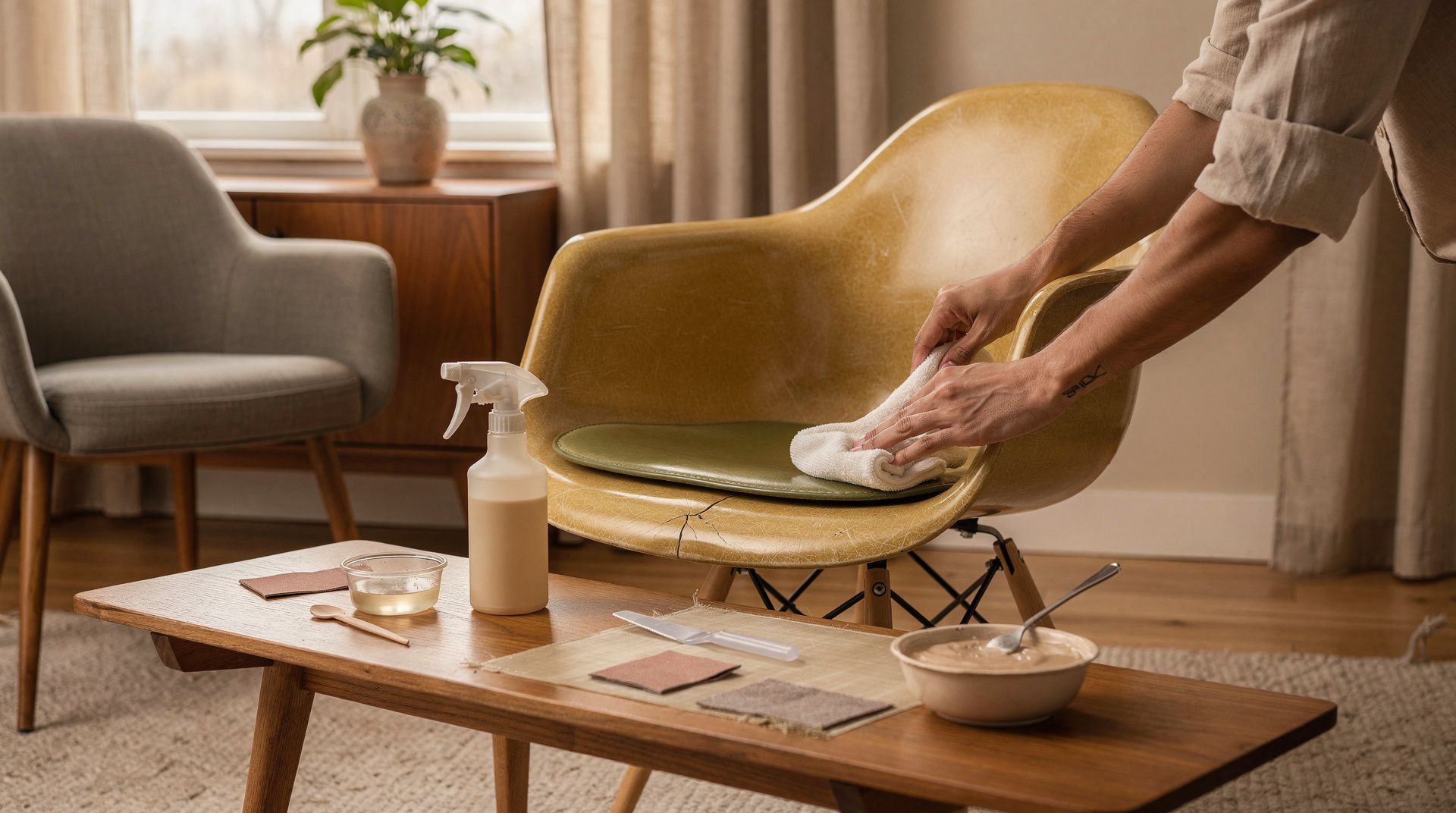
For cleaning, lukewarm water with a pH-neutral surfactant and a soft microfibre cloth is sufficient in almost all cases. Isopropanol in low concentration removes nicotine films and old waxes, but should be tested beforehand on a concealed area, as aggressive solvents can dull the gel coat surface. Fine scratches can be reduced with Micromesh pads from 3200 to 12000 in several stages with plenty of water, followed by a non-silicone plastic polish. Fractures at the seat shell and edge are among the most common types of damage. The correct method is to laminate them from the reverse side with epoxy resin and fibreglass fabric, not to fill them with superglue or two-component filler. Important: shock mounts – the bonded rubber buffers that connect the shell to the base – are wear parts and must be reattached when they come loose using a suitable two-component structural adhesive, without damaging the shell.
Regional Schools and Seminal Designs
The fiberglass era begins with the MoMA International Competition for Low Cost Furniture Design in 1948, for which Charles and Ray Eames developed their Shell series. From 1950 it was produced at Zenith Plastics in Gardena, California, for Herman Miller. In parallel, Eero Saarinen developed his Womb Chair for Knoll in 1948, likewise in glass fibre-reinforced polyester over a steel tube frame. This American school is characterised by industrial efficiency, a wide range of colours, and the basic variants Side Shell and Arm Shell with bases such as Eiffel, Dowel, Rocker, Stacking, and Rod Base.
In Europe, independent interpretations emerged. In Germany, Wilkhahn manufactured seat shells from the late 1950s; in Italy, Joe Colombo worked with plastics for Kartell, though there the switch to ABS and polypropylene was made early on. In Scandinavia, fibreglass remained a secondary material; more defining were the later designs of Verner Panton and Eero Aarnio, such as the Ball Chair of 1963 and the Pastil Chair of 1967, both executed in fibreglass. France is represented by Pierre Guariche and Steiner productions. These regional differences are relevant to assessment, because wall thicknesses, edge profiles, and resin formulations differ, and so does the ageing pattern.
Authenticity and Condition from a Collector’s Perspective
With an original Zenith shell, you look first for the markings on the underside: the Herman Miller lettering in various formats depending on the year of production, plus date stamps and occasionally the “Chromcraft” or “Summit” stamp on later licensed productions. The rope edge – the embedded fibreglass cord at the rim – is a reliable feature of production up to 1971. After that the edge profile changes, and after the production stop in 1989, the reissues resumed in 2001 follow, which are made of polypropylene and are clearly distinguishable in terms of material. Modal fibreglass reissues by Herman Miller and Vitra from 2013 onwards can be identified by their current labels and the clean, unpatinated surface.
For condition assessment, four axes matter: the substance of the shell with regard to cracks, missing sections, and repairs; originality of the shock mounts and the base; depth of colour and degree of yellowing compared to the original colour chart; and completeness of the markings. Shells that have been repainted are problematic for the collector market, as they conceal the original colour and surface texture. Replaced shock mounts, on the other hand, are accepted provided they have been executed properly, since they ensure usability. An honestly aged piece with documented provenance is generally preferable to one that has been cosmetically reworked.
At mid-centurydesigns.com we assess every fiberglass shell and chair against these criteria: material findings, labels and markings, condition of the shock mounts, originality of the base, and documented restoration steps. We describe yellowing, scratches, and historic repairs openly, so that you as a collector or designer have a reliable basis for your decision.
This article was generated automatically by an AI system. Disclosure pursuant to Article 50 of the EU AI Act.