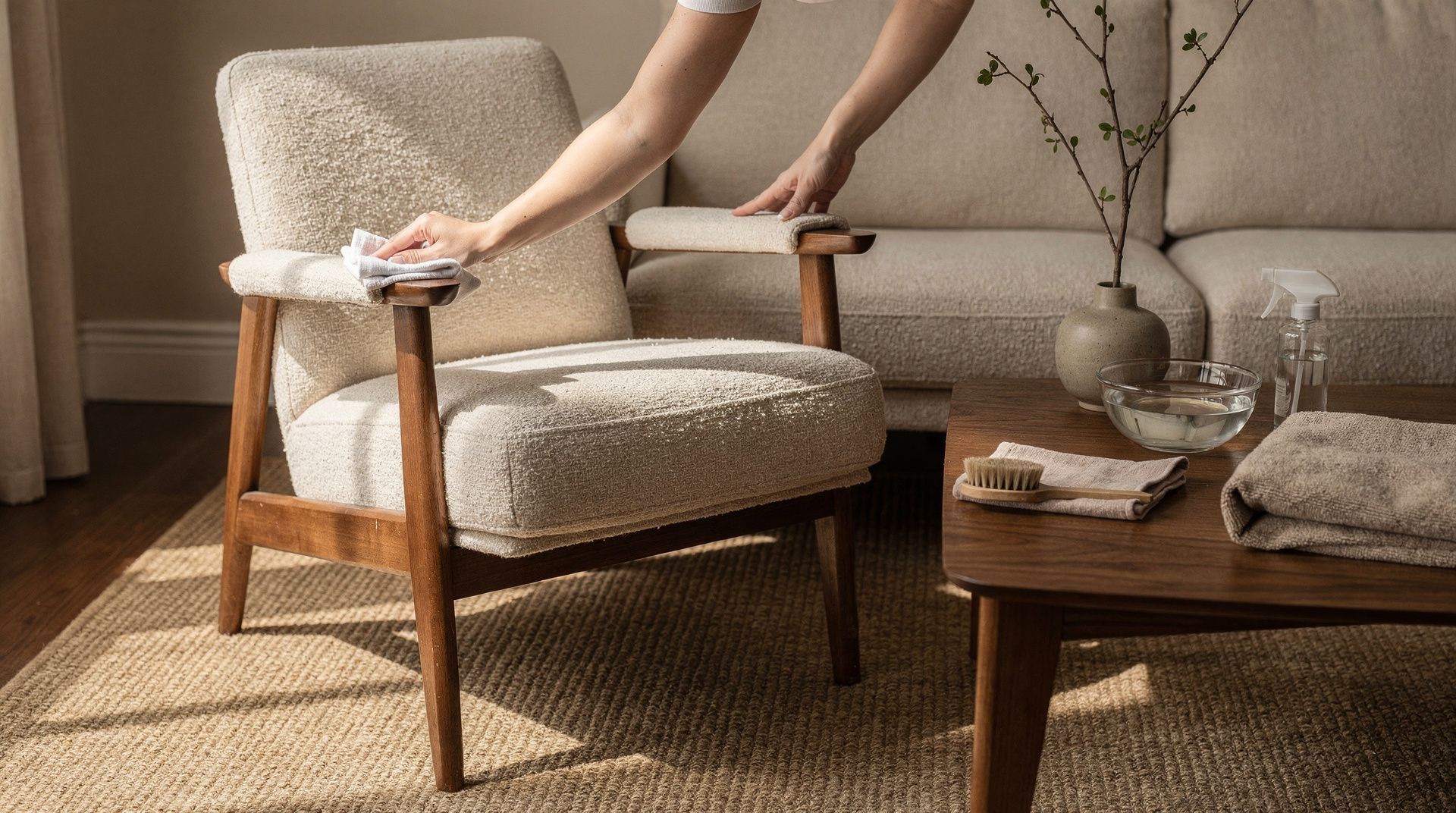
Cleaning Bouclé and Wool: Gentle Care for High-Quality Vintage Upholstery Fabrics
An original bouclé cover from the 1950s or 1960s is more than a textile. It is part of the substance of a piece of furniture, often responsible for its silhouette, tactility and the quiet visual rhythm that a chair by Pierre Paulin, a sofa in the orbit of Kagan, or a French post-war fauteuil develops. Those who care for such pieces are not deciding between clean and dirty, but between preservation and the loss of patina. Bouclé, loden, worsted, melton and other pure wool qualities are sensitive to moisture, mechanical friction and alkaline cleaning agents. Felting, shiny patches, colour deviations and roughened loops are generally no longer reversible.
The approach we recommend is conservational: as little intervention as possible, as early as necessary. A fresh stain is a different problem from a dried one, and an original first cover demands a different level of care than a later re-upholstering. Those who understand these differences make better decisions before water, white spirit or a steam cleaner even enter the picture.
1. Characteristic Materials and Their Cleaning Behaviour
Bouclé is an effect yarn whose characteristic loop structure is created by threads twisted in different directions. Classic qualities from the Mid-Century era, for example from Belgian, French or Italian production, consist of virgin wool, sometimes with portions of mohair, alpaca or linen. These loops are mechanically vulnerable: pulling on a loosened loop permanently distorts the weave pattern. When vacuuming, therefore, use only a soft upholstery nozzle with reduced suction power and never a rotating brush.
Pure wool felts as soon as three factors come together: moisture, heat and mechanical movement. Precisely this combination is what careless wet cleaning delivers. The scale layer of the wool fibre locks together irreversibly, the fabric shrinks, becomes harder and loses its soft drape. Dry cleaning with solvents (classically perchloroethylene, and increasingly hydrocarbons or liquid CO₂ in specialised establishments) is therefore the gentler method for fixed wool upholstery, provided the cover can be removed. For permanently upholstered seats, only spot treatment remains.
Stain treatment follows a simple sequence: blot rather than rub, work from the outside inwards, always test on a hidden area first. Blot fresh water-soluble stains (wine, coffee) with an absorbent white cloth, then work with lukewarm, distilled water and a pH-neutral wool detergent in heavily diluted form. Fat- and oil-based stains do not tolerate moisture; here dry starch or talcum powder helps – leave to act for several hours, then vacuum. We advise against home remedies such as vinegar, lemon juice, baking soda or ox gall soap on pigmented wool, as the reaction with dyes is unpredictable.
2. Regional Schools and Their Textile Culture
The choice of upholstery fabric in Mid-Century Modernism was rarely decorative, but part of the design. In Scandinavia, manufacturers such as Kvadrat (founded 1968), building on weaving traditions from Denmark and Sweden, worked with robust worsteds and melton qualities. Furniture by Hans J. Wegner, Finn Juhl or Arne Vodder was frequently upholstered in dense, milled wool fabrics that last for decades, but only with proper care.
France produced the soft, sculptural bouclé aesthetic that is so influential today, through Maisons such as Maison Leleu and later through designs by Pierre Paulin for Artifort. The Belgian weaver Bruno Triplet and the manufacturers in the orbit of Roubaix supplied base materials that were valued for their uniform loop structure.
Italy, for example at Arflex, Cassina or Tecno, favoured substantial wool blends, sometimes with a mohair content, that visually calmed spring-core and cold-foam constructions. In the USA, the term bouclé is closely associated with Florence Knoll, whose sofas and chairs from the 1950s established the fabric in the international interior vocabulary. Eero Saarinen’s Womb Chair (1948) for Knoll is still offered today in a bouclé variant whose historical roots lie in exactly this manufacturing culture.
For cleaning, this means: origin and weave determine the treatment. A dense Danish melton tolerates more than a loosely woven French bouclé with a mohair content.
3. Authenticity and Condition from a Collector’s Perspective
When purchasing or assessing a vintage upholstered piece, the upholstery fabric is one of the most important indicators of originality. An original first cover from the 1950s or 1960s, even with visible patina, generally increases the collector’s value far more than a technically clean but subsequent re-upholstering with a modern reproduction fabric. Therefore, before any cleaning measure, check:
- Seams and piping: Hand-sewn or factory machine-set seams, original zips (brands such as Éclair, Opti, Riri) indicate an untouched cover.
- Back and inner construction: Manufacturer labels, stamps, old batch numbers and the type of upholstery (horsehair, coconut fibre, early cold foam) date the piece.
- Colour gradation and light edges: Even fading on exposed sides is a mark of age, not a defect.
- Cleaning traces: Rings, hard patches or uneven sheen indicate earlier, often improper wet cleaning and reduce value.
Anyone deciding between aggressive restoration and careful maintenance should, when in doubt, leave the patina intact. A specialist restorer for historic upholstered furniture is a more sensible address for fragile original covers than a general textile cleaning service. We are critical of surface protection through subsequent impregnation treatments: they alter the feel and colour depth and are rarely reversible with wool. A disciplined routine of regular, gentle vacuuming, consistent protection from sunlight and a quick response to stains achieves more than any chemical aftertreatment.
At mid-centurydesigns.com, we examine every piece on offer for the authenticity of its construction, upholstery and covering fabric. We document whether it involves an original first cover, a contemporary re-upholstering or a later restoration, and provide specific care guidance for each object. This keeps the decision of how much intervention a piece can bear transparent, before it enters your collection.
This article was generated automatically by an AI system. Disclosure pursuant to Article 50 of the EU AI Act.