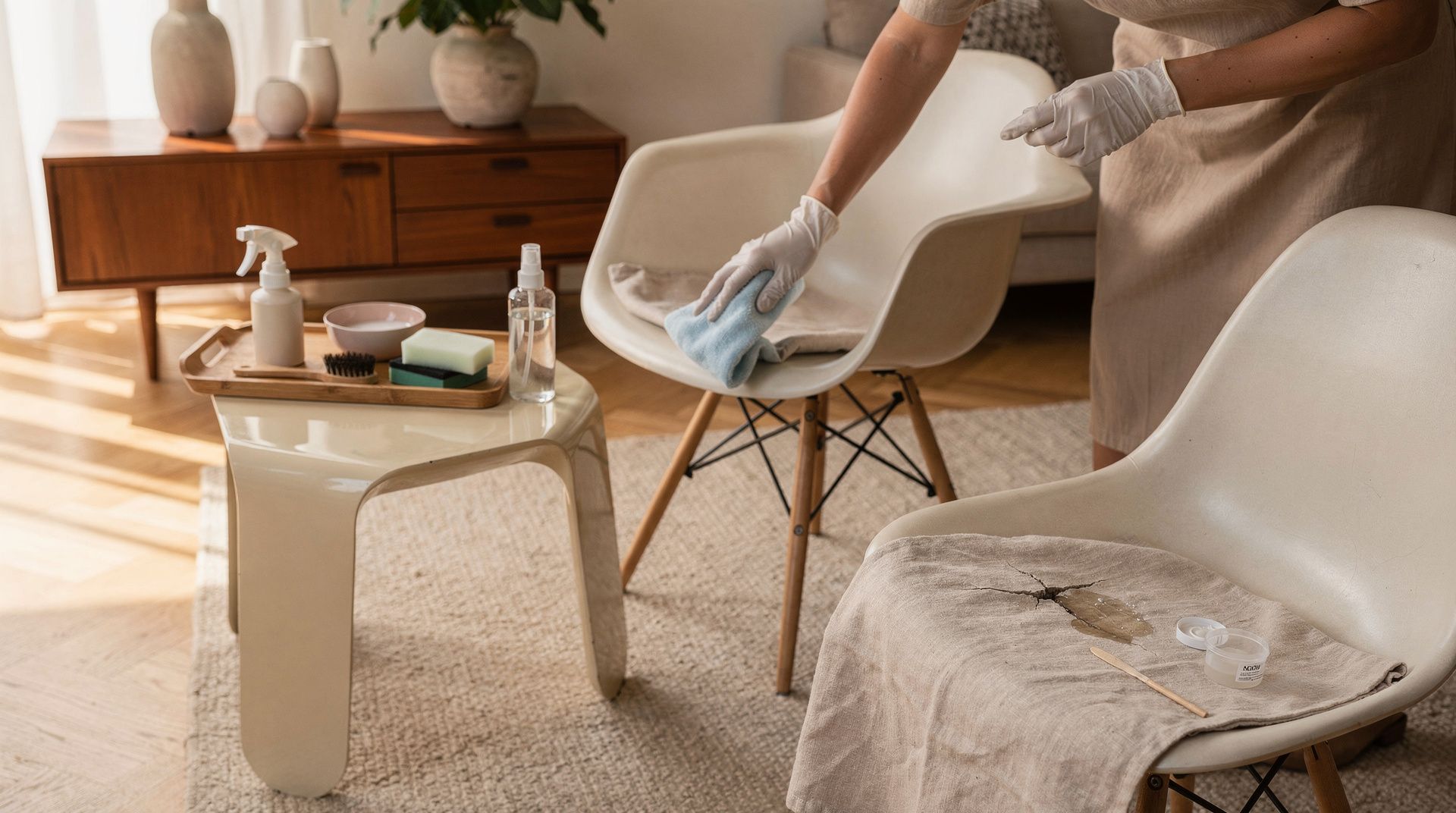
Fiberglass, Plastic and the Care of a Sensitive Material Generation
The introduction of glass-fibre-reinforced polyester and thermoplastic materials into furniture production marked a turning point in the late 1940s. What Charles and Ray Eames brought to serial production together with Zenith Plastics from 1950 onwards, later continued by manufacturers such as Herman Miller, Vitra, Kartell and Artifort, followed a different logic than wood or tubular steel: the surface is the material. There is no patina in the classical sense, only ageing through UV radiation, micro-scratches, hairline cracks and yellowing. Those who preserve shell chairs, Panton variants or Space Age designs from the 1960s and 1970s are caring for a material history in which every incorrect cleaning remains visible. The following notes bring together what has proven to be materially appropriate in the handling of original fiberglass and plastic furniture, and where conservation ends and restoration begins.
1. Characteristic Materials and Their Care
Fiberglass, more precisely glass-fibre-reinforced polyester resin (GRP), is a composite material with a visible fibre structure on the reverse of the shell. The front face carries a thin gelcoat layer that defines the visual impression and is at the same time the most sensitive zone. For cleaning, lukewarm water, a soft cotton or microfibre cloth and a pH-neutral cleaning agent are generally sufficient. Cream cleansers, melamine sponges and alkaline household cleaners leave matt patches that are irreversible. Solvents such as acetone, nitro thinner or isopropanol attack the gelcoat and printed signatures, and should only be used sparingly and with care – for example to remove adhesive residue.
Thermoplastics such as ABS, polypropylene, polycarbonate or the early Baydur polyurethane each react differently. ABS and polycarbonate are sensitive to aromatic solvents; polypropylene is chemically robust but prone to scratching. A golden rule: always test any product on a concealed area first. Superficial hairline cracks in the gelcoat can be closed with two-component epoxy resin that cures transparently and, once fully hardened, is wet-sanded with progressively finer grits (from 600 to 2000) and then polished. Cracks running through the laminate structure are a matter for conservation workshops, not the kitchen table. For long-term conservation, location is paramount: direct sunlight yellows white shells and bleaches pigments, dry heating air and temperatures above 40 degrees encourage stress cracks. UV-filter films on windows or museum-grade vitrine glazing are more effective than any subsequent coating.
2. Regional Schools and Defining Designs
The American lineage begins with the Eames Plastic Chair of 1950, whose early production at Zenith Plastics in Gardena, California, is still recognisable today by the coarse fibre texture and the so-called rope edge. Herman Miller continued the series; Vitra acquired the European rights and produced in fiberglass until 1993, then exclusively in polypropylene until the reintroduction in 2018. Eero Saarinen’s Tulip series for Knoll (1957) combined a fiberglass shell with a lacquered aluminium base – a hybrid with its own specific care requirements.
In Europe, Danish and Italian protagonists shaped the formal language of plastic furniture. Verner Panton’s Panton Chair, in production from 1967 with Vitra and Herman Miller, passed through several material phases – from cold-pressed Baydur polyurethane via Luran-S to today’s polypropylene. This material history is central for collectors, as early Baydur examples age differently and are sensitive in terms of restoration. In Italy, Marco Zanuso and Richard Sapper developed the stackable children’s chair K 1340 (1964) for Kartell – the first chair injection-moulded in one piece from polyethylene. Joe Colombo, Vico Magistretti and Anna Castelli Ferrieri worked consistently with ABS in the late 1960s. The Dutch position is represented by Pierre Paulin for Artifort, with foam-upholstered shells on metal frames whose covers raise their own conservation questions.
3. Authenticity and Condition for Collectors
With fiberglass shells, the markings on the underside matter. Embossed labels from Herman Miller, Zenith or Vitra, patent numbers and the characteristic rubber shock mounts provide information about the year of production and place of manufacture. Later replacement mounts are acceptable but should be documented. The fibre structure on the reverse also tells a story: the coarser and more irregular it is, the earlier the shell can usually be dated.
When assessing condition, it is important to distinguish between acceptable ageing and impairing damage. Light signs of use, a warm yellow tone on white shells, and fine surface scratches are all part of the material biography. Problematic are stress cracks in the laminate, delamination, inappropriate repaints that obscure the original colour character, and added parts without disclosure. Panton Chairs from the early Baydur series frequently show micro-cracks at the load zones beneath the seat shell – this is typologically well known and does not necessarily diminish value, but should be noted in the condition report. For Kartell pieces in ABS, UV-induced yellowing is the most common condition issue; for Tulip tables, it is the detachment of lacquer at the base.
At mid-centurydesigns.com, fiberglass and plastic furniture is materially assessed before being accepted into stock, checked for manufacturer marks, shock mounts and production characteristics, and described with a transparent condition report. Repairs, additions and conservation interventions are named, not concealed. This allows a purchasing decision to be based on what a piece actually is: a testament to a material generation that, treated with care, will give pleasure for decades to come.
This article was generated automatically by an AI system. Disclosure pursuant to Article 50 of the EU AI Act.