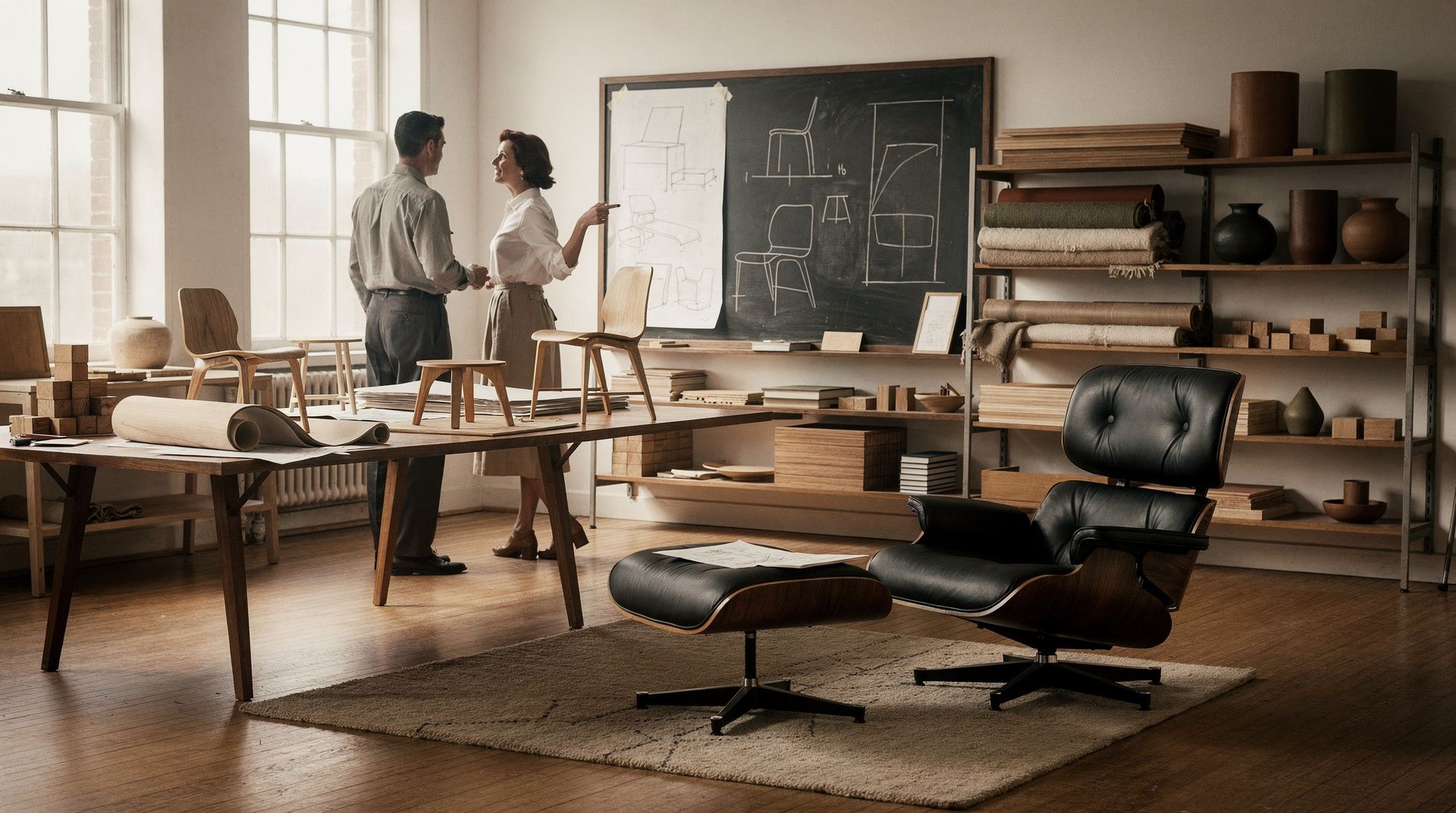
Charles & Ray Eames: From Molded Plywood to Pedagogical Conviction
Between the early 1940s and the 1970s, Charles and Ray Eames created a body of work that reaches far beyond individual furniture icons. What began with domestic experiments on bent plywood in their apartment in Neutra’s Strathmore complex in Los Angeles led — via military commissions for the U.S. Navy (leg splints in molded plywood, from 1942) — directly into serial production with Herman Miller in Zeeland, Michigan, and in parallel with Vitra in Weil am Rhein. The often-cited phrase from the Eames Office — that good design should deliver “the best for the most for the least” — describes less a marketing formula than a working method: the understanding of materials, the logic of serial production, the didactic clarity, and the curatorial precision of their exhibitions and films (such as Powers of Ten, 1977) are all part of the same idea.
For you as a collector or designer, this means: an Eames piece is never merely an object, but a testament to a process. Anyone who understands the LCW of 1946, the Lounge Chair 670 of 1956, or the Aluminum Group of 1958 also understands why the boundaries between craft, industry, and pedagogy were fluid for the Eames.
Characteristic Materials and Techniques
The “Plywood Leg Technique” is the technological core of the early œuvre. Together with Eero Saarinen, Charles Eames had already worked in 1940 on three-dimensionally formed plywood shells for the MoMA’s “Organic Design in Home Furnishings” competition; reproducible suitability for serial production, however, was only achieved with the custom-built “Kazam!” machine, which pressed veneer layers into molds under heat and pressure. Results of this process work include the LCW and DCW (1946), the Folding Screen FSW, and later the shells of the Lounge Chair 670 and Ottoman 671 in rosewood, walnut, or cherry veneer on multi-layered molded plywood.
In parallel, the Eames developed the fiberglass-reinforced polyester shells of the Plastic Chairs (from 1950, Zenith Plastics), whose visible fiber structure produced an aesthetic all their own. From the 1990s onward, Vitra and Herman Miller switched to polypropylene for ecological reasons; the original fiberglass versions were reissued in revised form by Herman Miller in 2013. For the Aluminum Group (1958) and the Soft Pad Group (1969), die-cast polished aluminum was introduced alongside a tensioned upholstery system that suspends seat and back cushions between the side frames without a supporting shell. The Wire Chair (DKR, 1951) and the Storage Units ESU (1949/50) further demonstrate the breadth: welded steel wire and anodized aluminum frames with colored plywood and Masonite panels, respectively.
Regional Schools and Key Figures
The Eames Office at 901 Washington Boulevard, Venice (California), was simultaneously workshop, film studio, and think space from 1943 to 1988. It stands as an exemplar of the “California Modern” lineage, in which Charles’s fellow student Eero Saarinen (Cranbrook Academy of Art), Harry Bertoia (wire sculptures and the Diamond Chair for Knoll, 1952), and George Nelson (as Design Director at Herman Miller from 1945, the Eames’s central champion) also worked. Without the Cranbrook Academy in Bloomfield Hills, Michigan, under Eliel Saarinen, this network would be almost unimaginable: Ray Kaiser, Florence Knoll (née Schust), and Harry Bertoia met there in the late 1930s.
In Europe, the work was received early on. Vitra acquired the manufacturing and distribution rights for the European market in 1957 and continues to maintain the line in Weil am Rhein; the Vitra Design Museum, together with the Library of Congress and the Eames Office, administers substantial portions of the archive. In Scandinavia, Arne Jacobsen (Ant Chair, 1952; Series 7, 1955) and Poul Kjærholm responded with independent takes on the plywood and tubular steel question; in Italy, Vico Magistretti picked up the serial clarity. The pedagogical impact of the Eames was evident in their exhibition projects “Mathematica” (1961) and “The World of Franklin & Jefferson” (1975/76), as well as in over 125 short films that continue to serve as a reference for exhibition-based knowledge communication.
Authenticity and Condition for Collectors
For dating and attribution, manufacturer labels are the decisive first point of reference. Herman Miller used different labels across the decades: the circular “Herman Miller Furniture Company” foil label of the early 1950s, the rectangular black paper label with the Zeeland address, later the “M” signet from 1946 (designed by Irving Harper in the Nelson Office), and from the 1970s onward, model and serial number stamps. Vitra editions carry their own markings from the 1960s onward; early European Lounge Chairs (670) were distributed through Contura/Fehlbaum and can be identified as such.
With the Lounge Chair 670, pay attention to the number of veneer layers in the shells (early editions with five layers, later versions with seven), to the rubber shock mounts between shell and frame (fatigue and cracks are typical and a technical, not an aesthetic, matter), to the material of the star base (cast aluminum, with very early versions lacking the later glides), and to the quality of the leather. Rio rosewood was used by Herman Miller until 1990/91, then replaced by cherry, walnut, and Santos rosewood; Vitra followed the relevant CITES regulations. With plywood chairs (LCW, DCW), check the adhesion of the shock mounts, hairline cracks in the back shell, and the original veneer surface; with fiberglass shells, examine the fiber structure in raking light, manufacturer markings on the underside (Zenith, Summit, Herman Miller), and the bases (Eiffel, Dowel, Rocker, Stacking). Aluminum and Soft Pad Group pieces require a close look at the seams of the upholstery, the condition of the spacer sleeves, and the chrome plating or polishing of the frame profiles.
Restorations are not grounds for exclusion, but they must be documented. A re-upholstered Lounge Chair with original shell, original shock mounts, and original base remains collection-worthy; a replaced shell, however, significantly alters the substance.
At mid-centurydesigns.com, we curate every piece according to these criteria: we examine labels, material layers, shock mounts, and star bases, document provenance and restoration history, and disclose the findings in each individual object description. This allows you to make a purchase decision on the same factual basis used by museums and archives.
This article was generated automatically by an AI system. Disclosure pursuant to Article 50 of the EU AI Act.