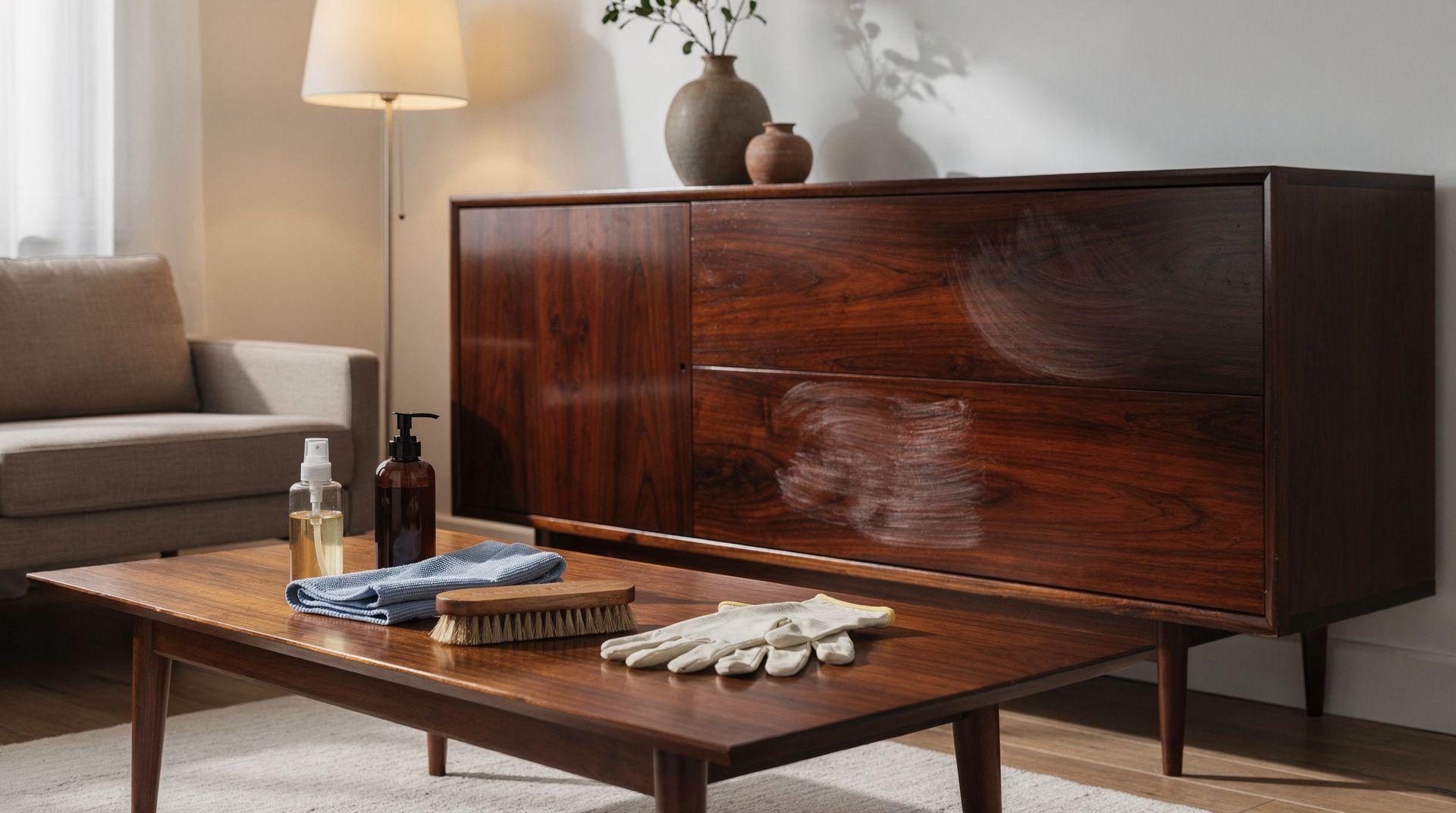
Rosewood calls for restraint, not cosmetics
Rosewood is the defining veneer of Scandinavian and international modernism from the 1950s to the early 1970s. Rio rosewood (Dalbergia nigra) and, less frequently labelled correctly, East Indian rosewood (Dalbergia latifolia) characterise the sideboards, dining tables and seating furniture of that era with their distinctive grain: warm brown, red and black tones, restless figure patterns, often mirror-matched as veneer. Since 2017, the genus Dalbergia has been listed on Appendix II of the Convention on International Trade in Endangered Species (CITES); trade and cross-border movement are regulated. Anyone who owns a rosewood piece of furniture is therefore not merely custodian of a design object, but of a fragment of material-cultural history with a finite supply.
For precisely this reason, care here is a matter of attitude. The goal is not the flawless, mirror-bright surface of a new piece of furniture, but the preservation of the original layer: the initial oil, the polish or the satin lacquer applied by workshops such as Rud. Rasmussen, France & Søn or Jens Risgaard Hansen. Every overly aggressive refresh, every untested oil, every sanding of the top coat diminishes substance and value. The following sections outline what you should bear in mind when handling vintage rosewood furniture.
1. Characteristic materials and their care logic
In mid-century modernism, rosewood was used almost exclusively as veneer on solid substrate boards and, later, on particleboard. Veneer thickness was typically between 0.6 and 1.2 millimetres. This figure is critical: anyone who sands risks breaking through, especially at edges and drawer fronts. Restorative work on veneer belongs in professional workshop hands.
The original surfaces are usually one of three variants:
- Satin nitrocellulose or synthetic resin lacquer, common on Danish production furniture (Omann Jun., Brouer, Skovmand & Andersen). Care: dry or slightly damp microfibre cloth, occasionally a silicone-free wax-based furniture polish. No oil – it cannot penetrate and leaves a tacky film.
- Oiled surfaces, typical of certain workshop pieces and later 1960s series. Care: apply sparingly with pure, low-resin furniture oil (such as pure linseed oil or a specific hard oil), apply thinly and remove completely after 15 to 20 minutes. Oil applied too thickly polymerises at the surface, becomes tacky and darkens unevenly.
- Shellac or polish surfaces, rarer, found on finer individual pieces. These surfaces are sensitive to alcohol and heat and should be treated exclusively by a conservator.
The most common care mistake is applying oil indiscriminately to lacquered furniture. Oil on lacquer provides no nourishing effect – it creates a separating layer that attracts dust and permanently degrades the appearance. Equally problematic: silicone-containing spray polishes, which hamper future restoration by preventing the adhesion of new surface treatments.
Regarding colour preservation: Rio rosewood bleaches noticeably under direct UV radiation; the deep violet and black tones turn a greyish-brown. Positioning away from direct sunlight, a relative humidity of between 45 and 55 per cent and stable room temperatures are more effective than any cosmetic treatment. Areas that have already faded can only be partially reactivated with oil; the actual colour depth comes from the wood itself, not from a surface application.
2. Regional schools and the signature of their surfaces
Rosewood is not a uniform material, and regional working traditions differ in veneer pattern, construction and surface finish. Anyone caring for a piece should know what they are dealing with.
Denmark accounts for the majority of reference pieces. Arne Vodder for Sibast – in particular the model series 29A and 227 – Kai Kristiansen for Feldballes Møbelfabrik, Ib Kofod-Larsen and Johannes Andersen defined the image of the rosewood sideboard. Characteristic features include mirror-matched veneers on sliding doors, dovetail-jointed drawer carcasses in oak or beech, and thinly applied lacquers. Poul Kjærholm worked with a different logic on PK furniture; here rosewood is more of an overlay on a steel frame and requires correspondingly different handling at the transitions.
Sweden produced a somewhat stricter, often darker lacquer finish through makers such as Nils Jonsson for Troeds or Yngve Ekström for Westbergs. Norway is represented by Torbjørn Afdal for Bruksbo and Sven Ivar Dysthe, where rosewood was more frequently combined with leather – which raises the question of material boundaries when caring for such pieces: leather care products must never come into contact with the veneer.
Outside Scandinavia: Brazilian modernism around Joaquim Tenreiro and Sergio Rodrigues used jacarandá – that is, Rio rosewood from a local source – frequently as solid timber rather than veneer. These pieces can tolerate more because the same material lies beneath the surface, but they equally demand restrained oils. In Italy (Ico Parisi, Osvaldo Borsani) and France (Pierre Jeanneret in the Chandigarh series, where teak and sissoo were mostly used) rosewood appears sporadically, often on front sections in combination with other timbers.
This classification is not academic: a Danish production lacquer from 1962 tolerates a different care regime than a Brazilian solid-wood piece from 1958 or a French polished surface.
3. Authenticity, condition and what collectors check
Anyone collecting or acquiring rosewood furniture checks in this order: provenance, substance, surface.
Provenance and CITES documentation. CITES Appendix II applies to Rio rosewood with retroactive effect: furniture demonstrably manufactured before 2 January 2017 is tradeable as a pre-convention object, but requires a marketing permit (EC certificate) for trade within the EU and corresponding import and export documentation for cross-border movement. East Indian rosewood has been subject to relaxed but still applicable regulations for commercial consignments since 2019. A reputable dealer will provide these documents.
Substance. Points to check: veneer integrity (no blistering, no open edges, no large-scale re-veneering), construction (original fittings, dovetail-jointed drawers, stamped manufacturer’s marks), structural integrity of the joints. Manufacturer’s marks are often found on the backs of drawers, on cabinet back panels or in the form of metal plaques. On Danish furniture, the inspection marks of the furniture trade association (Dansk Møbelkontrol, often with a four-digit manufacturer number) are a strong indicator.
Surface. An original, well-maintained surface is a key determinant of value. Surfaces that have been completely rebuilt reduce collector value, even when technically well executed. Minor retouching, conservatorially applied wax coatings or expert cleaning are, however, accepted. A common misjudgement: matt, slightly dried-out surfaces look repair-worthy at first glance, but can often be revitalised with a gentle wax application without touching the original layer.
At mid-centurydesigns.com we curate rosewood furniture exclusively from verified provenance. Every piece is documented with regard to manufacturer’s marks, construction and substance; for CITES-relevant objects, the corresponding certificates are either already available or obtained prior to sale. We leave surfaces in their original condition or have them treated exclusively by specialist conservators, whose interventions are transparently recorded in the object report. This means that as a collector or designer, the decision of how much patina you see in an object – and how much you wish to preserve – remains yours.
This article was generated automatically by an AI system. Disclosure pursuant to Article 50 of the EU AI Act.