MATERIAL · CARING FOR ANILINE AND COGNAC LEATHER

Caring for aniline and cognac leather: preserving substance, protecting patina

Understand the structure before you reach for the cloth.

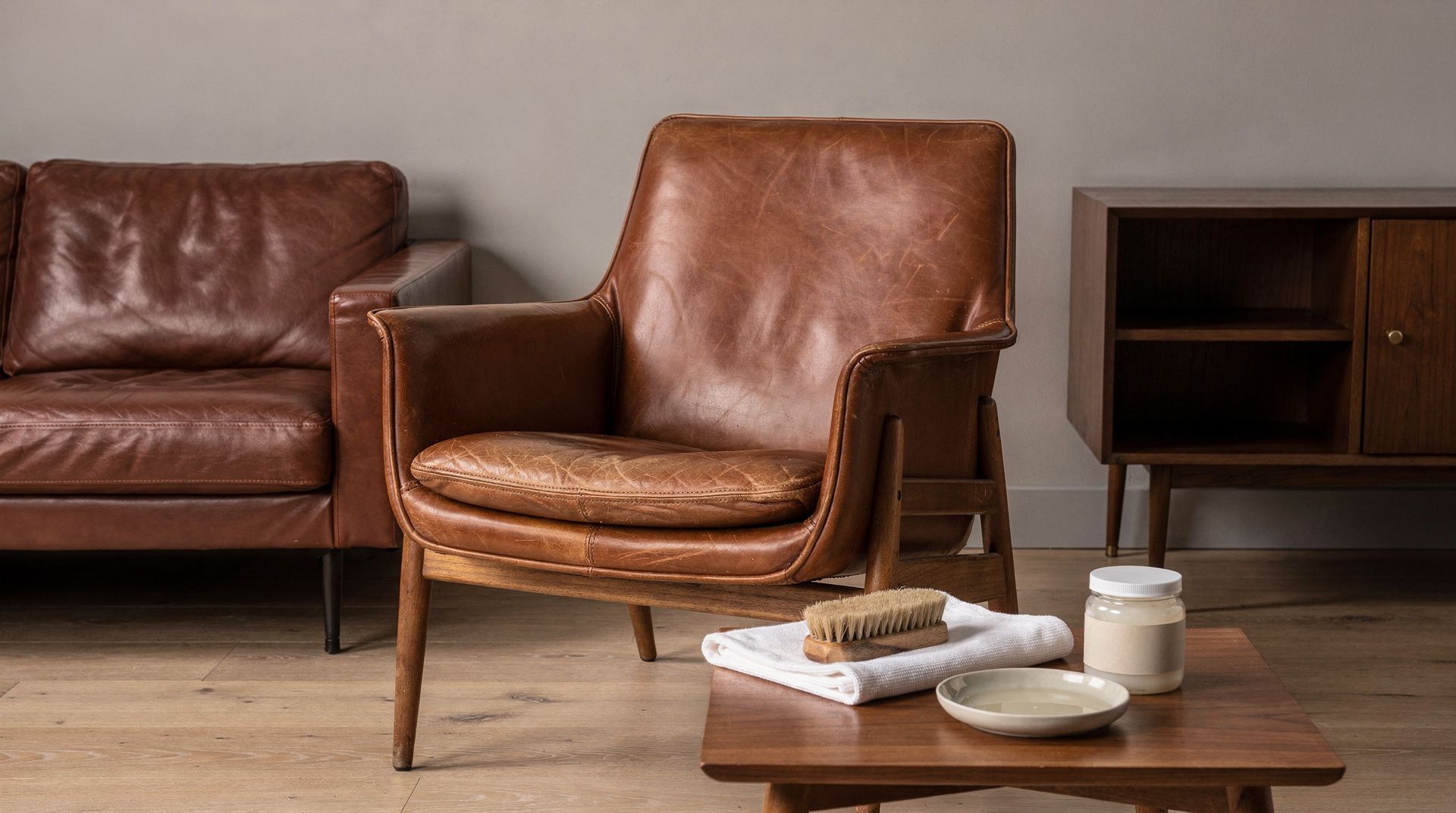
Aniline leather is fully through-dyed and has no opaque pigment layer, which keeps the natural grain visible and allows liquids to penetrate the fibres immediately. Cognac-coloured surfaces from the 1950s to the 1970s develop a warm patina over decades that significantly contributes to the value of a chair by Børge Mogensen, Arne Norell or Illum Wikkelsø. On this page we explain how to coordinate structure, cleaning, stain treatment and conditioning so that the leather retains its depth rather than disappearing beneath a coat of polish.

mid-century·designs

Caring for aniline and cognac leather

ESSAY · 01

Work & Context

mid-century·designs

Why aniline and cognac leather demands its own care logic

Aniline leather is one of the most honest surfaces the furniture trade knows. It reveals pores, scars, vein markings and the fine traces of a life lived, because it is dyed exclusively with soluble dyes and not concealed beneath an opaque pigment layer. This is precisely what creates the warm, iridescent tone that collectors prize in early chairs by Børge Mogensen or Illum Wikkelsø, or in the robust club furniture of the 1960s. A cognac hue is not a fixed standard but a family of warm brown and red tones that deepen or lighten through tannins, fat liquoring and decades of light exposure. Those who care for such pieces work with the patina, not against it. The aim is to conserve a condition, not to restore a new state that simply no longer exists in a sixty-year-old piece of furniture. The following sections cover the materials, the regional traditions and the criteria by which condition can be assessed with authority.

Characteristic materials and their response to care

Pure aniline leather is open-pored and readily absorbs moisture, fat and dyes. This makes it sensitive to water marks, ballpoint pen, red wine and strongly alkaline cleaners, while at the same time making it receptive to mild, pH-neutral cleaning with distilled water and a soft cotton cloth. Semi-aniline leather carries a thin pigment layer and tolerates damp cleaning better, but sacrifices some of the typical depth effect. Vegetable-tanned leathers, as frequently used in Scandinavian workshops and in the Italian tradition, respond to fat liquoring with a visible darkening and develop the sought-after cognac patina over years. Chrome-tanned leathers remain more colour-stable but respond less finely to conditioning. For routine conservation, dusting with a soft cloth, one to two fat liquorings per year with a pure, wax- and solvent-free leather balm, and consistent protection from direct sunlight are generally sufficient. Greasy stains are lifted with dry potato or cornstarch, fresh liquid stains are blotted and absorbed over a wide area — never rubbed. Silicone-based care products, shoe polish and furniture polish have no place on high-quality vintage leather, as they clog the pores and complicate future restoration.

Regional schools and their leather practice

Danish Modernism shaped the cultivated handling of aniline leather like almost no other school. Fritz Hansen, Fredericia, Getama and Carl Hansen & Søn worked with tanneries supplying vegetable pre-tanned, fat-softened full-grain hides from which the seat surfaces of models such as the Spanish Chair by Mogensen or the AP programme by Hans J. Wegner were made. In Sweden, Arne Norell combined heavy saddle leather with brushed steel and solid wood frames, favouring an emphatically tactile, full-bodied cognac tone. The Norwegian workshop of Fredrik Kayser and production at Vatne Møbler favoured similar qualities. In Italy, Poltrona Frau from the 1920s onwards, and later Cassina, developed their own signature with thicker, more richly fat-liquored leathers that form a deeper, almost red-brown patina on models by Tobia Scarpa or Afra and Tobia Scarpa. The German and Swiss tradition — for example at de Sede from the late 1960s — worked with particularly heavy hides and open cut edges that demand special attention in care, as leather dries out first at seams and edges.

Authenticity and condition for collectors

When assessing an original leather upholstery, substance, grain and provenance are what count. An authentic cover shows even wear at contact zones, a calm interplay of colour and an intact grain structure free of cracks at edges and seams. Re-dyed surfaces can be identified by a matt, chalky residue in recesses, by colour transfer onto a light cloth and by an atypically homogeneous colouring lacking depth. A look at the back and inside the seams reveals the original colour and tanning character. Manufacturer stamps, old fabric labels beneath the seat and the consistency of the upholstery — horsehair, webbing or early foam — provide additional clues as to year of manufacture and workshop. Collectors distinguish between a conservative intervention — cleaning, nourishment and localised retouching — and a substance-altering re-upholstery, which frequently reduces market value. A dry but intact original cover is generally more valuable than a technically perfect new cover, provided it can be stabilised with proper fat liquoring.

At mid-centurydesigns.com we examine every piece of leather before it enters our inventory for authenticity of cover, condition of tanning, seam pattern and provenance. We document interventions transparently, distinguish between patina and damage, and advise you on which conservation measures a particular model will tolerate and which it will not. This preserves the character of a chair, a bench or a sofa without the substance suffering on its way to you.


This article was generated automatically by an AI system. Disclosure pursuant to Article 50 of the EU AI Act.

FAQ · 02

Frequently asked about Caring for aniline and cognac leather

5 Answers

01
What are the structural differences between aniline and cognac leather?
Aniline leather is a through-dyed leather in which dyes penetrate directly into the leather fibres without forming an impermeable surface layer. This keeps the natural grain and patina of the leather visible, allowing it to develop over time. Cognac leather (also semi-aniline) has a thin, transparent protective layer that makes the leather more resistant but allows less flexibility in colour development. Both types are common in high-quality vintage furniture but require different care approaches.
02
How do I clean aniline leather correctly without damaging it?
Aniline leather tolerates only gentle cleaning: first remove dust and soiling with a soft, lint-free brush or dry brush. For light soiling, use a barely damp (not wet) cloth with distilled water and dry immediately with a dry cloth. Never use solvents, alcohol or aggressive cleaners, as they can dissolve the aniline dyes. Regular dry dusting is the best prevention.
03
How do I treat stains on cognac leather professionally?
Cognac leather tolerates slightly more cleaning effort than aniline leather, as its protective layer is more robust. Blot fresh stains immediately with a lint-free, lightly damp cloth — do not rub. For oil or grease stains, use a specialist leather brush with minimal moisture. Stubborn stains require a pH-neutral leather cleaning product followed by treatment with leather conditioner. That said, cognac leather is also sensitive enough that deep stain treatment should be left to a professional.
04
What conservation measures protect valuable leather furniture in the long term?
Climate control is the fundamental basis: consistently stable room temperatures of 18–22°C and relative humidity of 45–55% prevent cracking, drying out and mould. Avoid strong sunlight, as UV light bleaches the dyes. Dust leather furniture at minimum once a month with a lint-free cloth. High-quality aniline and cognac leathers benefit from infrequent, expert refreshing with a specialist leather oil or wax, at most every 12–18 months. Chemicals, heat and moisture are the main enemies.
05
Can I care for aniline and cognac leather with the same products?
No, they require different approaches. For aniline leather, only very mild, specially formulated products are suitable that do not dissolve the dyes. Cognac leather, with its protective layer, tolerates more robust leather oils and care products. It is essential to identify the leather type before applying any substance — ideally via a label or specialist advice. A test patch in an inconspicuous area is always advisable. When in doubt, a leather conservator should be consulted for the care of valuable pieces.

GLOSSARY · 03

Related Terms

9 Entries

Aniline leather
Leather that is through-dyed with soluble dyes and finished without a protective top coat. Aniline leather reveals the natural grain and patina but requires intensive care, as it is susceptible to staining and wear.
Cognac leather
Vegetable-tanned leather with a warm brown to golden colouring that develops a characteristic ageing patina through UV exposure. The leather becomes more open-pored and gains depth and character over time.
Tanning
The chemical process that converts animal hide into stable, durable leather. Vegetable tanning with tannins or chrome tanning determines the structure, feel and care requirements of the material.
Patina
The natural surface change of aniline and cognac leather through use, light and ageing. It documents the history of the piece of furniture and is regarded as an authentic mark of quality in valuable vintage items.
Grain
The visible surface profile of the leather hide, which is particularly pronounced in aniline leather. Natural grain is not a flaw but a sign of genuine leather and the individual character of each piece.
Chrome tanning
A synthetic tanning method using chromium salts that is faster and less costly than vegetable tanning. Chrome-tanned leather is more resistant to stains and moisture but does not develop the natural patina.
Conservation
Preventive preservation measures for vintage leather through climate control, UV protection and minimal intervention. The aim is to preserve the original substance without damaging the material through invasive cleaning.
Colour rub-off
A natural characteristic of aniline leather in which dye transfers onto surfaces. This is not a defect but a consequence of the through-dyeing technique and demonstrates the authenticity of the material.
Leather conditioning
The targeted moisturising and nourishment of open-pored leather surfaces with neutral oils or waxes. With aniline and cognac leather this must be done sparingly in order to preserve sheen and breathability.