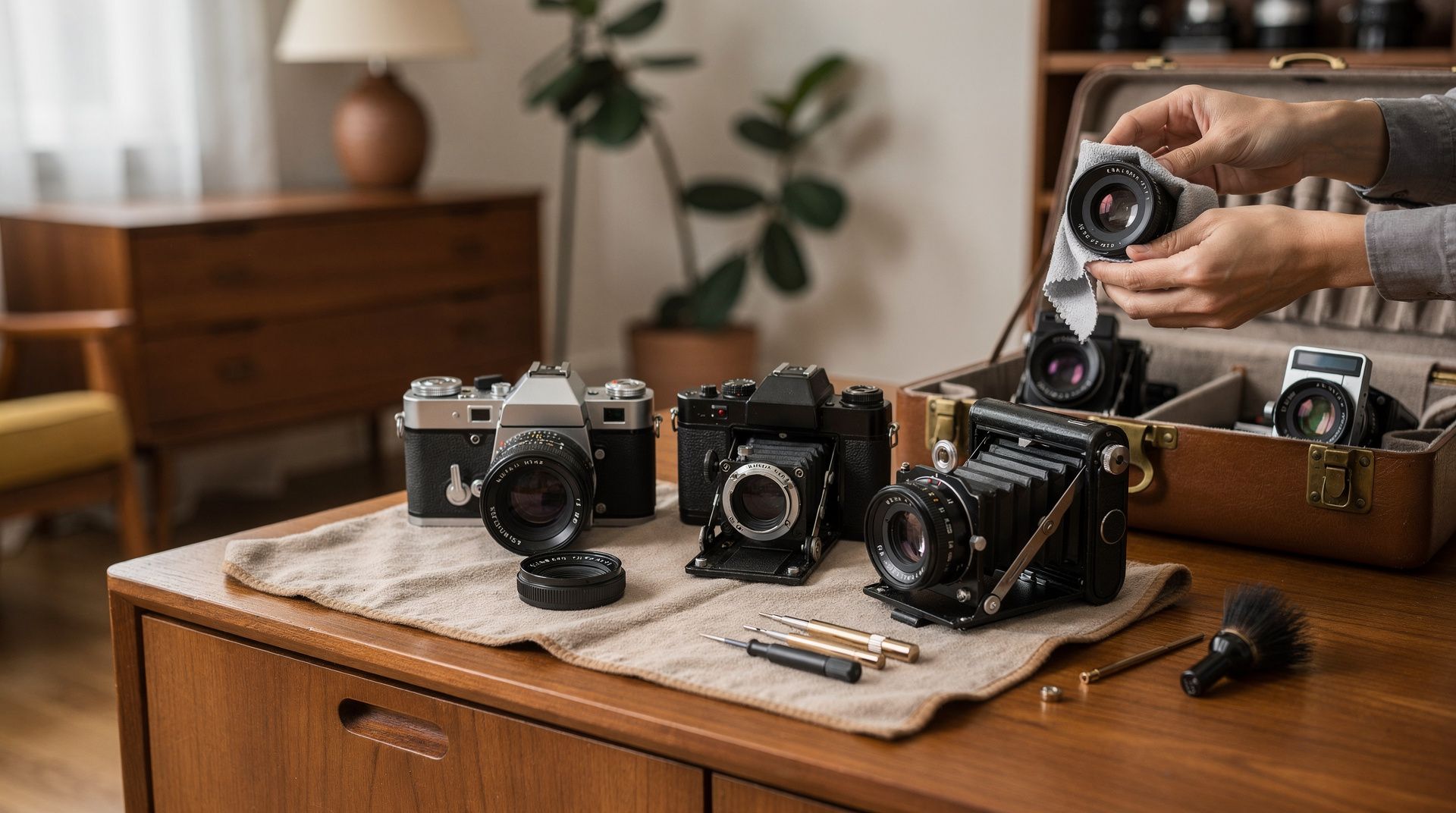
Caring for and maintaining old cameras: cleaning lenses, adjusting the shutter, and safe storage of vintage cameras
A Leica M3, a Rolleiflex 2.8F, or a Hasselblad 500 C/M are more than tools. They are precision-mechanical testimonies of an era in which precision optics, screwed brass housings, and hand-leathered components defined the standard for durability. Those who collect such apparatus know: their value arises from the interplay of original substance, functioning mechanics, and coherent provenance. Care is therefore not a cosmetic exercise but conservation work. It determines whether a device will still fire in twenty years, whether the coating of a Sonnar or Planar remains clear, whether the cloth shutter of a Barnack Leica holds its speeds. This text puts the material knowledge, the origins of the most important design schools, and the criteria by which collector quality is measured today into context.
Characteristic materials and their care requirements
The housings of classic rangefinder and medium-format cameras from the 1950s to 1970s consist predominantly of brass castings, chrome- or nickel-plated, often with top covers made of zinc die-cast. Leathering is traditionally vulcanite, later also embossed synthetic leather or genuine leather. Vulcanite tends to shrink and crack, particularly on Leica housings from the 1950s. Cleaning is carried out dry or with a lightly dampened cotton swab – never with solvents that dissolve the rubber.
Lenses combine glass elements with coatings of magnesium fluoride or multi-layer coatings. They are mechanically more sensitive than they appear: friction from textile cloths can create nano-scratches. The established cleaning method involves a blower, a soft goat-hair brush, and – if necessary – distilled water or pure isopropanol on a lint-free optical cloth, always working from the centre outwards in a spiral motion. Fungal growth, recognisable by delicate white branching patterns between the lens elements, requires professional disassembly, as spores can embed themselves in the coating and leave etching marks.
Shutters divide into two families: cloth shutters made of rubberised silk, as found in the Leica M2 through M4, and metal-blade shutters as in the Nikon F or Contax. Leaf shutters in lenses – such as Compur or Synchro-Compur – operate with lubricated springs and escapements. Resinified oil is the most common cause of speeds that run too slow. Adjustment should be entrusted to a CLA specialist (Clean, Lubricate, Adjust), who tests shutter speeds with a speed tester and maintains tolerances within one-third of a stop.
Regional schools, manufacturers, and the signature of the designers
The photographic industry of the mid-century period is structured into clearly defined regional schools. Wetzlar and Solms stand for Leitz with the Barnack line and the M models from 1954 onwards, designed under Hugo Wehrenfennig and Willi Stein. Braunschweig is the home of Rollei, whose twin-lens reflex cameras have been shaped by Reinhold Heidecke since 1929 and were fitted with Zeiss Planar and Xenotar lenses in the postwar decades. Oberkochen and Jena form the dual legacy of Zeiss, divided by the postwar order, with the optical genius of Ludwig Bertele (Sonnar, Biogon) and the continuation of classical formulas in Jena under Harry Zöllner.
In Gothenburg, Victor Hasselblad developed the modular 6×6 system from 1948, whose bayonet, magazine, and finder interchange are still regarded as a benchmark of design. Japan followed with its own signature: Nippon Kogaku (Nikon) in Tokyo initially adapted Contax principles; Canon in Tokyo worked within the Leica school; Olympus under Yoshihisa Maitani created its own miniaturisation school with the Pen half-frame series from 1959 and the OM-1 from 1972. For collectors, these attributions are more than anecdote: they explain why certain spare parts, bayonet dimensions, and exposure meter cells can only be correctly replaced by specialist workshops.
Authenticity, condition, and valuation for collectors
For valuation, the match of serial numbers on the body, top cover, and – where relevant – lens is paramount. Leica serial numbers can be dated using the published production lists, as can Rollei numbers via the factory registers. Originality trumps perfection: an untouched vulcanite leathering with fine signs of age is more valuable than a newly releathered top cover. Complete equipment also counts – from the matching finder to the original ever-ready case and guarantee booklet.
When assessing condition, mechanical and optical criteria differ. Mechanically, collectors test all shutter speeds by ear and, where possible, by measurement, the rapid-wind lever, film transport, and the rangefinder image for contrast and alignment of the rangefinder. Optically, lenses are examined in transmitted light for cleaning marks, separation of the cemented element (balsam separation, visible as iridescent edges), fungus, and dust. A slight haze is often reversible; deep scratches on the front element permanently diminish value.
Safe storage follows conservation principles: relative humidity between 40 and 50 percent, temperatures around 18 to 20 degrees, darkness, dust-free display cabinets. Drying cabinets with regulated humidity, as used in museum practice, prevent fungal growth more reliably than silica gel pouches. Leather cases should be stored separately from the body, as tannins in the leather can attack chrome and brass. Batteries should always be removed.
At mid-centurydesigns.com we curate furniture and objects of Mid-Century Modernism with the same standard that applies to precision-mechanical collectibles: documented provenance, verified substance, transparent condition description. Each piece undergoes an assessment of the originality of materials, the traceability of the workshop or manufacturer, and an evaluation of age-appropriate wear versus later interventions. Those who collect will find objects with us whose history remains legible.
This article was generated automatically by an AI system. Disclosure pursuant to Article 50 of the EU AI Act.