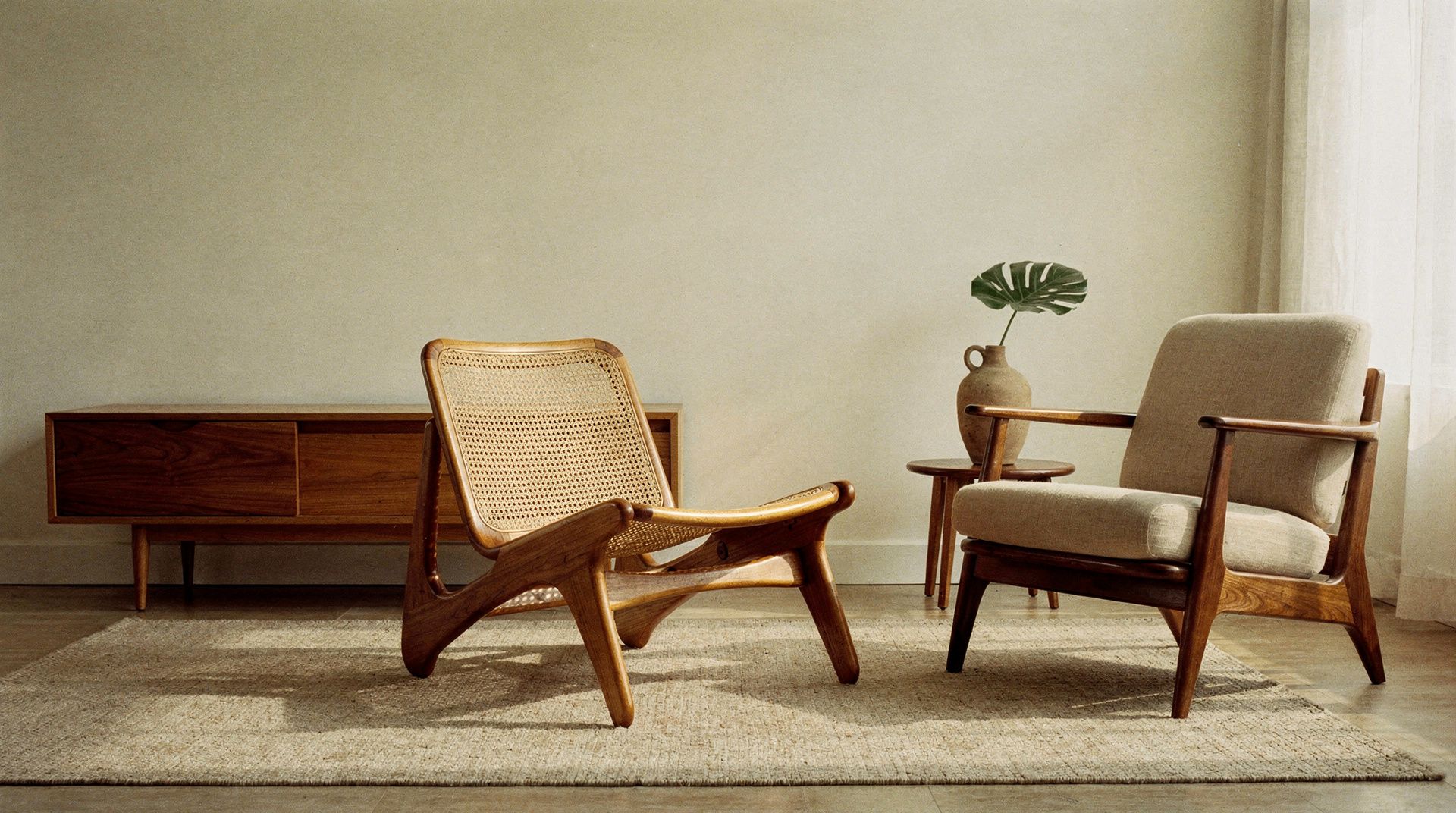
Brazilian Modernism: Tropical Modernism between Jacarandá and Organic Form
Brazilian Mid-Century is not a translation of European modernism, but an autonomous response to climate, material and way of life. While industrial design was maturing in Milan and the cabinetmaking tradition was being formally refined in Copenhagen, Joaquim Tenreiro, Sergio Rodrigues, José Zanine Caldas and Jorge Zalszupin were formulating a vocabulary in São Paulo and Rio de Janeiro from the late 1940s onwards that masters weight and lightness in equal measure. Tenreiro’s famous formula that furniture must be “light, formal and structural” breaks with the colonial opulence of Portuguese precedents and opens the eye to a modernism that comes from the land itself: from its woods, its density of craftsmanship, its architecture under Oscar Niemeyer and Lúcio Costa.
For collectors, this chapter is central for two reasons. First, the edition sizes are historically small – many designs were produced in artisanal workshops such as Langenbach & Tenreiro, Oca (Rodrigues) or L’Atelier (Zalszupin), not in industrial series. Second, the question of material is today both an ethical and legal one: Pau-ferro, Jacarandá da Bahia (Dalbergia nigra) and Imbuia have been listed under CITES protection since 1992 and 2017 respectively. Those who collect Brazilian modernism therefore move within a narrow corridor of provenance, documentation and responsibility.
Materials: Jacarandá, Peroba, Caviúna and the Logic of Solid Wood
The defining material of Brazilian Mid-Century is Jacarandá da Bahia, also known as Rio rosewood. Its dense grain with violet, chocolate and black lines determines the visual character of countless icons, such as the Poltrona Mole (1957) by Sergio Rodrigues or Tenreiro’s three-legged Cadeira de Três Pés (1947) in a multi-coloured laminated construction. Due to the CITES Appendix I listing of 1992, international trade in timber felled after that date is virtually impossible; vintage pieces require pre-convention documentation.
Alongside this, Caviúna (Machaerium scleroxylon), Pau-ferro, Imbuia and Peroba do Campo define the workbenches. In his Nova Viçosa phase, Zanine Caldas deliberately worked with root stocks and offcut timber from deforested areas, often with an archaically hewn surface. Jorge Zalszupin developed a distinctive patchwork technique for L’Atelier using small-format Jacarandá tiles joined from offcuts – an early form of material-economical thinking. Leather upholstery is mostly vegetable-tanned; cane weaving and cotton webbing replace padded constructions in warmer climates.
Schools and Protagonists: Rio, São Paulo and the Second Generation
Joaquim Tenreiro (1906–1992) is regarded as the founder of the modern Brazilian furniture language. In Rio de Janeiro, he combined Portuguese cabinetmaking precision with tropical reduction. His designs, often produced in small series at Langenbach & Tenreiro and later in his own workshop, are today held in museum collections, including MoMA New York and the Pinacoteca do Estado de São Paulo.
Sergio Rodrigues (1927–2014) shifted the discourse towards everyday relevance from 1955 onwards with the Oca gallery in Rio. The Poltrona Mole, awarded first prize at the Concorso Internazionale del Mobile in Cantù in 1961, is perhaps the most famous Brazilian piece of furniture of all: a solid wood frame of Jacarandá, webbed with leather and covered with a generously cut leather cushion. Other key designs include the Kilin, Diz, Oscar and Mesa Yacht.
Jorge Zalszupin (1922–2020), a Polish-Brazilian architect, founded L’Atelier in São Paulo in 1959. His Presidencial armchairs, Dinamarquesa series and Guanabara tables display a structural elegance that combines Scandinavian training with tropical materiality.
José Zanine Caldas (1919–2001) represents two phases: the industrial plywood production at Móveis Artísticos Z in the 1950s, and his later sculptural work in solid wood in Nova Viçosa, Bahia. Carlo Hauner and Martin Eisler (Forma, later Interiores), as well as Lina Bo Bardi with designs such as the Bowl Chair (1951), also shape the picture.
Authenticity, Condition and Provenance: What Collectors Should Look For
Brazilian modernism is a market subject to considerable pressure from fakes and reproductions. Check the following points:
- Workshop marks and brandings. Tenreiro did not sign consistently; early Oca pieces often bear a burned-in logo on the underside, as do L’Atelier pieces. Missing marks are not a disqualifying criterion, but demand an even stronger chain of provenance.
- Construction. Originals from the 1950s and 1960s display solid wood, dovetail joints, slotted screws and hand-finished surfaces. Modern reproductions frequently use veneer on MDF, Phillips-head screws or machined clean dowel joints.
- CITES documentation. A pre-convention certificate is required for international shipping of Jacarandá furniture. Without this paperwork, cross-border trade within the EU and beyond is risky.
- Condition of the wood. Jacarandá darkens under UV light and develops a warm patina. Re-polished or heavily reworked surfaces significantly reduce collector value. Cracks along the grain are common due to climate and are usually tolerable; cross-grain cracks, however, are problematic.
- Leather and webbing. On the Poltrona Mole, Mole variants and Rodrigues armchairs, the leather has often been replaced. A professionally executed replacement using vegetable-tanned cowhide does not necessarily diminish value, provided the frame is original.
- Literature comparison. Standard references such as Soraia Cals’ “Sergio Rodrigues” (2000) or the Zalszupin monograph from Olhares Edition offer reliable comparative illustrations.
Every piece of Brazilian modernism offered on mid-centurydesigns.com undergoes an assessment of material, construction and provenance. We document workshop attribution, condition and, where applicable, the CITES situation – and we state restorations openly. This allows you to make decisions based on verifiable facts, not on narrative.
This article was generated automatically by an AI system. Disclosure pursuant to Article 50 of the EU AI Act.