The Braun T1000 is better understood as a documented source object than as a vague Rams legend
The Braun T1000 becomes more interesting the moment you stop treating it as a generic symbol of Dieter Rams minimalism. The V&A lists the T 1000 Weltempfaenger as a radio designed by Dieter Rams, manufactured by Braun AG in West Germany, and briefly dates it to 1961. The Brooklyn Museum and SFMOMA, by contrast, date their museum objects to 1963. For collectors, that discrepancy is useful rather than annoying: it shows that postwar product history often requires separating design introduction, market life and the dating of a particular surviving example.
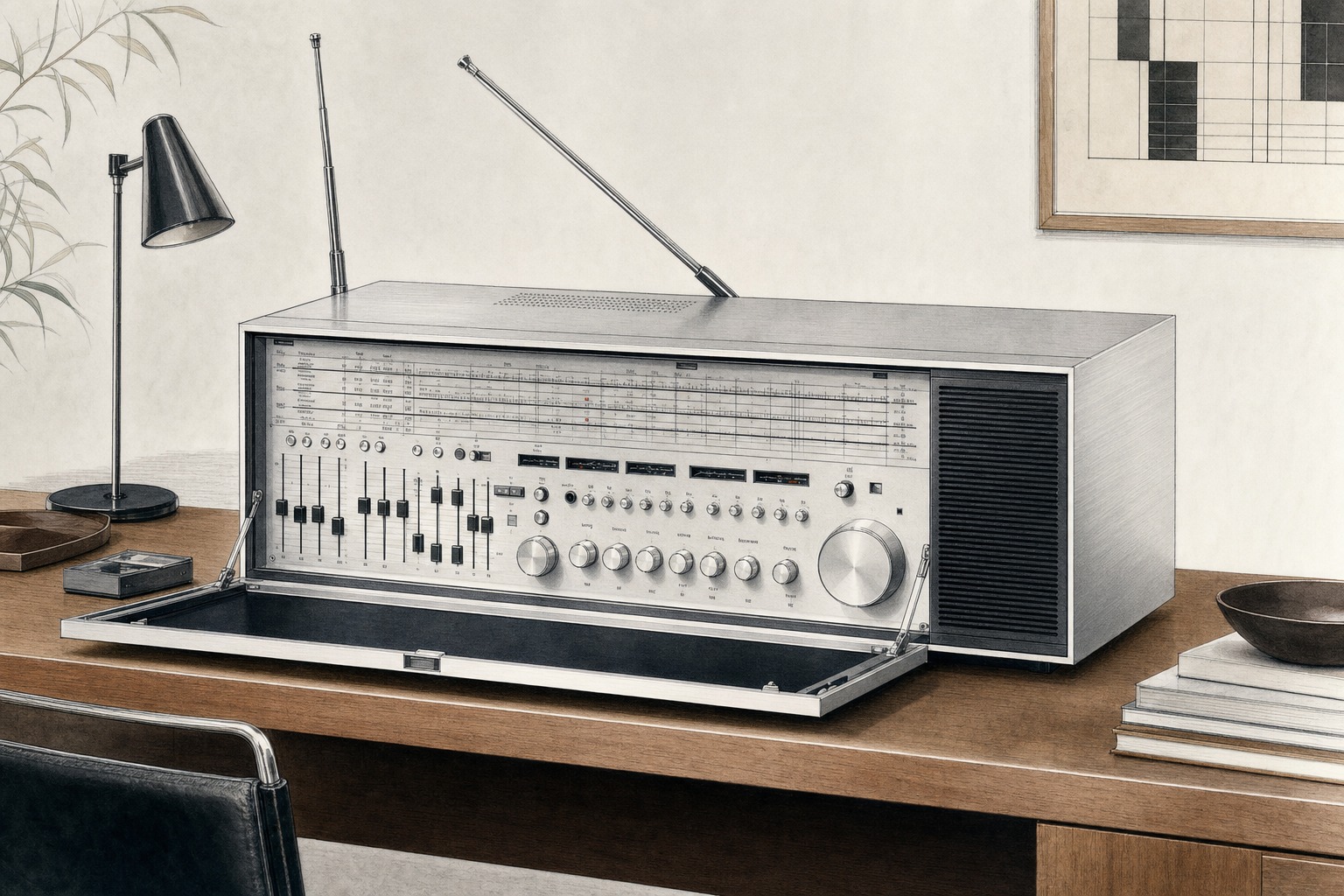
The physical descriptions are similarly concrete. The V&A describes an oblong aluminium radio with drop down flap on the front, while the Brooklyn Museum specifies aluminum, plastic and leather for its example. That moves the conversation away from an abstract “Braun aesthetic” and back toward verifiable object features.
Why “world receiver” is not just a dramatic product name here
The strongest insight comes from the V&A summary. It explains that the radio was designed to receive transmissions from all over the world, which made the controls for the various wavelengths unusually complex and required a thick user manual stored in the drop-down cover. The Rams Foundation reinforces the same point, calling the T 1000 world receiver of 1963 legendary because short-wave transmitters worldwide could be received with it.
That combination matters because the T1000 is not merely restrained in appearance; it is densely functional. Its aerials, scales, selectors and power options make it look less like a decorative domestic object and more like a serious instrument. The V&A even notes that its portability and abundance of aerials, dials and buttons give it the character of military or surveillance equipment, even though it was explicitly designed for the consumer market.
The Brooklyn Museum record shows why markings matter for buyers
For the market, museum documentation becomes especially valuable when it records actual markings. The Brooklyn Museum notes 6/12 V DC, 24 V DC, 110/220 V, 50/60 cps, made in West Germany, and Braun station T1000 CD on the back of its example. That is exactly the kind of detail that helps buyers distinguish a documented design object from a merely attractive vintage radio.
Readers who already know our pages on Dieter Rams or the antique radio can read the T1000 as the point where those two stories meet: West German industrial design and collectible audio technology. For buyers at mid-century·designs, the real value lies not in mythology but in the unusually strong combination of date, materials, markings and institutional context. For a wider survey of curated objects, see mid-centurydesigns.com/en/shop.