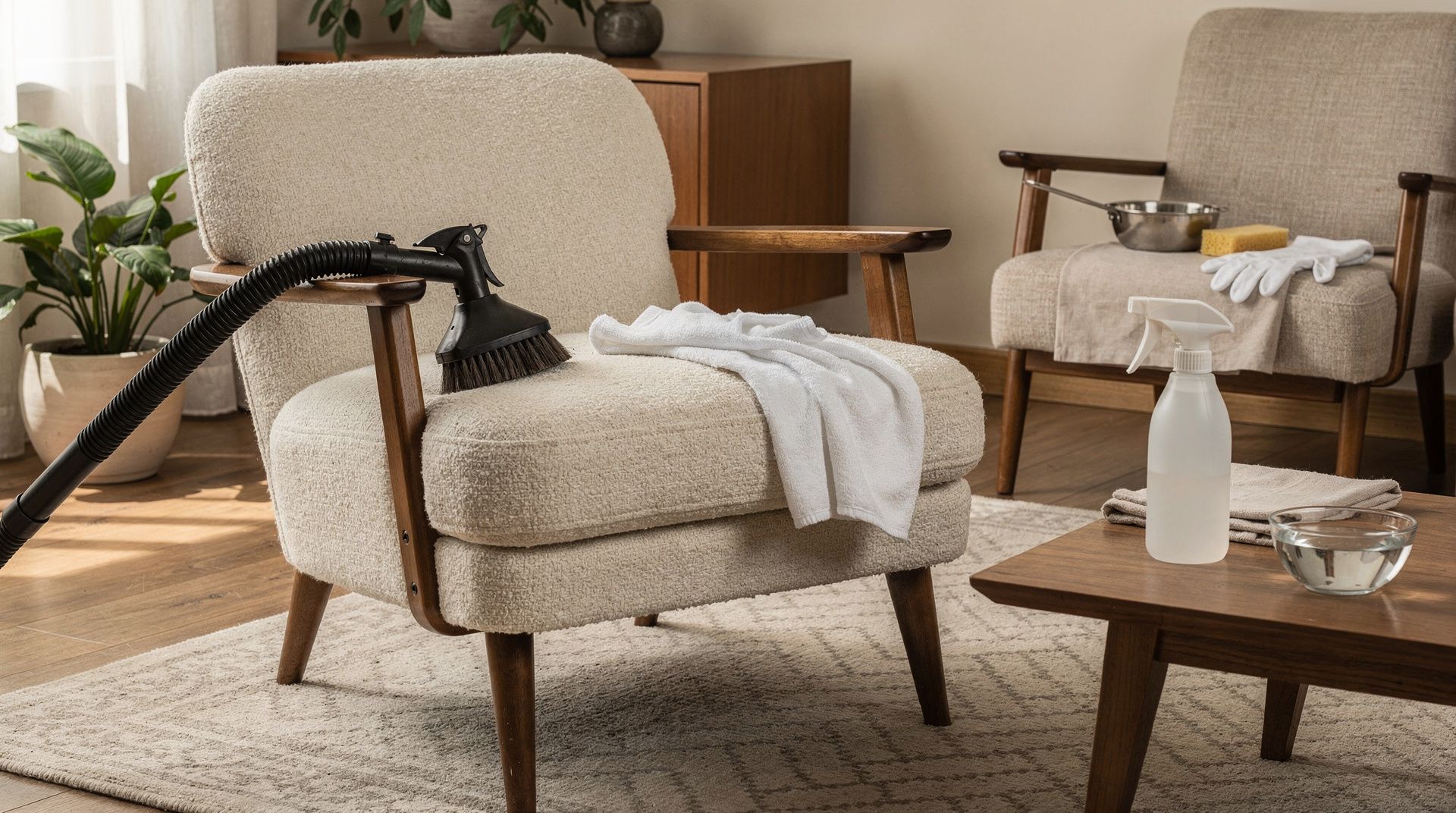
Thoroughly Cleaning Bouclé and Wool Fabrics
Bouclé, flame yarn, virgin wool and the dense upholstery wool fabrics of post-war modernism are among the most demanding surfaces in mid-century interiors. They are not merely coverings but a constitutive part of the design language: the nubby texture of a bouclé softens the hardness of a sculptural seat shell, while a coarse wool fabric from the fifties lends a club chair the tactile weight that no modern rewoven substitute can reproduce. Cleaning such fabrics means caring for substance, not appearance. This demands a different approach than dealing with contemporary upholstery. Vintage wool is typically carded, sometimes spun as woollen yarn, often backed with natural latex or jute and built up on horsehair, kapok or early foam. Every introduction of moisture, friction or surfactant penetrates deep into this structure. The goal of proper cleaning is therefore not to make an upholstery look like new, but to gently remove soiling, grease and particles without causing fibre breakage, felting, colour bleeding or damage to the backing. Three procedural approaches have proven themselves and complement one another: dry cleaning as a foundation, controlled wet cleaning for localised and overall treatment, and specialised procedures for conservatorially sensitive cases.
Dry Cleaning as the First and Most Important Step
Before any water comes mechanics. Loose particles, hair, skin flakes and household dust lodge in the loop structure of a bouclé and act as an abrasive. A soft natural-hair brush, ideally made from goat or horsehair, loosens them without pulling the loops. Vacuuming follows with reduced suction power and a piece of gauze or fly screen between the nozzle and the fabric, so that no loop is lifted. For firm wool fabrics – such as Kvadrat qualities from the sixties and seventies or the coarse virgin wool weaves of Scandinavian origin – a soft upholstery brush used in the direction of the fibre is suitable. Stubborn grease, for example on armrests and the headrest area, can first be absorbed with pure wheat starch or medical-grade diatomaceous earth: apply the powder, leave it to work for several hours, brush off carefully and vacuum. This method comes from textile conservation and removes lipids without touching the fibre core. Only once dry methods have been exhausted does moisture come into play.
Controlled Wet Cleaning
Wool is hygroscopic, prone to felting and sensitive to alkaline environments. Every wet cleaning therefore begins with a fibre analysis, a rub-fastness test on a concealed area and a pH test of the solution being used. Mildly acidic to neutral wool cleaners based on gentle surfactants, dosed well below the manufacturer’s recommended level, have proven effective. The work is done with foam, not liquid: the cleaner is whipped up, the dry foam applied with a soft sponge or microfibre pad in short, overlapping strokes and immediately removed with a clean, lightly dampened cloth. The aim is never to wet the fabric through to the backing. Stains are worked from the outside inward to avoid tide marks. Red wine, coffee and blood each require different chemistry and should never be tackled with universal cleaners. After treatment, the piece is dried lying flat, in constant ambient air, away from sunlight, fan heaters and UV. Steam, carpet-washing machines and extraction devices are generally unsuitable for vintage wool because they soften backing materials, dissolve adhesives and compress horsehair fillings.
Specialist Procedures for Conservatorially Sensitive Pieces
Some fabrics rule out any wet cleaning. These include early bouclés with undyed natural wool and unstable mordants, hand-woven wool fabrics of Scandinavian and Italian provenance with visible colour bleeding, and upholstery on historically significant designs where any intervention diminishes the patina. Here, specialist textile restorers work with solvent-based processes using hydrocarbons or siloxanes, as known from professional fur and carpet care. These agents dissolve fats without swelling the wool fibre and leave no residues in the backing material. For localised work, micro-suction devices with upstream filters are available, drawing particles from deep within the fabric without mechanical abrasion. In cases of doubt, the fundamental rule of conservation applies: less is more. An honest, worn condition with visible patina is always preferable to an over-cleaned upholstery weakened in its fibre structure – economically as well.
At mid-centurydesigns.com, every upholstered piece is assessed for its textiles before being included in the inventory. Fibre composition, age of the upholstery, condition of the backing and filling, as well as cleaning and, where applicable, reupholstering history are documented and disclosed. This means that when you purchase, you know whether you are acquiring an original flame-yarn piece from the sixties, a professionally reupholstered classic in period-appropriate wool quality, or a piece that has been deliberately left in its original, cleaned surface condition.
This article was generated automatically by an AI system. Disclosure pursuant to Article 50 of the EU AI Act.