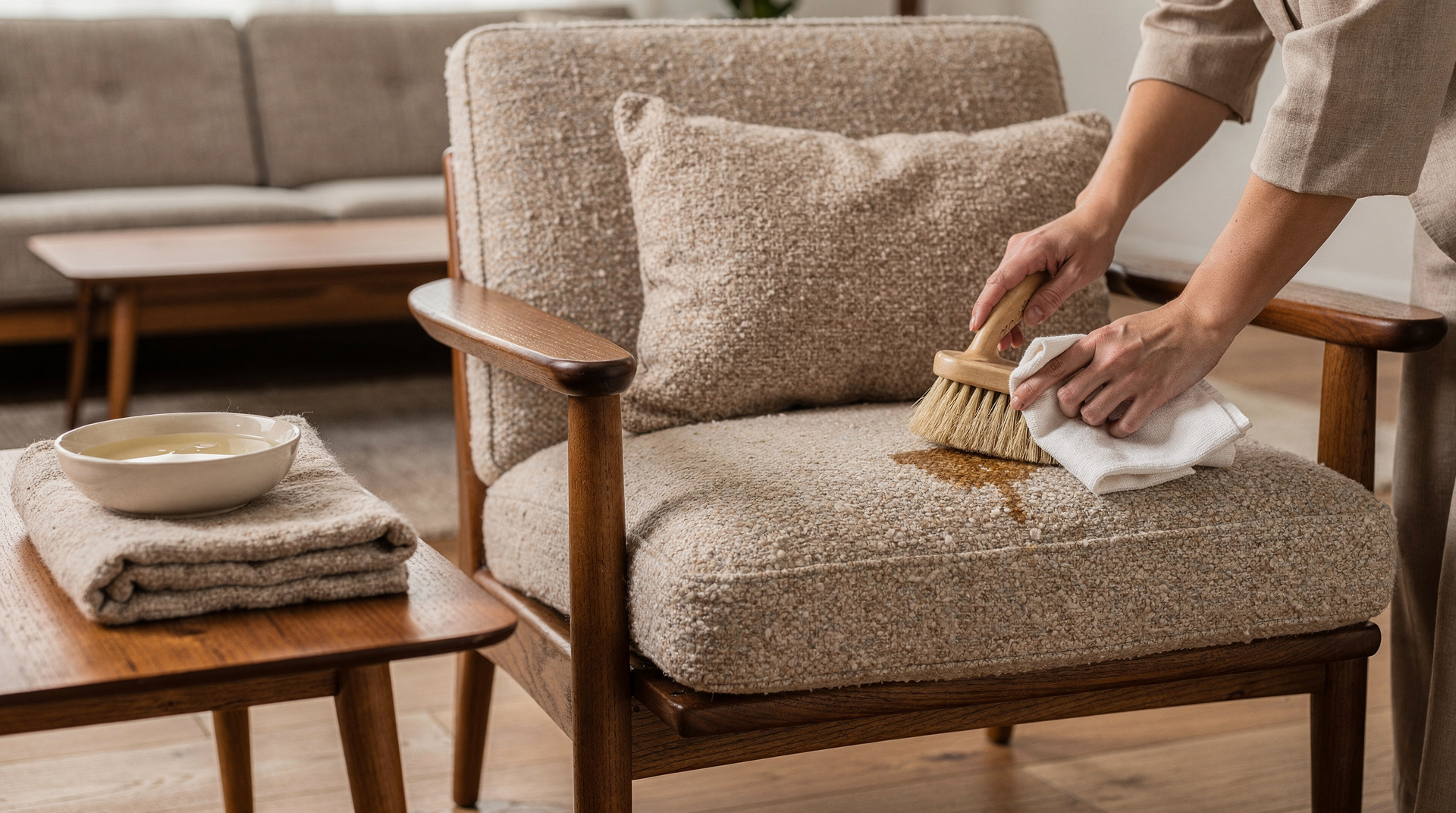
Cleaning Bouclé and Wool: Professional Care for Vintage Upholstery Fabrics
Original upholstery fabrics from the 1950s to the 1970s are not interchangeable consumables, but an integral part of an object’s history. Anyone who owns a chair by Pierre Paulin, a sofa by Florence Knoll or a lounge chair of Scandinavian origin with its original covering is custodian of a piece of textile and design history. Bouclé, milled pure new wool, worsted flat weave and the characteristic wool-nylon blends of those decades are sensitive to water, friction, alkaline cleaners and heat. A wrongly applied stain dabber can destroy a patina that has developed over decades, or trigger felting that cannot be undone.
The following sections summarise what you should know about the materials, their origins and collection-worthy condition before reaching for a brush, sponge or cleaning agent. The guiding principle: intervene as little as possible, as precisely as necessary. And when in doubt, dry rather than wet, mechanically gentle rather than chemically aggressive.
Characteristic Materials and Their Care Behaviour
Bouclé is not a fabric in the strict sense, but a yarn construction: an effect yarn with loops that has been used for upholstery coverings since the 1940s, particularly in France, Italy and Scandinavia. Classically it consists of pure new wool, often blended with mohair or alpaca, occasionally with a supporting thread of cotton or, in later years, nylon. The loops form a three-dimensional surface that mechanically traps dust, fibres and particles. Cleaning therefore means first and foremost: regular vacuuming with reduced suction power and a soft upholstery attachment, without a rotating brush. For heavy soiling, work with dry cleaning foam, which you apply, allow to act briefly and then brush out with a soft natural-hair brush in the direction of the fibres.
Pure wool in woven form — such as the dense furnishing fabrics from the weavers Kvadrat, De Ploeg or Rohi — is more robust, but equally susceptible to felting. Water above 30 degrees, wringing or circular rubbing lead to irreversible interlocking of the scale layer. Targeted stain treatment is carried out with distilled water and a drop of pH-neutral wool detergent, applied with a white cotton cloth, always dabbing from the outside inward. Grease and oil stains should first be absorbed dry using potato starch or cornstarch, which you leave to act for several hours and then vacuum off. Only then should a wet aftertreatment follow, if necessary at all. Red wine, coffee and ink should be entrusted to a textile conservator once they have dried.
Regional Schools, Designers and Typical Upholstery Fabrics
The material choices of the mid-century era were regionally shaped and allow conclusions to be drawn about origin and dating. In Denmark, Hans J. Wegner, Finn Juhl and Arne Vodder worked closely with weavers such as Kvadrat (founded 1968) as well as with older manufacturers that supplied coarse, mostly undyed or earthy-toned wool fabrics. Typical are marl worsteds whose depth of colour comes from the yarn itself rather than from surface dyeing. These fabrics tolerate careful dry cleaning but respond to wet treatment with visible tidemark rings.
In France, Pierre Paulin, Olivier Mourgue and Michel Ducaroy defined the use of jersey, stretch fabrics and bouclé in bold colours for manufacturers such as Artifort, Ligne Roset and Airborne. In these designs the covering is frequently an integral part of the form — re-upholstering alters the silhouette and is conservationally delicate. Italian houses such as Cassina, Arflex and Tecno, working with Marco Zanuso, Gio Ponti and the Castiglioni brothers, used wool-nylon blends and robust flat weaves alongside pure wool from an early stage. In the United States, Florence Knoll and Ray Eames defined the aesthetic of the flat, often unpatterned wool fabric — as seen on Eero Saarinen’s Womb Chair or the Coconut Chair by George Nelson — through Knoll Textiles and Herman Miller. The bouclé that Knoll established under Florence Knoll and that Eero Saarinen chose for his seating furniture remains a reference material to this day and is recognised as such by collectors.
Authenticity, Condition and Assessment Criteria for Collectors
For the valuation of a mid-century piece of furniture, the original upholstery is a central criterion, often with a marked influence on market value. An original, well-maintained wool covering in serviceable condition is generally preferable to a professionally re-upholstered piece, provided the construction is intact and hygiene is assured. Check seams, welting, zips and labels: manufacturer’s marks from Knoll, Cassina, Fritz Hansen, France & Søn or Artifort are frequently incorporated into seams and provide information about the year and country of production. A missing label does not rule out originality, but reduces the weight of evidence.
Typical signs of age include even wear on the seat area, slight felting at contact points, gentle colour shift on light-exposed surfaces and a certain softness at the edges. These traces are part of the provenance and are not defects in the strict sense. What becomes critical is moth damage, mould stains, resinous soiling from old care products and large-scale watermarks from previous cleaning attempts. Before taking any action yourself, a fibre analysis is worthwhile — if necessary the classic burn test on a concealed spot: wool burns slowly with the smell of burnt hair and leaves a crumbly ash, while synthetics melt into a hard bead. This information determines the choice of all subsequent steps.
At mid-centurydesigns.com, the pieces on offer are curated and assessed with precisely these criteria in mind: identification of upholstery materials, attribution to manufacturer and designer, documentation of labels and visible signs of ageing, and an honest condition description that distinguishes between patina worth preserving and actual restoration requirements. If you are unsure whether a covering is original or whether cleaning would be advisable, the description of each piece contains the relevant details, enabling you to decide how much care your piece truly needs.