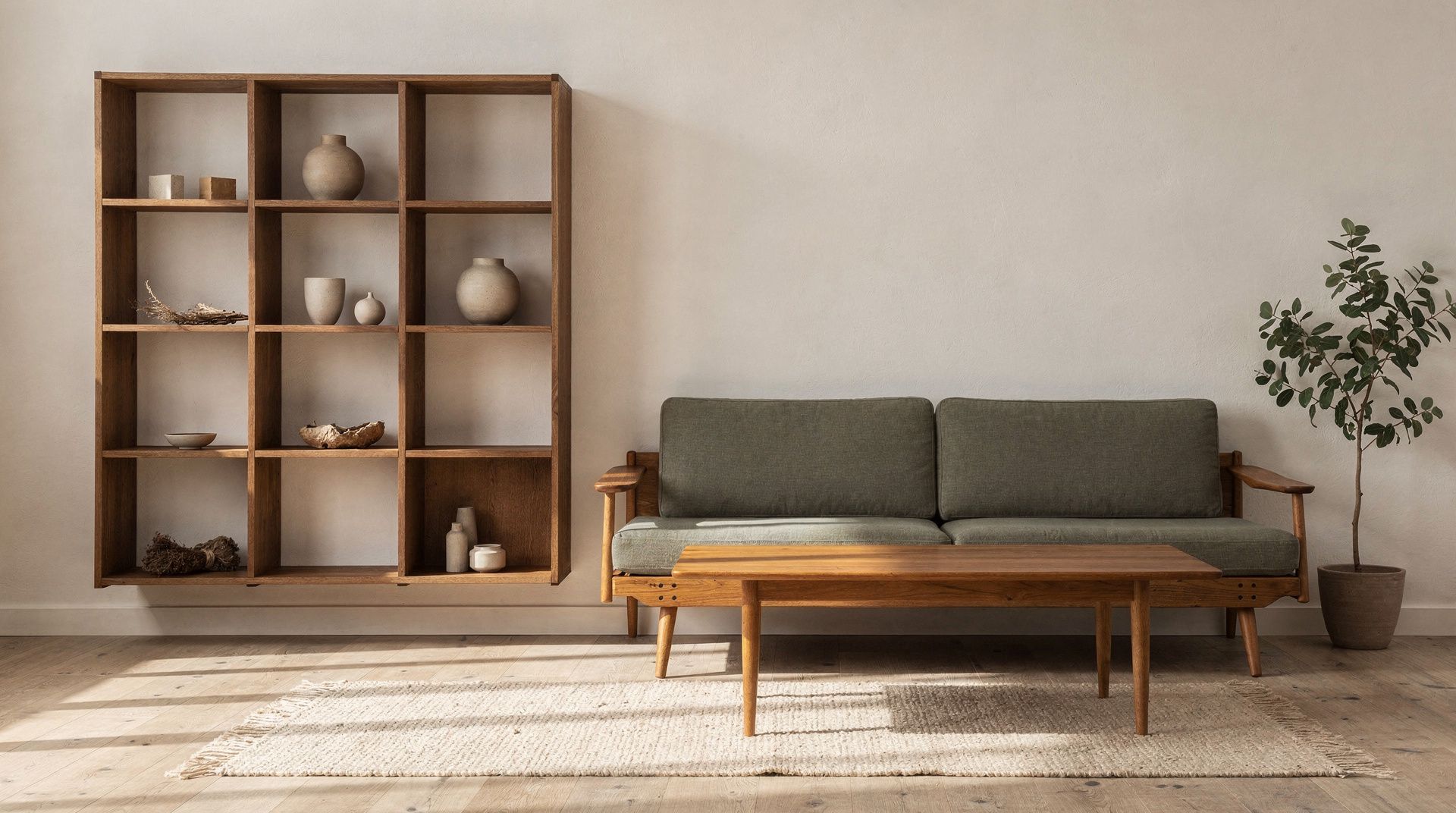
Børge Mogensen: Rigour as an Attitude
Børge Mogensen (1914–1972) belongs to those Danish designers whose work resists easy admiration and only reveals its full depth through use. Trained as a furniture joiner, later a student and close friend of Kaare Klint at the Møbelskolen of the Royal Danish Academy of Fine Arts, Mogensen took over the leadership of the Møbelafdeling of the cooperative FDB (Fællesforeningen for Danmarks Brugsforeninger) in 1942. There he formulated a social ambition that continues to define Danish mid-century design to this day: good furniture for everyday life, made with honest craftsmanship, affordable for the working household.
Mogensen’s formal language is sober, almost laconic. Where Finn Juhl thinks sculpturally and Hans J. Wegner polishes the silhouette, Mogensen seeks reduction to the essential. Shaker furniture-making, English Windsor chairs, Spanish travel studies on folding and lacing constructions, and Klint’s anthropometric studies all flow into a body of work that places proportion, material honesty and standard dimensions above fashionable signalling. The furniture culture that emerged is not a pose but an attitude: the piece of furniture serves — it does not stage itself.
Those who collect Mogensen today collect less a style than a way of thinking. This makes engaging with his pieces particularly rewarding for connoisseurs, and the examination of provenance, execution and condition all the more essential.
1. Materials: Solid Wood, Leather, Wool, Visible Joinery
Mogensen’s material canon is narrow and consistent. At its centre stands solid European oak, less frequently pine, beech and teak. The FDB series of the 1940s and early 1950s — such as the J39 chair (1947) — rely on lightly stained or soaped oak and beech with turned legs and woven paper cord seats (papirgarn) over dowelled rails. This combination of solid wood, visible tenons and woven seats references Shaker and Windsor traditions and to this day defines the visual grammar of the series.
For the collaboration with master joiner Erhard Rasmussen and later with Fredericia Stolefabrik (from 1955), the material spectrum shifted towards darker woods and leather. The Spanske Stol (Model 226, 1958) combines solid oak with saddler-crafted saddle leather in cognac, natural or black, held by visible brass buckles. The Jagtstolen (Model 2229, 1950) and the Hunting Table demonstrate the same logic: the leather is construction, not upholstery. It ages, develops a patina and documents use.
For upholstered pieces — such as the Sofa 2213 (1962) for Fredericia — Mogensen worked with aniline-tanned saddle leather in large, calm surfaces whose seams recall laced travel trunks. Textile covers frequently came from Lis Ahlmann, whose striped or checked woollen fabrics woven in muted earth tones accompanied his seating furniture. The palette remains restrained: natural white, ochre, rust, moss green, anthracite.
2. Workshops, Contemporaries and the Klint School
Mogensen cannot be understood without Kaare Klint. From 1924, Klint had established a methodology at the Academy that systematically examined human dimensions, historical furniture types and storage logic. This analytical school — frequently referred to as the Klint-Skole — shaped an entire generation: Ole Wanscher, Mogens Koch, Hans J. Wegner, Poul Kjærholm and, of course, Mogensen. Within this group, Mogensen represents the most democratic, least representative branch.
His modular concept Boligens Byggeskabe (BB, 1954) and later Øresund (1955), manufactured by Karl Andersson & Söner, translates Klint’s storage studies into a system of stackable, combinable carcass modules with a fixed grid dimension. The principle anticipates what Scandinavian living culture continues to define to this day: furniture as an open system, not a closed, singular object.
The key manufacturing partners read like a map of Danish workshop culture: FDB Møbler for the vernacular series; Erhard Rasmussens Snedkeri for the early collector’s pieces and participation in the Snedkerlaugets Møbeludstilling (Copenhagen Cabinet Makers’ Guild Exhibition, 1927–1966); Fredericia Stolefabrik for the mature late work; Fritz Hansen and P. Lauritsen & Søn for individual editions; Søborg Møbelfabrik for office chairs; C. M. Madsen and Karl Andersson & Söner for the cabinet systems. Each of these firms brings its own construction details and stamps, which are decisive for the attribution of a piece.
3. Authenticity and Condition: What Collectors Should Look For
The attribution of a Mogensen piece of furniture begins with the mark. Fredericia Stolefabrik typically burnt or pressed the manufacturer, model number and often the year of production into concealed surfaces — such as the underside of the rail or the frame beneath the seat leather. The FDB series usually carry a round paper label or brand mark with the FDB signet on the underside. Erhard Rasmussen identified pieces with metal plaques or burnt workshop marks. Missing marks do not rule out authenticity, but call for a careful examination of the construction.
With woodwork, you examine visible tenons, dowelled joints, the grain direction at the leg joints and the character of the edges. Original pieces from the 1950s and 1960s show slight tool marks, minimally irregular roundings and a surface treatment with soap, oil or wax — not modern clear lacquer. Resanding and aggressive re-staining diminish value and character considerably.
With the saddle leather of Models 2226 and 2213, patina is expressly desirable: wear marks, colour gradients and softened edges are part of the story. Cracks at buckle openings, broken seams or dried, brittle areas are cause for concern. Paper cord seats on the J39 are wear parts and may legitimately be re-woven by a skilled craftsperson, provided the technique is correct and the cord gauge is historically consistent. With upholstered pieces, it is worth inspecting the original webbing and spring cores. Re-editions — particularly current Fredericia productions — are of high quality but are clearly to be distinguished from vintage stock by the collector; dating via marks, screws, glue joints and wood ageing is decisive here.
On mid-centurydesigns.com, works by Børge Mogensen are only listed after verification of manufacturer marks, construction, material age and provenance chain. Each piece is documented photographically, described transparently with regard to condition and, where possible, accompanied by details of the workshop, production period and previous ownership. This is how you find furniture that still does justice to its designer’s quiet, matter-of-fact attitude after decades.
This article was generated automatically by an AI system. Disclosure pursuant to Article 50 of the EU AI Act.