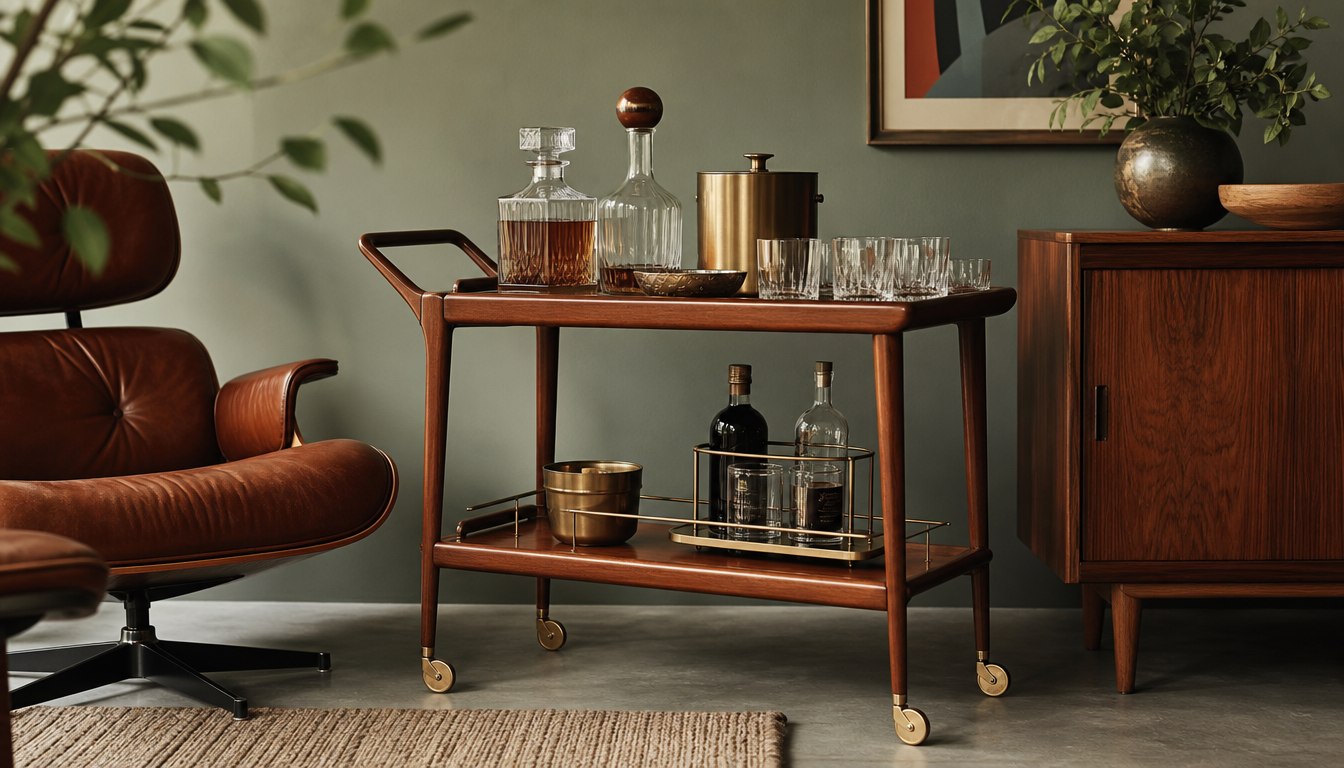
CATEGORY · BAR CART

Bar Carts & Serving Trolleys: Functional Mid-Century Design with Collector's Value

Where material quality, craftsmanship and design history converge.

Bar carts and serving trolleys from the 1950s through the 1970s rank among the most versatile objects of Mid-Century Modern. Designed by creators such as Cesare Lacca, Ico Parisi, or from the workshops of Scandinavian cabinetmakers, they combined teak, chrome-plated steel tubing and glass surfaces into furniture that served representation and everyday utility in equal measure. Well-preserved examples with traceable provenance command stable prices on the collector's market today, because they unite era, material and function in a compact form.

mid-century·designs

Bar Cart

ESSAY · 01

Work & Context

mid-century·designs

Bar Carts and Serving Trolleys in the Mid-Century: Functional Design Between Everyday Culture and Collector’s Item

The bar cart is one of the most revealing objects of the Mid-Century Modern era, because it so openly negotiates the contradiction between function and representation. In the post-war decades, as the social ritual of domestic entertaining took on new forms, the rolling trolley evolved from a purely utilitarian object into a visible expression of a modern lifestyle. Architects and industrial designers regarded it not as an afterthought but as part of a thoroughly conceived living ensemble. Today, well-preserved examples from the 1950s through the early 1970s are sought-after collector’s pieces whose market presence grows as more buyers come to understand what distinguishes an original from a later reproduction. This page sets out what truly matters when it comes to material, origin and condition.

Characteristic Materials: Brass, Teak, Chrome and Laminate

The material language of a bar or serving trolley allows precise conclusions about its period of origin and regional provenance. Scandinavian designs of the 1950s and 1960s work almost exclusively with solid teak or rosewood for surfaces and frames, combined with slender brass handles and clearly contoured rods of chrome-plated steel. The wood was rarely lacquered but oiled, leaving the lively grain visible and tying the trolley visually into the concurrent furniture language of Scandinavian living rooms.

American designs of the same decade more frequently draw on chrome as the supporting structure, supplemented by glass shelves or plastic laminate in pastel tones. This combination is characteristic of the so-called California Modern and of designs that emerged in the orbit of manufacturers such as Troy Sunshade or Salterini. Glass set into metal rails is sensitive to improper cleaning and is a common weak point in pieces of American origin.

Italian bar carts, particularly from the milieu of Milan’s Triennale culture, combine brass frames with mirror glass, lacquered woods and occasional ceramic or marble inlays. The weight of such pieces is noticeably greater than that of Nordic counterparts. Original wheels or castors are an important authenticity marker: later replacement castors in plastic point to an undocumented repair and measurably reduce collector’s value.

Regional Schools and Defining Designers

The most important design impulses for the classic bar cart came from three geographical centres that differ markedly in their formal language and philosophy of craftsmanship.

Scandinavia set the tone for restrained cabinetmaking: Finn Juhl designed serving trolleys that function as autonomous sculptural objects. Nanna Ditzel developed a serving trolley for Kolds Savværk that consistently carries forward the organic formal language of her chairs. Most widely found today are pieces that derive from the Danish cabinetmaker tradition without being attributed to a prominent individual name. These anonymous works of high craft quality are often less expensive than designer pieces and no less convincing in material terms.

Italy produced more elegant, theatrically charged versions through Ico Parisi, Gio Ponti and the broader circle of the Stile Italiano. Ico Parisi’s designs for the manufacturer Cassina and related producers combine gilded metal structures with dark wood tones and reflect the representational needs of the northern Italian post-war bourgeoisie. Attributions in this segment are harder to verify and require documentary substantiation.

Germany and Austria contributed a more functionalist variant through the legacy of the Bauhaus and the Wiener Werkstätten milieu. Designs influenced by Wilhelm Wagenfeld or by the circle of the HfG Ulm display clear geometries that dispense with any decorative embellishment. Manufacturers such as WK Möbel or Rosenthal Studio produced serving trolleys that are strongly represented in the German-speaking market and hold stable price positions today.

Authenticity and Condition: What Collectors Should Look For

Anyone wishing to acquire a classic bar or serving trolley faces a series of evaluative tasks that differ from those involved with seating furniture or lighting. The functional character of the object means it was used daily over decades. That leaves specific traces.

The shelf surfaces — whether wood, glass or laminate — show signs of use through moisture, alcohol and heat. Water rings on teak surfaces can in many cases be refreshed by re-oiling without destroying the original character. Deep scratches or burns that have been concealed with filler or paint, however, are interventions that must be documented. Opacity about such details is a warning sign.

The frame and its joints deserve particular attention. With brass rods, examining weld seams and connector sleeves is informative: original joints of the 1950s and 1960s look different from modern repair welds. Castors and wheels, as already mentioned, should ideally retain their original condition or have been replaced with documented provenance.

Markings and labels are rare but valuable. Danish cabinetmakers used branded stamps or glued paper labels, which are frequently found under shelves or on the inner faces of frames. Manufacturer labels of Italian producers are occasionally engraved on metal profiles. The absence of such markings does not preclude originality, but makes attribution more complex and requires comparative knowledge of construction details.

The collector’s value of a bar cart today is determined less by the prominence of the designer alone than by the combination of demonstrable provenance, complete condition and aesthetic coherence of the design. Pieces that meet all three criteria are increasingly difficult to find in a steadily consolidating market.


At mid-centurydesigns.com, every piece undergoes a thorough evaluation according to precisely these criteria before being accepted into stock. Material condition, construction details and available provenance information are documented and communicated transparently. The goal is not volume but reliability of assessment, so that you as a buyer or collector can make an informed decision without having to research every point of detail yourself.

FAQ · 02

Frequently asked about Bar Cart

5 Answers

01
Which designers and manufacturers are considered particularly collectible for Mid-Century bar carts?
Among the most sought-after names are Cesare Lacca, whose chrome-plated brass trolleys of the 1950s now command high prices at international auctions, and Ico Parisi for his house MIM Roma. From Scandinavia, bar carts by Poul Henningsen and Jens Quistgaard are well known. In the German-speaking market, WMF produced serving trolleys in stainless steel from the late 1950s onwards that combined craft quality with a clear formal language. American pieces of Russell Wright's calibre or from the orbit of Herman Miller are rarer but well documented. Decisive for collector's value is always the combination of verified authorship, original condition and traceable provenance.
02
What materials were typically used for classic Mid-Century bar carts?
The predominant materials reflect the spirit of the 1950s and 1960s: chrome-plated steel tubing or brass for the frame, teak or rosewood for shelving surfaces and handles, and glass for trays and intermediate shelves. Italian examples frequently employ brass with leather accents, while Nordic manufacturers favoured oiled teak combined with matte steel. Some French pieces from the transitional Art Déco period work with chrome and mirror glass. Material condition is a central evaluation criterion: original lacquer, unpolished patinated brass and unstained wood surfaces are considered value-preserving.
03
How do I recognise an original piece of the period as opposed to a later reproduction?
Authentic Mid-Century bar carts display manufacturing characteristics typical of their time: hand-finished weld seams rather than industrial spot welding, slotted screws rather than cross-head or Torx, and wood joints without modern dowel systems. Labels, stamps or struck serial numbers from the manufacturer are important evidence. Reproductions from the 1980s onwards often use an MDF core beneath veneer, which is betrayed by the weight and edge treatment. UV light can reveal subsequently applied lacquers. For high-value pieces, assessment by a specialist dealer or an auction house with proven Mid-Century expertise is recommended.
04
How is the market for Mid-Century bar carts developing currently, and what factors influence the price?
The market for original bar carts from the 1950s through the early 1970s has been noticeably more active since around 2015. Well-preserved pieces by named designers regularly achieve four- to five-figure euro sums at Christie's, Sotheby's and specialist houses such as Wright Chicago. Price-determining factors include: complete provenance with proof of acquisition, original condition of all parts including castors and handles, rarity of the model, and current demand among interior designers. Anonymous, well-preserved teak serving trolleys of Nordic origin trade stably in the lower four-figure range. Restorations — even professionally executed ones — generally reduce collector's value measurably.
05
What should I bear in mind when placing and caring for an original Mid-Century bar cart?
Teak surfaces should not be treated with commercially available furniture oils, as these alter the appearance of the wood and complicate future restoration. Instead, occasional wiping with a lightly dampened linen cloth is recommended. Brass parts with a natural patina should not be polished, as the even oxidation layer represents an authenticity marker. Castors made of rubber or Bakelite are sensitive to direct sunlight and should be protected from it. Glass inserts are safest stored in their original position; vibrations during transport are the most common cause of breakage. For long-term value preservation: as little intervention as necessary, as much documentation of condition as possible.

GLOSSARY · 03

Related Terms

10 Entries

Bar Cart
A mobile piece of furniture from the Mid-Century Modern era, designed for serving and presenting drinks. Typical features: two to three tiers, brass handles, castors in brass or chrome-plated steel. Emerged in the 1950s and 1960s as a standard element of representative living spaces.
Serving Trolley
A wheeled multipurpose trolley that served in the Mid-Century both as a side table and as a carrier for drinks and food. Broader in function than a pure bar cart, often fitted with removable trays or folding side panels.
Teak
The preferred wood of Scandinavian furniture designers from the 1950s through the 1970s. Teak (Tectona grandis) excels through its high oil content, resistance to moisture and warm grain. In bar carts of this era, frequently used as a veneered or solid material for shelving surfaces.
Brass Fittings
Decorative and functional elements made of brass that were widespread on bar carts of the Mid-Century period. These include handles, rails, castors and frame profiles. Brass oxidises over time and develops a patina that collectors regard as an authenticity marker and evidence of age.
Provenance
The verifiable ownership and origin history of a piece of furniture. For bar carts with secure provenance, the manufacturer, year of production, previous owners and exhibition history can be substantiated. An unbroken provenance substantially increases authenticity and market value.
Chrome Steel
Steel refined by chrome plating, frequently used in Mid-Century bar carts for the frame, railing and castors. The shiny, corrosion-resistant surface corresponded to the spirit of post-war modernism and harmonised visually with glass and wood surfaces.
Danish Furniture Design
A design tradition that was internationally formative between 1945 and 1975. Danish manufacturers such as Stelton or Dyrlund produced bar carts with clean lines, craft precision and organic forms. The quality label 'Danish Furniture Makers Control' identifies certified original pieces.
Collector's Value
The monetary and cultural valuation of a design object on the secondary market. For bar carts, factors such as designer attribution, condition, material quality, year of production and rarity determine collector's value. Signed or catalogued pieces generally achieve significantly higher prices.
Original Lacquer / Original Finish
The factory-applied surface treatment of a piece of furniture in its unrestored state. For Mid-Century bar carts, a preserved original finish is regarded as a quality marker, since later reworking can diminish authenticity and therefore collector's value.
Poul Henningsen Influence
A design principle attributed to the Danish designer Poul Henningsen (1894–1967): the union of aesthetic reduction and everyday functional utility. This approach also left a lasting mark on the design of serving and bar trolleys within the Scandinavian Mid-Century tradition.