Caring for and preserving Bakelite
Bakelite, developed in 1907 by Leo Baekeland as the first fully synthetic plastic based on phenol and formaldehyde, defines the aesthetic of an entire design era. From radio cabinets of the 1930s through to the early post-war period, the material stands for an aesthetic of warm brown tones, deep blacks and rich bordeaux hues, for pressed forms with soft radii and for a tactile presence that differs markedly from later thermoplastic materials. Those who collect Bakelite are simultaneously collecting the history of materials: as a thermoset — irreversibly hardened under heat and pressure — it ages differently from polystyrene or ABS and requires a correspondingly restrained approach to care.
The following notes summarise what has proven itself in restoration practice and collector literature. The guiding principle: as little intervention as possible. Bakelite is chemically stable, but superficially sensitive to UV radiation, alkaline cleaners, solvents and mechanical abrasion. An intact, evenly aged patina is part of the object and is generally value-enhancing. Polishing, sanding and aggressive cleaners destroy precisely that surface which identifies a piece as a witness to its time.
1. Characteristic materials and their care
Bakelite is not all the same. Pure phenolic resin appears deep dark brown to black; the colourful, marbled variants, often referred to as Catalin, are cast phenolic resins without fillers and were used primarily in the USA for jewellery, radios and everyday objects. Alongside these, urea and melamine resins (such as Bandalasta and Beetleware) exist — frequently confused with Bakelite, yet lighter and more moisture-sensitive. Identification is achieved through weight, the sound when gently tapped, the characteristic phenolic smell produced by brief friction on an inconspicuous spot, and UV light, under which Catalin often fluoresces greenish.
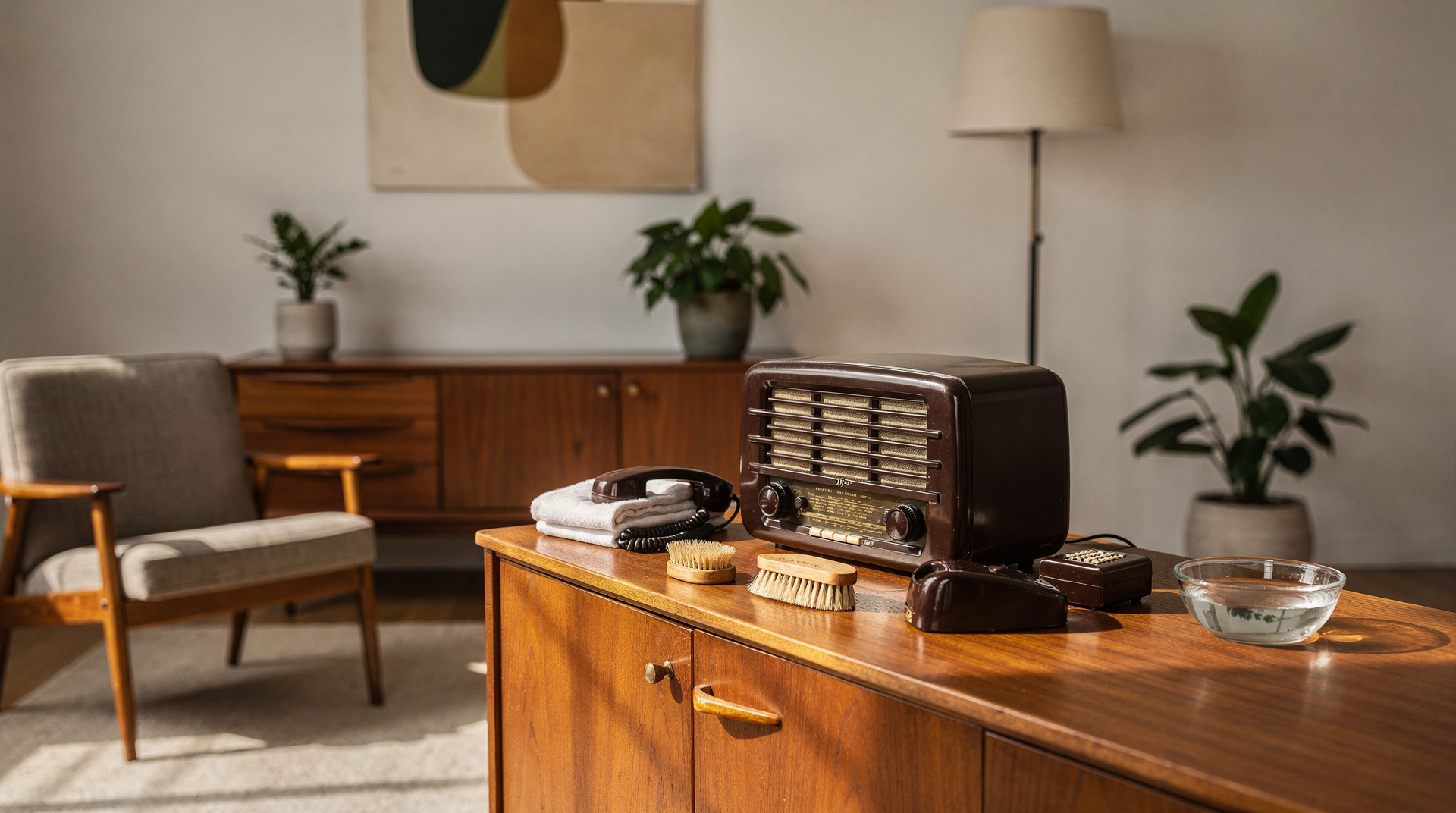
For cleaning, a soft cotton cloth lightly dampened with distilled water and a few drops of pH-neutral soap will suffice in most cases. Alcohol, acetone, nail polish remover and ammonia-based glass cleaners should be avoided; they attack the surface, cause it to become matt or dissolve historical lettering. For pieces that have lost their sheen, high-quality microcrystalline wax (such as Renaissance Wax) applied in the thinnest possible layer has proven effective: apply sparingly, allow to penetrate briefly, then buff out with a soft cloth. Yellowed or oxidised surfaces can be carefully brightened with car polishes based on the finest abrasive particles, though every such intervention removes substance and should therefore only be considered for severely degraded pieces. Dials, clock faces and printed manufacturer markings should fundamentally be left untouched.
2. Regional schools, manufacturers and designers
The cultural history of Bakelite is closely intertwined with the radio. In Germany, companies such as Telefunken, Mende, SABA, Grundig, Braun and Loewe-Opta shaped casings ranging from the objective Bauhaus legacy to the soft streamlining of the 1930s. The Volksempfänger VE 301 and the DKE 38 (Deutscher Kleinempfänger) mark the widespread dissemination of the material in everyday life. In the 1950s, Hans Gugelot and Dieter Rams at Braun set standards that, while increasingly using other plastics, built upon the Bakelite era in terms of design.
In Great Britain, Ekco (E.K. Cole Ltd.) with the circular models AD-65 and AD-75 by Wells Coates (1934/1940), and Murphy Radio with designs by R. D. Russell, established a distinctive formal language. Serge Chermayeff and Misha Black also provided casing designs. In the USA, a colourful radio culture emerged around Catalin, with manufacturers such as Fada, Emerson, Addison and Motorola; Norman Bel Geddes and Walter Dorwin Teague translated the Streamline aesthetic into everyday objects. France made its own contributions through Sonora and Radialva, the Netherlands primarily through Philips, where Louis Kalff shaped the visual identity. These regional schools differ considerably in proportion, dial design and handle details, and are more informative for attributing a piece than mere material identification.
3. Authenticity and condition for collectors
For collectors, the correspondence of cabinet, chassis, dial, knobs and back panel is paramount. Replaced knobs, recast cabinet parts or over-painted surfaces substantially diminish value, even if they are visually convincing. Examining press seams, ejector pin marks on the interior and the embossing of manufacturer logos or patent numbers aids in dating. Original type plates, valve complement and — in the case of radios — documented correspondence with the manufacturer’s circuit diagram are central points of verification.
Typical damage patterns include hairline cracks at corners and around fixing screws, bleaching of exposed surfaces, whitish deposits caused by plasticiser migration in composite materials, and heat-induced deformation. Cracks can be stabilised but not invisibly repaired; reversible bonding with Paraloid B-72 is preferable from a conservation standpoint to adhesives such as superglue or two-component resins. For storage: constant room temperature, relative humidity of around 45 to 55 percent, no direct sunlight, no proximity to radiators. Radios should be electrically tested before any operation; old paper and electrolytic capacitors pose a genuine fire risk and are replaced professionally without sacrificing the original sound character.
At mid-centurydesigns.com, we examine every Bakelite object and every vintage radio for material integrity, originality of components and documentable provenance. We favour pieces with grown patina over excessively restored examples and disclose visible interventions transparently. This keeps it decidable what you are acquiring: a technically reliable, historically coherent object that preserves the design clarity of Mid-Century Modernism.