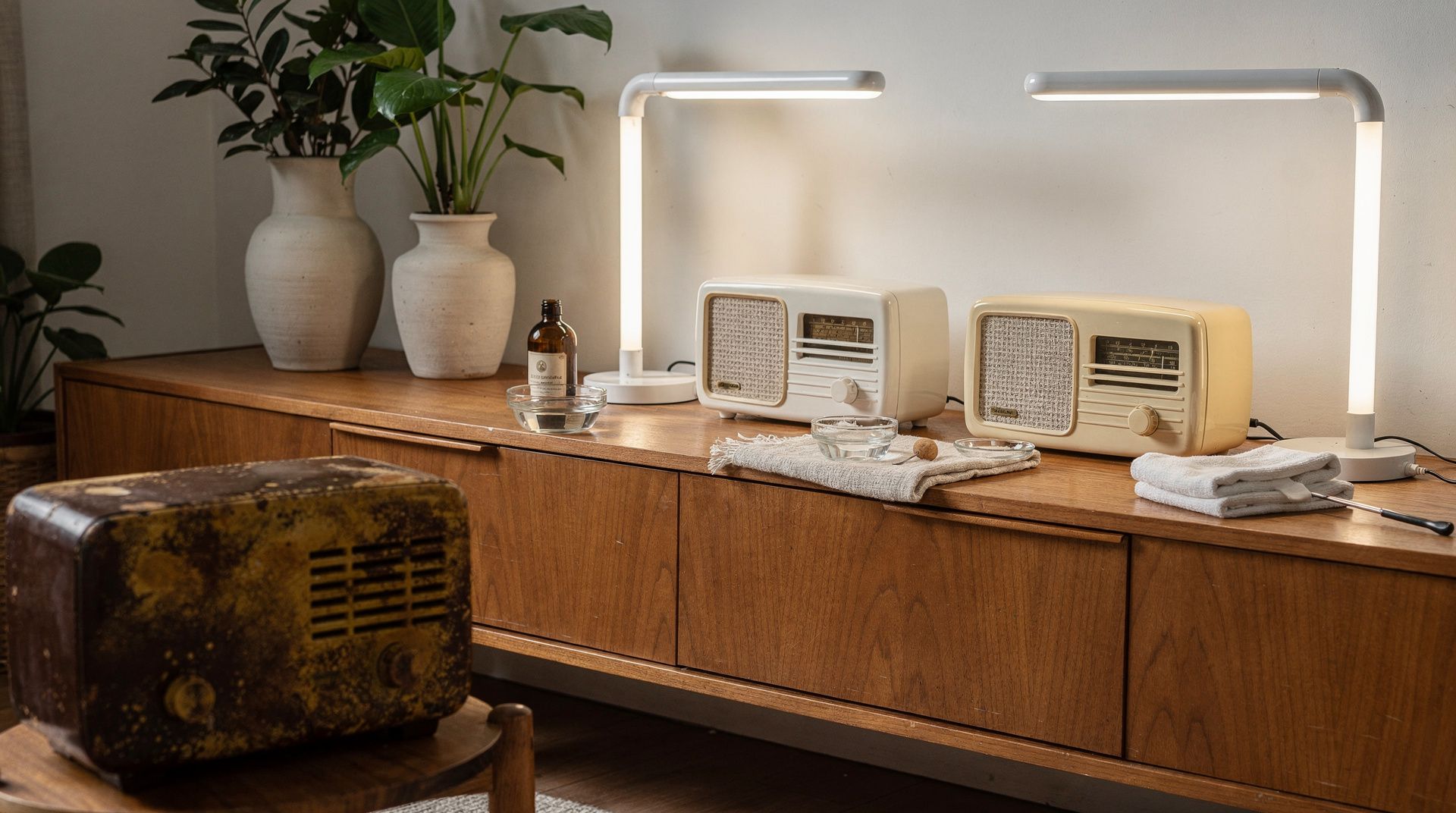
Bakelite between patina and care: what really matters when brightening yellowed housings
Bakelite, patented in 1907 by Leo Baekeland, is the first fully synthetic plastic in industrial history. As a thermosetting material based on phenol and formaldehyde, it cannot be reshaped once cured, which made it so attractive for radio housings, telephone sets, switches and handles from the 1920s to the 1950s. Over the decades, however, the surface and colour change: UV radiation, oxygen, nicotine, cleaning agents and skin oils deposit, oxidise or penetrate the uppermost layer of the material. The result is that yellowish-brown to dull appearance that many collectors mistakenly take for irreversible decay.
Before undertaking any treatment, a sober diagnosis is worthwhile. Genuine Bakelite is dense, heavy, warm to the touch and smells faintly of phenol or formaldehyde when rubbed with a thumb. It is not the same as urea-formaldehyde (Bandalasta, Beetle), Catalin (cast, often marbled) or later thermoplastics such as polystyrene and ABS, which were used in early transistor radios. The distinction is crucial, because the Retrobright formulations with hydrogen peroxide and UV commonly used for ABS cannot be applied to Bakelite one-to-one. Bakelite does not yellow primarily through bromine compounds, but through superficial oxidation of the phenolic resin and absorbed residues. Anyone who approaches this too aggressively destroys the characteristic gloss and with it a significant part of the value.
1. Characteristic materials and their behaviour towards brightening
Phenolic-resin Bakelite is most common in dark shades such as black, oxblood, walnut brown and mahogany. These colours are produced by fillers such as wood flour, asbestos or cotton fibres. With dark housings, ageing manifests less as yellowing and more as a dull, grey haze — a mixture of oxidised surface layer and microscopic abrasion marks. In many cases, careful cleaning with lukewarm water and neutral soap, followed by polishing with a very fine car polish or Simichrome and then carnauba wax, is sufficient here.
Light phenolic resins, Catalin and urea-formaldehyde behave differently. They are naturally ivory, butter-coloured or pastel and show yellowing clearly. With Catalin, which is solid-cast, the discolouration often sits millimetres deep; the original colour can be revealed again by careful wet-sanding with grits from 800 to 2500 and subsequent polishing. With thin-walled Bakelite radio housings this approach is risky, because embossings, logos and edges are irretrievably lost. For these, a surface treatment with hydrogen peroxide is more appropriate — ideally as a cream at 9 to 12 per cent, applied over the entire surface, wrapped in cling film and exposed to sunlight for a few hours. Spot application leads to staining; too long a UV exposure can encourage hairline cracks (crazing).
2. Regional schools, manufacturers and what their housings require
The great Bakelite form-givers of the mid-century era are clearly located geographically. In Germany, Walter Maria Kersting with the VE 301 (Volksempfänger, 1933) and later the housings of Braun, Grundig, Telefunken and SABA shaped the formal language. These objects are frequently finished in deep brown or black and respond well to conservative care. In Great Britain, Wells Coates for Ekco (AD-65, 1934) and Serge Chermayeff created round, sculptural housings that rank among the icons of the collector scene. Their surfaces often feature a mirror-like lacquer that can be etched matt by hydrogen peroxide — caution is essential.
In the USA, Harold van Doren, Norman Bel Geddes and above all Walter Dorwin Teague, with designs for Air King and Sparton, defined the streamlined mid-century look. American Catalin production also brought forth the famous multicoloured Fada and Emerson housings, whose original colour tones (such as the legendary alabaster or butterscotch) often become visible again only after expert brightening. In Italy, Livio and Pier Giacomo Castiglioni provided early examples of consistently modern Bakelite design with pieces for Phonola in the 1930s. Depending on the manufacturer and decade, the resin formulation varies, and with it the response to any treatment. A test patch on a concealed area is mandatory for every piece.
3. Authenticity, condition and protection for the collection
For collectors, alongside provenance, the integrity of the original surface is paramount. A slight, even patina is in many cases value-enhancing because it attests to the authenticity of the piece. Excessive brightening, recognisable by an unnaturally white, chalky appearance, on the other hand reduces market value. Before buying or before treatment, check whether the housing has hairline cracks, glued breaks, recast sections or overpaintings. A UV lamp helps in identifying repairs, as modern epoxies and lacquers fluoresce differently from original phenolic resin. Embossings, manufacturer’s marks and serial numbers should be sharp and untouched.
After any cleaning or brightening, protection is crucial. Carnauba wax or microcrystalline wax (such as Renaissance Wax) lays a thin, reversible layer over the surface and significantly slows renewed oxidation. Store Bakelite objects not in direct sunlight, not behind glass in overheated display cabinets, and not in rooms with strong temperature fluctuations. Avoid cleaners based on ammonia, acetone, alcohol in high concentration or abrasive pastes; they attack the resin matrix. With vintage radios it is also advisable to remove nicotine deposits completely, as they accelerate the yellowing process through a catalytic effect. An annual check of the surface, electrics and seals is as much a part of care as clean documentation of provenance and previous interventions.
At mid-centurydesigns.com, objects made of Bakelite and related materials are examined before being listed for their material composition, originality of surface, previous restorations and condition of the brand embossings. Every description transparently states patina, conservation interventions and visible signs of ageing, so that you as a collector or designer can make an informed decision as to whether a piece should remain in its found condition or deserves careful attention.
This article was generated automatically by an AI system. Disclosure pursuant to Article 50 of the EU AI Act.