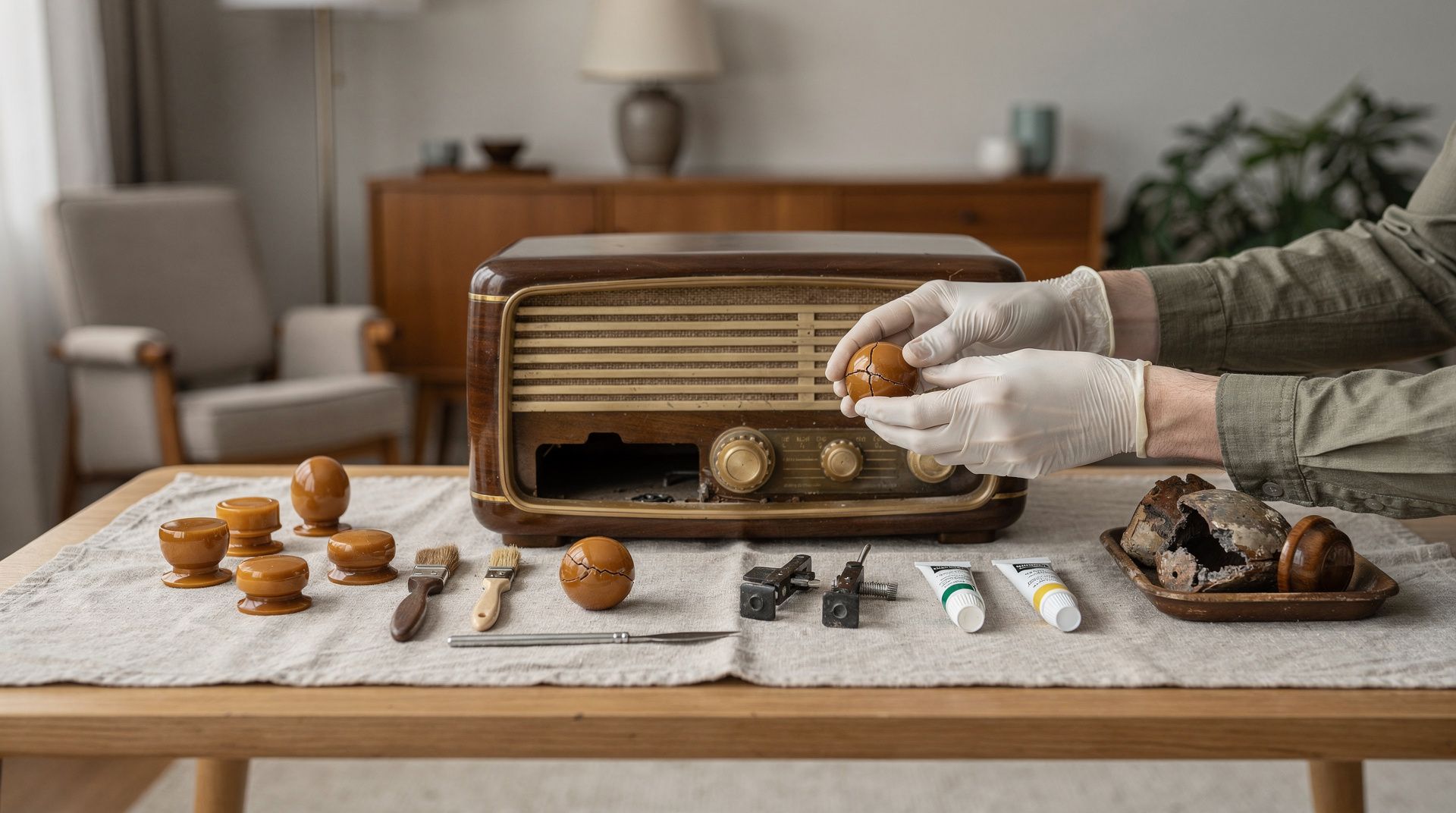
Bakelite Repair for Warping and Cracks
Bakelite was the first fully synthetic plastic, patented in 1907 by Leo Hendrik Baekeland, and as a phenol-formaldehyde resin shaped the appearance of radios, telephones, switches and handles for decades. Unlike thermoplastics, Bakelite is a thermoset: once cured, it cannot be remelted and reshaped. This property makes the material robust against heat and chemicals, but sensitive to mechanical impact, stress cracks and long-term UV exposure. Anyone restoring an original Siemens, Telefunken or Bakelite telephone from the 1930s to 1950s is not working on an ordinary plastic, but on a historical document of early industrial culture. Every repair should therefore be carried out with appropriate restraint and in keeping with the material. The following notes summarise what is considered sound in specialist literature and restoration practice, and where the boundary to professional work begins.
Material Behaviour, Damage Patterns and Characteristic Compositions
Bakelite consists of a phenolic resin that was extended with fillers such as wood flour, cellulose, mineral powders or textile fibres. These fillers determine colour, surface texture and fracture behaviour. Dark housings of radios and telephones usually contain wood flour, while coloured knobs tend to use mineral fillers. Typical damage patterns include hairline cracks on loudspeaker grilles, chipping at housing edges, stress cracks around screw bosses and milky surface hazes caused by oxidised resin. True warping rarely occurs with Bakelite, as the material is not thermoplastic. What looks like warping is generally a fracture that has been bonded in a displaced position, or a distortion from the original pressing mould. Attempts to reshape Bakelite by heating almost always lead to blistering, charring or total loss. For cracks, two-component epoxy resins with a long pot life have proved effective, as they penetrate the crack face and are chemically compatible with the phenolic resin. For smaller voids, restorers use pigmented epoxy or, at structural fracture edges, mixtures reinforced with phenolic resin fibres. Cyanoacrylate is only suitable for completely stress-free, dry joints and should be used sparingly due to whitening at the bond line.
Workshop Practice, Regional Manufacturer Traditions and the Limits of DIY Repair
European Bakelite processing was strongly shaped by regional traditions. In Germany, companies such as Rheinische Gummi- und Celluloid-Fabrik and Jurid supplied the raw moulding compounds for manufacturers like Siemens, Mende, Mix & Genest and Hagenuk. British housings from Ekco, Bush or GPO display a different surface polish, often with a deeper gloss, while French manufacturers such as Radiola and Thomson frequently worked with marbled compounds. These differences are relevant for repair, because filler content and surface finish determine how well a damaged area can be matched in colour. For the home workshop: always clean with isopropanol before bonding, not with acetone, which attacks the surface. Fix broken pieces without tension using masking tape or silicone bands, not clamps that create new cracks. Polish exclusively with fine microcrystalline wax paste, never with abrasive compounds that remove the patina. As soon as a housing base cracks under load, screw bosses break out or visible surfaces of a rare model are affected, the right course of action is to consult a specialised restorer. Back-filling with tinted epoxy, taking moulds of missing trim strips via silicone negatives and re-polishing shellac surfaces are tasks for experienced hands, not least because every incorrect intervention permanently reduces the collector’s value.
Authenticity, Condition and What Collectors Value
For collectors, Bakelite objects are valued not for a flawless surface but for the traceable history of the piece. A homogeneous, slightly darkened patina is considered authentic, whereas aggressively polished housings or fully overpainted surfaces significantly reduce value. When assessing a potential purchase, check the insides for original press marks, batch numbers and manufacturer logos, which are absent from reproductions. A brief test with a damp cotton swab on a concealed edge will release a characteristic phenolic odour from genuine Bakelite, clearly distinguishable from later urea or melamine resins. Documented repairs reduce value less than invisibly concealed interventions that become apparent under UV examination. For knobs and handles: original set completeness outweighs the perfect condition of individual parts. For telephones, the handset, finger-hole dial and housing base should ideally come from the same production batch, identifiable by matching date stamps inside.
At mid-centurydesigns.com, Bakelite and early plastic objects are individually inspected, described in terms of condition and provenance and, where necessary, provided with notes on professional restoration, just like the rest of the range. Every piece undergoes an assessment of surface originality, completeness of fittings and traceability of manufacturer marks, so that you receive a curated selection that meets the standards of a serious collector’s item.
This article was generated automatically by an AI system. Disclosure pursuant to Article 50 of the EU AI Act.