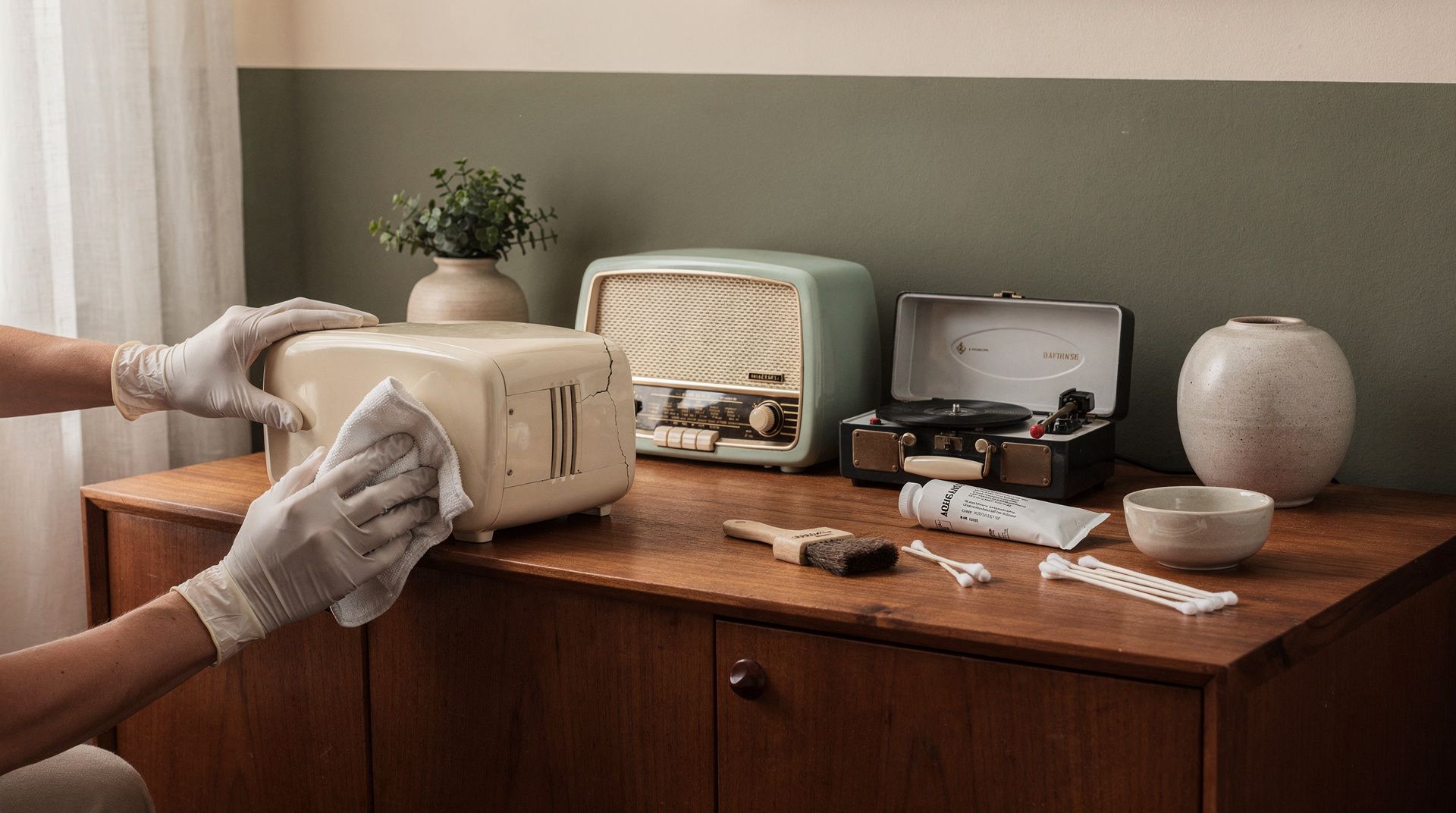
Bakelite and Early Plastics: Care That Respects the Substance
The housings of radios, telephones, clocks, and small appliances from the 1930s to the 1960s tell us not only about the design aspirations of their creators, but also about an eventful history of materials. Bakelite, Catalin, urea-formaldehyde, cellulose acetate, early polystyrene, and from the 1950s onwards increasingly ABS: each of these materials ages differently, reacting differently to light, heat, solvents, and perspiration. Anyone who adds a device from this era to their collection takes on responsibility for an object whose surface can rarely be reversibly restored. We therefore advocate a conservatorial approach: identify first, then clean carefully, and only intervene where the preservation of the piece requires it. Restoration is not cosmetics — it is a question of material knowledge and restraint.
Characteristic Materials and Their Ageing Behaviour
Genuine Bakelite — that is, phenol-formaldehyde thermoset — can be recognised by its warmth in the hand, the dull sound it makes when tapped, and the characteristic carbolic smell when rubbed. It is chemically stable, but tends to develop a dull surface patina as the plasticisers at the interface react with UV light and oxygen. This layer can be removed with a soft cotton cloth, distilled water, and a drop of pH-neutral soap; ultrafine polishing paste of the kind used in watchmaking has proven effective for restoring the shine. Under no circumstances should acetone, nitro thinner, or ammonia-based cleaners be used on Bakelite, nor should ultrasonic baths.
Catalin, often found in butterscotch and marbled finishes on American radios of the 1940s, oxidises more strongly: the once bright, translucent tones turn amber. This yellowing is not dirt, but a permanent chemical change within the material itself; it cannot be cleaned away, but only reduced by mechanically abrading the top layer — which tends to lower collector value rather than raise it.
Urea-formaldehyde, frequently used for pastel-coloured housings on tape machines and kitchen appliances, is considerably more sensitive to moisture and fine hairline cracks. Cellulose acetate, used for dial faces and early television knobs, can exhibit the so-called Vinegar Syndrome and must then be stabilised climatically. Polystyrene and ABS — the materials of the Braun and Nordmende era — yellow due to brominated flame retardants; the collector community discusses the so-called Retr0bright treatment using hydrogen peroxide and UV light, which however further damages the molecular chains and can bleach out markings.
Regional Schools and Designers Who Took Plastic Seriously as a Material
The English-speaking world shaped the early phase: Wells Coates gave Ekco in 1934 the AD-65, a round, fully Bakelite-formed housing that translated tube technology into an iconic form. In the USA, Harold van Doren, Norman Bel Geddes, and Walter Dorwin Teague developed a design language that did not conceal the material but instead showcased its flow properties; Fada and Emerson supplied the corresponding colour-intense Catalin housings.
In Italy, Livio and Pier Giacomo Castiglioni, along with Marco Zanuso for Brionvega, set new standards: the TS 502 by Zanuso and Richard Sapper from 1964 used ABS for a folding radio that would have been inconceivable without the plastic. In Germany, Hans Gugelot and Dieter Rams at Braun defined a sober, light-grey plastic aesthetic in which every chamfer, every radius, and every label has a function; the SK series, the TP 1, and the T3 are key references here. Scandinavia contributed a cool, technical line through Bang & Olufsen and designer Jacob Jensen, in which aluminium and plastic were deliberately contrasted. These schools differ not only formally, but also in the plastic formulations used, which remains relevant for care and assessment.
Authenticity and Condition: What Collectors Look For
An original housing shows uniform ageing, homogeneous colour depth, and the period-typical tool marks on the interior: ejector pins, manufacturer’s embossed stamps, material identifiers. Recast reproductions made from polyester or epoxy resin are usually lighter, sound brighter, and show no original mould marks. When it comes to breaks, the choice of adhesive is crucial: two-component epoxy resins with a long pot life have proven effective for Bakelite, colour-matched with pigments, whereas cyanoacrylate creates brittle joints that break again under stress. Visible but cleanly joined old cracks are worth documenting and reduce value less than sanded-down, re-lacquered surfaces that lose the original embossing of the dial or logo.
For conservation, the following applies: constant indoor air humidity between 40 and 55 percent, temperatures of around 18 to 20 degrees Celsius, no direct sunlight, no halogen spotlights at close range. For long-term care, a thin coat of microcrystalline wax — such as Renaissance Wax — applied every one to two years is sufficient; it protects against perspiration and stabilises the surface gloss without forming a film that complicates future interventions. Yellowing of ABS cannot be reversed, but can be slowed by displaying the object in a UV-reduced environment and choosing vitrine materials free of plasticiser.
At mid-centurydesigns.com, we examine every radio, every Braun icon, and every Brionvega device for material authenticity, completeness of controls, original markings, and the traceability of previous interventions. We document signs of ageing openly, identify restored sections, and advise you before purchase on the climate, placement, and care of each piece — so that the substance that makes these objects witnesses of their era is preserved.
This article was generated automatically by an AI system. Disclosure pursuant to Article 50 of the EU AI Act.