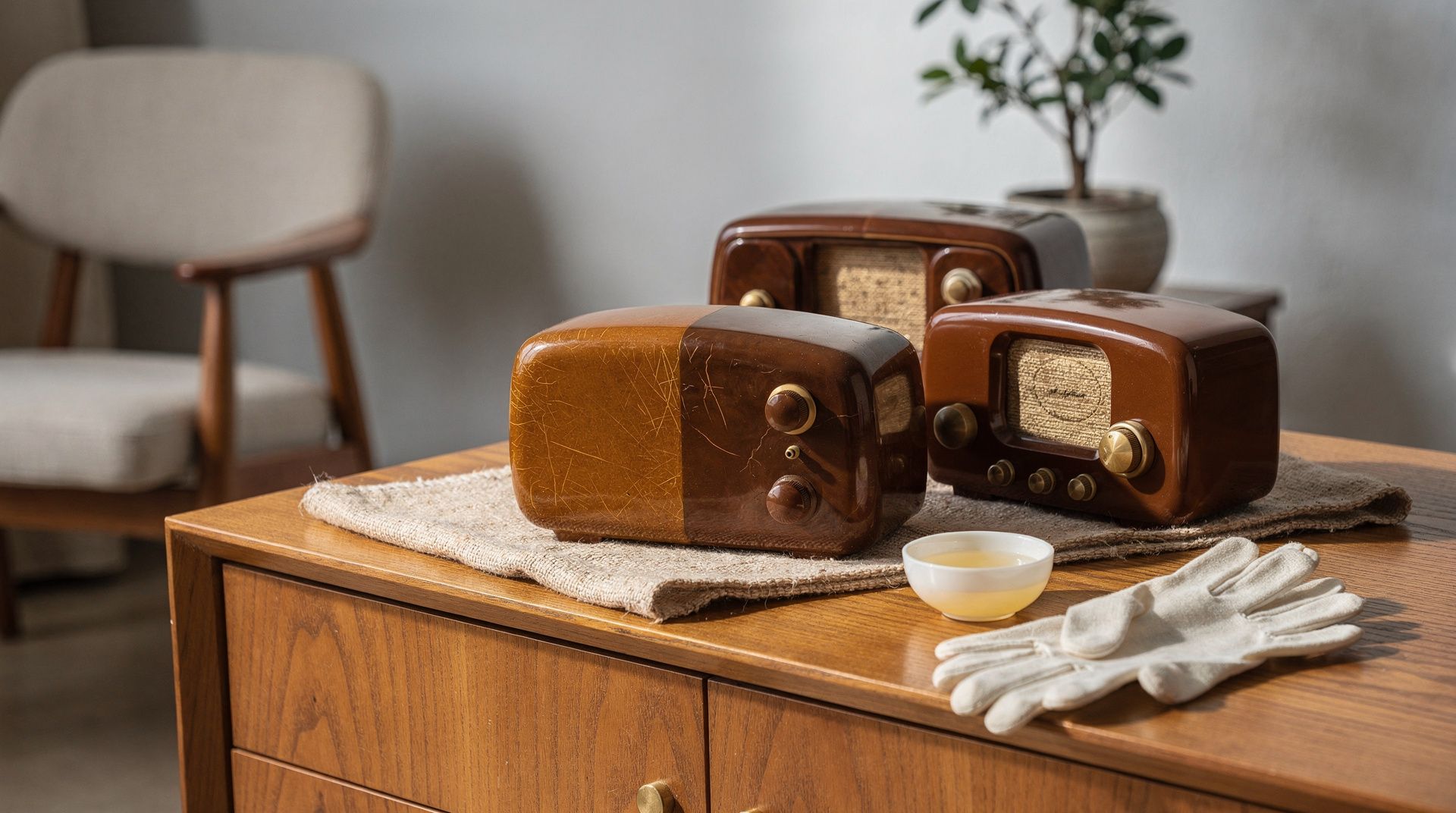
Bakelite in the Mid-Century: Care, Restoration and Preservation of Radios and Appliances
Bakelite is the first fully synthetic plastic in industrial history, patented in 1907 by Leo Baekeland as a phenol-formaldehyde resin. What from the 1920s onwards shaped housings for tube radios, telephones, cameras and household appliances is today a delicate collecting field: the thermoset material ages slowly but irreversibly. Surfaces yellow through UV exposure and oxidative processes at the boundary layer, fine hairline cracks form due to stresses in the moulded part, and aggressive cleaners dissolve the thin, glossy shellac or phenolic resin top coat that gives many devices their depth.
Handling Bakelite demands restraint. Unlike modern thermoplastics, lost substance cannot be replicated — every polish removes material, every chemical brightening intervenes in the molecular structure. Those who own a Braun radio, a Deutsche Post telephone or a Volksempfänger housing are not working on a utilitarian object, but on a historical document of industrial design. The following sections contextualise material, origin and condition, and show which interventions are professionally justifiable.
1. Characteristic Materials and Their Ageing
Genuine Bakelite consists of phenol-formaldehyde resin, usually mixed with fillers such as wood flour, asbestos fibres (before 1970) or cotton flocks. It is thermosetting, meaning: once cured, it cannot be remelted. Typical colours are black, brown, marbled and reddish-brown; light tones such as ivory or green were usually made from urea-formaldehyde (Bandalasta, Beetle) or casein and are colloquially — and incorrectly — equated with Bakelite. The distinction is relevant because urea resins respond differently to cleaning and brightening.
Yellowing in dark Bakelite is superficial: it affects the uppermost micrometres, in which phenol groups oxidise to quinoid structures under UV light. A careful reduction of the yellowed film with very fine polishing paste (Menzerna, Autosol in a heavily diluted application) on a soft cotton cloth often restores the original gloss. Important: no Retrobright, no hydrogen peroxide under UV, as is common with ABS. Peroxide strips cross-linking bridges from the phenolic resin and renders the surface chalky in the long term.
Scratches up to a depth of approximately 0.1 millimetres can be invisibly levelled through multi-stage polishing with grits from 2000 through 4000 to 8000, followed by carnauba wax as a final sealant. Fine cracks (craquelé) are irreparable in the sense of material restoration; they can be stabilised and visually calmed with microscope-precise application of Paraloid B-72 in acetone — a method from museum conservation. For routine cleaning, distilled water, a drop of pH-neutral soap and a microfibre cloth suffice. Alcohol, neat acetone, ammonia and chlorine cleaners are to be avoided.
UV protection is the most effective conservation step. Positioning away from direct sunlight, display cases with UV-filtering acrylic glass (such as Plexiglas GS 2458) and an annual thin application of microcrystalline wax (Renaissance Wax) slow oxidation by orders of magnitude.
2. Regional Schools and Formative Designers
Bakelite was processed in almost every industrialised nation, yet the formal handwriting differs markedly. In Germany, the workshops of Telefunken, Siemens, Nordmende and Grundig shaped a sober, often near-cubic formal language with clean curves and typographically strict dials. Walter Maria Kersting designed the Volksempfänger VE 301 in 1928, whose housing was pressed in Bakelite from 1933 onwards and is today one of the most historically charged objects in the collecting scene. After 1945, Hans Gugelot and Dieter Rams set new standards at Braun, with Braun switching early from Bakelite to injection-mouldable thermoplastics.
In Great Britain, Ekco and Murphy stand for a more sculptural approach. Wells Coates designed the Ekco AD-65 in 1934, a circular radio with encircling ribs regarded as an icon of inter-war modernism and celebrating the plastic character of the material. Serge Chermayeff worked in parallel for Ekco on flatter, horizontally emphasised housings.
The United States brought the Streamline style into the world of appliances through Norman Bel Geddes, Raymond Loewy and Harold Van Doren. Fada and Emerson produced radios in Catalin, a castable relative of Bakelite, often in vivid colours with marbling. These Catalin radios are today the highest-priced objects in the segment, because the material was not injection-moulded but machined and remained in small series.
Italy and France form a third school: Radiomarelli, Phonola and Ducretet-Thomson experimented with organic forms and coloured urea resins. Livio and Pier Giacomo Castiglioni designed the Phonola Model 547 in 1939, an early example of ergonomically tilted control surfaces.
3. Authenticity and Condition for Collectors
The first examination is material identification. Bakelite can be recognised by its characteristic phenolic odour, released by rubbing with the thumb on a concealed spot. A second, more reliable test is the Simichrome test: a tiny amount of Simichrome polish on a cotton swab turns yellow on genuine Bakelite. The hot needle test should be avoided on collector’s pieces, as it leaves visible marks.
Condition assessment is based on five criteria: completeness of the housing including rear panel and dial glass, originality of the knobs (frequently replaced, identifiable by a slightly different depth of colour), preservation of original labelling and manufacturer’s marks on the underside, condition of the interior (bleaching, burn marks from overheated valves), and the presence or absence of craquelé at the corners and around screw bosses, where material stresses are highest.
Restorations only retain collector value when they are documented, reversible and substance-preserving. Repaints, breaks bonded with epoxy resin, or repaints in colours that never belonged to the model are value-reducing. Provenance through receipts, previous-owner documents or factory records significantly increases value, particularly for iconic models such as the AD-65 or early Fada Bullet radios.
Technical function is secondary for collector’s pieces, but an original chassis condition with datable capacitors and valves confirms that the device has not been rebuilt multiple times. Those who collect in order to listen should strictly separate the restoration of the electronics from the housing and entrust it to a specialist workshop that installs safety capacitors to current standards without discarding the original components.
At mid-centurydesigns.com we curate Bakelite objects and appliances of the classical modern period with precisely these criteria in mind: documented provenance, materially appropriate condition, traceable interventions. Each piece is examined for substance, originality of components and formal integrity before being accepted into the inventory. This is how you find radios, telephones and appliance housings that stand as historical witnesses and remain caretakeable.
This article was generated automatically by an AI system. Disclosure pursuant to Article 50 of the EU AI Act.