Børge Mogensen and the Workshop Philosophy of Danish Modernism
Børge Mogensen (1914–1972) ranks among the defining figures of the Danish Møbelkunst chapter that matured in the orbit of the Copenhagen Kunsthåndværkerskole and the Snedkerlaugets Møbeludstillinger. As a student of Kaare Klint and later head of the Møbelafdeling at FDB Møbler (from 1942), he understood design not as an authorial pose but as a social task: solid, repairable, everyday-proof furniture for bourgeois and modest households alike. His designs read like a commentary on Danish post-war modernism, in which reason, craftsmanship and regional material culture converge.
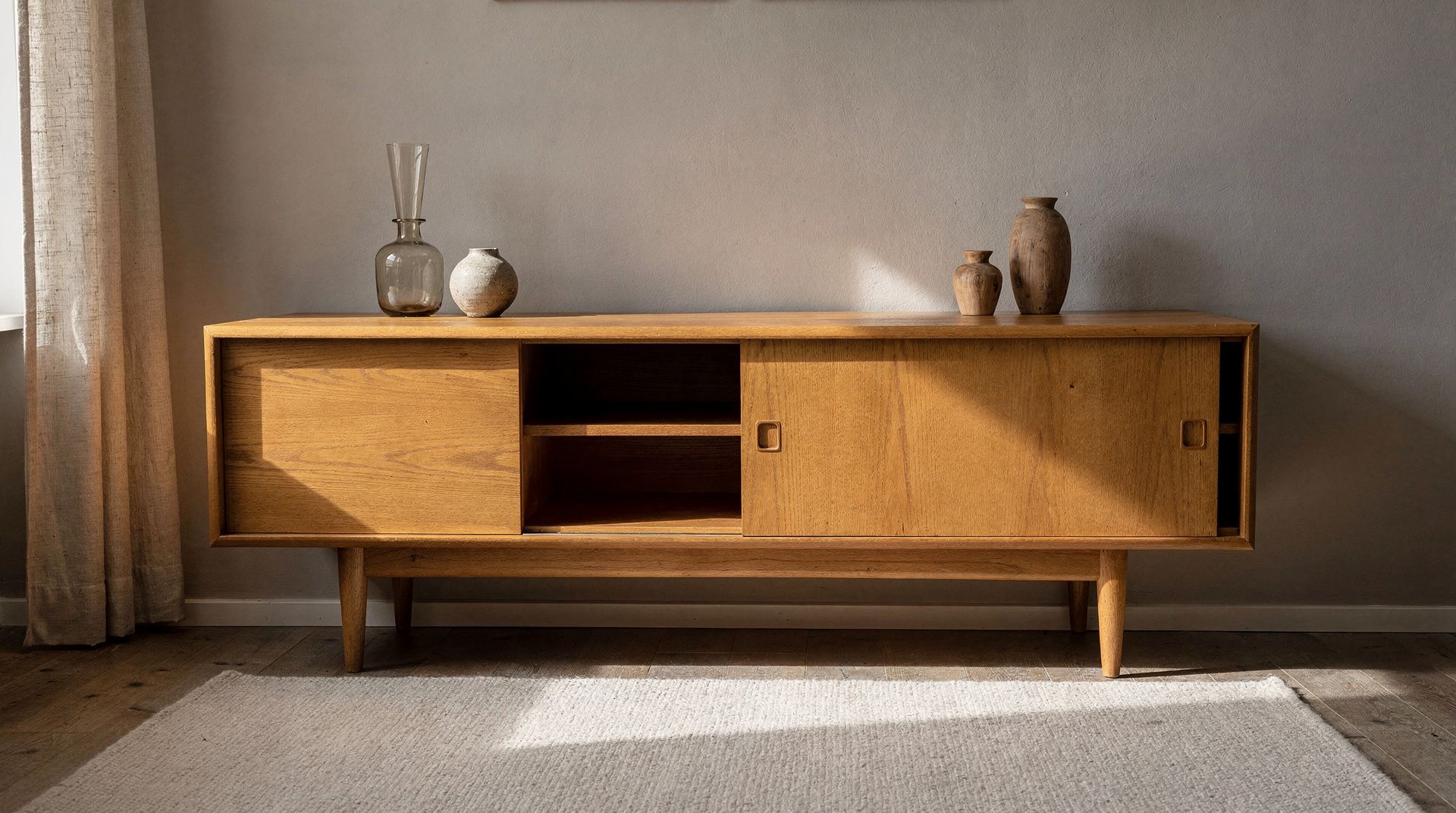
Anyone who takes Mogensen’s work seriously quickly recognises that simplicity is not a stylistic label for him, but the result of a methodical approach: measurement of historical precedents (in the spirit of Klint’s proportion studies), strict modular dimensions, and a vocabulary of tenons, rails and visible joinery. The famous compartment sideboards — manifest in series such as Model 232 or in the library systems of the “Øresund” range for Karl Andersson & Söner (1955) — are the clearest testimony to this. They open the carcass into open and closed compartments, reveal construction rather than concealing it, and translate farmhouse-cupboard typologies into a reduced, urban language.
1. Characteristic Materials and Construction
Mogensen’s choice of materials follows a logic of regional availability and long service life. Solid oak, frequently soaped or lye-treated, dominates the work groups of the 1950s and 1960s; he uses pine programmatically at FDB and in the “Øresund” series, deliberately engaging with the social ambition of affordable, long-lasting furniture. Teak appears in selected designs of the 1960s, for example in representative pieces for P. Lauritsen & Søn or in collaboration with master cabinetmaker Erhard Rasmussen.
Constructively, you can recognise Mogensen by open dovetail joints, through-tenons with wedge keys, precise tongue-and-groove connections, and metal fittings in brass or burnished steel whose formal language is closer to the tool than to ornament. In upholstered furniture — above all the “Spanish Chair” (Model 2226, 1958) and the “Hunting Chair” (Model 2229, 1950) — he uses robust saddle-leather panels with visible straps and buckles, as well as untreated natural leather that develops a warm patina. Textiles frequently stem from his collaboration with Lis Ahlmann, whose striped and checked woven fabrics provide an acoustic and chromatic counterpoint to the wood.
2. Regional Schools and the Network of Danish Contemporaries
Mogensen is inconceivable without the Klint school. From it emerged contemporaries such as Hans J. Wegner, Ole Wanscher and Mogens Koch, with whom Mogensen shared a common understanding of proportion and workshop culture. Unlike the more sculptural work of Finn Juhl — realised in collaboration with craftsmen such as Niels Vodder — Mogensen deliberately remained close to the guild tradition of cabinetmaking. His most important production partners were Fredericia Stolefabrik (from 1955 the central manufacturer of many seating pieces and sideboards), Karl Andersson & Söner in Huskvarna, Sweden, C.M. Madsens Fabriker for FDB, and Erhard Rasmussen’s workshop in Copenhagen.
The geographical axis Copenhagen–Fredericia–southern Sweden explains many of the detail differences you encounter when attributing pieces: thicker material gauges and more robust fittings at Fredericia, finer veneer work at Karl Andersson, more rustic surfaces in the FDB series. Collectors of Mogensen should be able to read these workshop profiles; they are the true key to stylistic positioning within Danish Modernism, far beyond the mere assignment of model numbers.
3. Authenticity and Condition for Collectors
In assessing a Mogensen piece, the chain of provenance comes first. Original Fredericia productions typically carry burned-in or embossed manufacturer’s marks, frequently combined with the addition “Designed by Børge Mogensen” and a model number. FDB furniture bears paper labels or stamped marks that are often only fragmentarily preserved due to moisture; cross-referencing with historical FDB catalogues is helpful here. Karl Andersson & Söner used metal or paper labels on the reverse of the carcasses.
In terms of condition, it is important to recognise the balance between honest signs of use and substantive damage. Soaped oak surfaces may be refinished but must not be sanded through; lost edges and washed-out joints reduce value considerably. On leather furniture, the original natural hide — even with dry cracks and dark zones — is usually more valuable than a re-upholstery. Look out for replacement fittings, subsequently drilled holes, exchanged back panels and veneer patches on sideboards. On upholstered pieces, webbing, spring core and the original Ahlmann upholstery fabrics should be assessed separately; a professionally executed restoration using period-accurate materials is legitimate, provided it is documented.
At mid-centurydesigns.com we curate Mogensen’s œuvre according to precisely these criteria: every piece is examined for manufacturer’s markings, constructive details and surface condition; provenance information is substantiated wherever possible; restorations are openly documented. This means you will find sideboards, seating furniture and smaller pieces in our inventory that live up to the standards of Danish workshop philosophy — without your having to forgo scrutiny of substance and origin.
This article was generated automatically by an AI system. Disclosure pursuant to Article 50 of the EU AI Act.