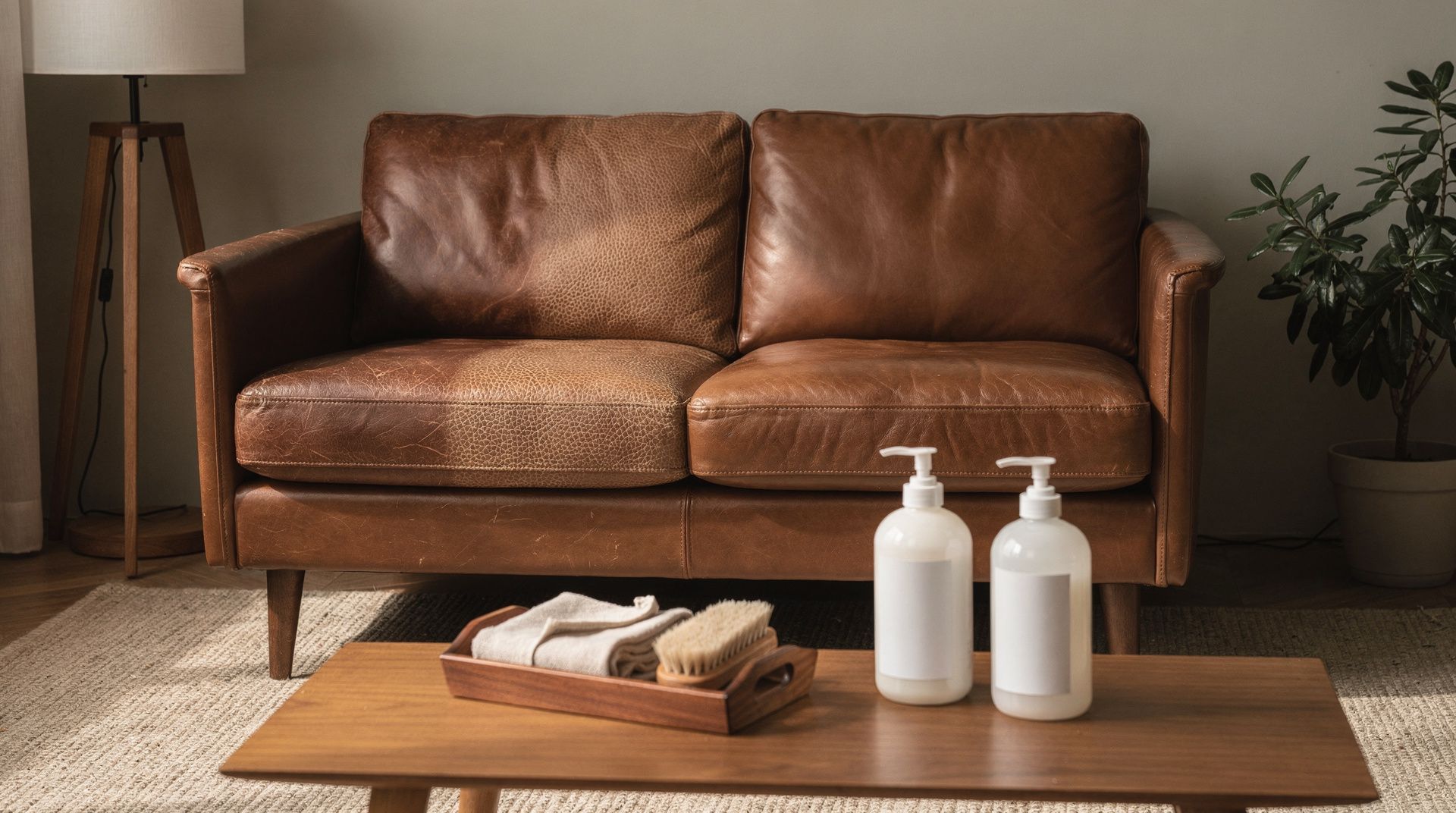
Aniline or pigment leather: why the distinction determines the preservation of your upholstered furniture
Anyone who collects mid-century upholstered furniture cannot avoid the question of leather type. Aniline and pigment leather are two fundamentally different material concepts that demand completely different answers in terms of feel, ageing and, above all, care. Confusing them has consequences: a pigment-based cleaning agent on open-pored aniline leather can permanently obscure its natural character, while a purely nourishing oil on a closed pigment layer achieves little and, in the worst case, leaves rings. We approach the subject from the perspective of conservation, not quick refreshment. The goal is to keep the substance of a piece of seating furniture legible over decades – with all the traces that belong to an authentic vintage piece.
1. Characteristic materials: aniline, semi-aniline, pigment
Aniline leather is dyed through without an opaque colour layer. The grain remains visible, the pores are open, the material absorbs moisture and develops patina – that depth of character and soft handle that collectors prize in an aged armchair. It can be identified by the water-drop test: a tiny drop of distilled water visibly darkens the spot and is absorbed within a few minutes. The colour across the surface is never entirely uniform; every hide shows individual characteristics such as insect bites, vein runs or growth marks.
Semi-aniline leather receives a very thin pigmentation that evens out colour differences without closing the grain. The water drop darkens more slowly and less noticeably here. This finish was common among Scandinavian manufacturers of the 1960s and 1970s because it combined everyday robustness with a natural appearance.
Pigment leather carries a closed colour and finish layer. The surface feels smoother, often slightly cool to the touch; water beads off. The grain is usually embossed, not grown. In terms of care, this means: pigment leather is cleaned, not nourished. Fatty conditioners remain on the surface. Aniline leather, on the other hand, requires re-fatting, low-solvent preparations based on natural fats and waxes, applied sparingly and massaged in evenly. Aggressive all-purpose cleaners, excessive saddle soap or silicone-containing sprays are unsuitable for both types.
2. Regional schools and their choice of leather
Danish furniture modernism consistently relied on high-quality aniline and semi-aniline leathers. Fritz Hansen sourced fine aniline grades for Arne Jacobsen’s Egg and Swan from the late 1950s onwards – leathers that today, after decades of use, carry an unmistakable patina. Børge Mogensen worked with Fredericia Stolefabrik using so-called natural leather, a vegetable-tanned, largely untreated cowhide that darkens with the years and became the hallmark of model 2213. Poul Kjærholm’s designs for E. Kold Christensen, later Fritz Hansen, combined spring steel with tautly upholstered aniline leather in clear black tones.
In France, Pierre Jeanneret and Charlotte Perriand used robust, vegetable-tanned leathers, frequently in cognac and saddle colours. The Italian school around Cassina, Tobia Scarpa, and Afra and Tobia Scarpa’s designs for the Soriana armchair worked with soft, semi-aniline-dyed leathers that lent the sculptural, padded volumes the necessary suppleness. American modernism – for example Charles and Ray Eames for Herman Miller – initially used high-quality aniline leathers for the Lounge Chair 670, later increasingly opting for pigmented grades for the contract market. This provenance history aids classification: an original Danish armchair from the 1960s almost invariably features open-pored leather, and any restoration should respect that.
3. Authenticity and condition: what collectors look for
When purchasing, a calm, systematic inspection is worthwhile. First, the handle: warm and slightly rough suggests aniline, smooth and cool points more towards pigment. Then a look at the pores – ideally with a 10× loupe. Visible, irregularly distributed pores and natural grain characteristics indicate untreated or only lightly treated leather. A perfectly uniform structure points to an embossed finish. The water-drop test mentioned earlier should only be carried out in an inconspicuous spot and with a minimal amount of water.
For condition assessment, patina is central. Seat surfaces may be worn in, armrests may be darkly polished – this is part of the furniture’s biography. Critical, however, are cracks in fold lines, broken grain, dried-out areas with a powdery surface, and overpainting with leather dye that clogs the pores and complicates assessment. On sewn covers, it is worth examining the stitch pattern, thread weight and zip brand markings, which provide clues about originality and later re-upholstery. For long-term conservation: maintain a constant room humidity of around 50 per cent, avoid direct sunlight, keep distance from heat sources, and carry out sparing, material-appropriate care twice a year. Less is substantially more.
At mid-centurydesigns.com, upholstered pieces are assessed for leather type, provenance and condition before being added to our inventory. We document whether a cover is original, contemporaneously replaced or professionally restored, and provide an assessment of care requirements and recommended products for every piece. This allows you to make a purchasing decision based on transparent facts and to acquire a piece of furniture whose material history remains clear.
This article was generated automatically by an AI system. Disclosure pursuant to Article 50 of the EU AI Act.