Aniline and Cognac Leather on Vintage Furniture: Care with Respect for the Patina
Open-pored aniline leather is the most honest form of refined cowhide. It is dyed exclusively in soluble aniline dyes — without a covering pigment layer, without embossed foil, without concealing finish lacquers. What you see is the animal’s own grain: insect bites, vein traces, growth marks, fine creases. It is precisely this openness that makes the material so sought-after on classics of the Mid-Century era, and it is precisely this openness that demands a different kind of care than closed semi-aniline or pigmented leather.
Cognac is not a single colour in the strict sense, but a colour family ranging from warm caramel and reddish-brown to whisky, which deepens and grows more complex over decades through UV exposure, hand oils and slow oxidation. An original cognac upholstery on a chair from the late 1950s to the early 1970s carries a patina that can neither be reproduced nor reversed with modern care products. Those who do not understand it will destroy it in a single cleaning session. Those who do understand it will preserve it for further decades.
This page summarises what you should bear in mind when dealing with open-pored fine leathers on vintage furniture, which makers and workshops shaped this material, and how collectors assess authenticity and condition.
1. Characteristic Materials and Their Peculiarities
Aniline leather can be identified by the cool drop test: a drop of distilled water immediately darkens the surface because it is absorbed into the fibres unimpeded, then dries without leaving a ring. With semi-aniline the darkening is weaker; with pigmented leather the water beads off at the surface. This permeability is the reason why open fine leathers are particularly sensitive to dirt, grease and solvents.
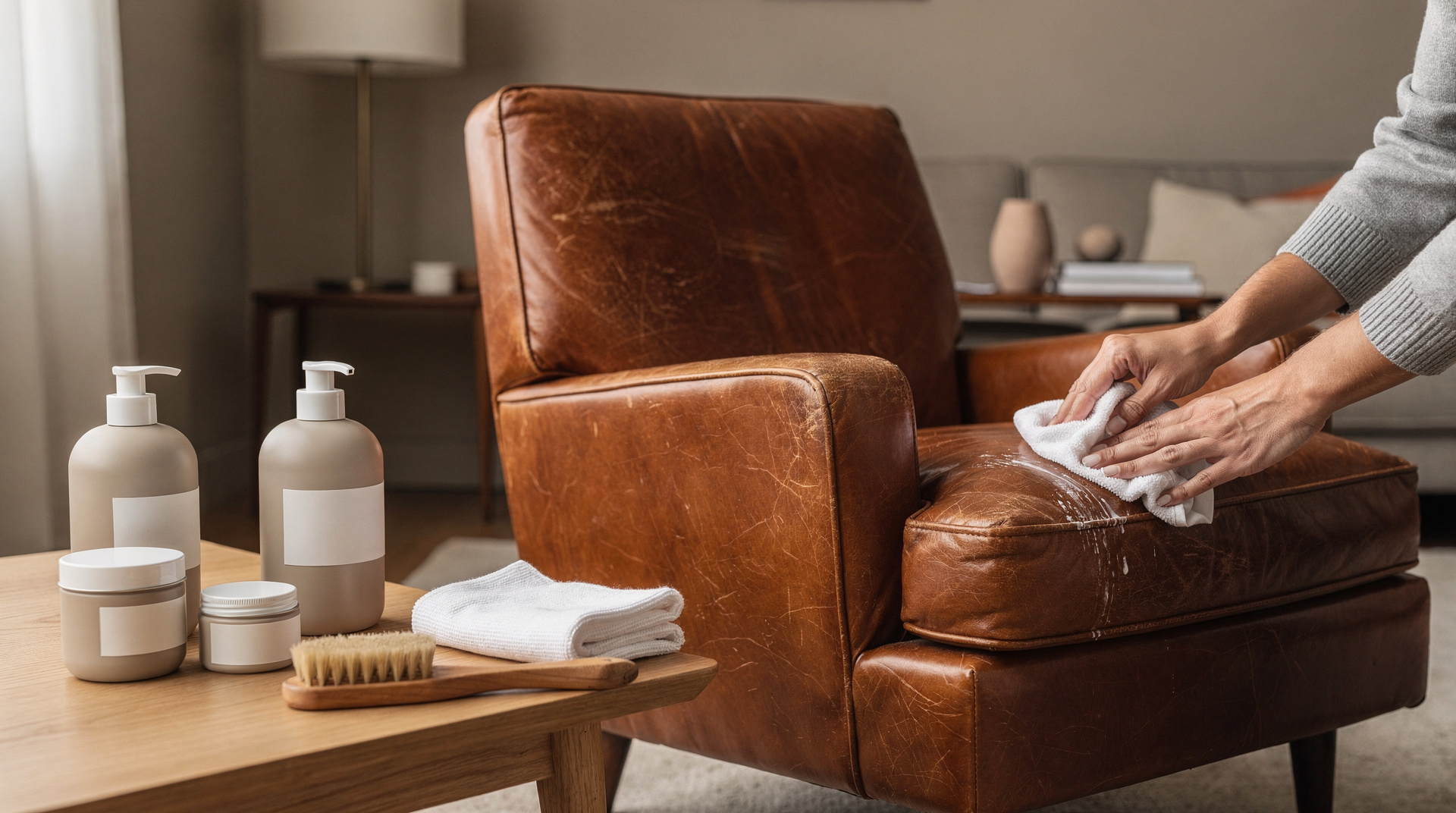
For care, this means three fundamental principles. First: dry cleaning before wet cleaning. Loose dust that collects in the grain acts like sandpaper and should be picked up with a soft horsehair brush or a microfibre cloth — not rubbed in. Second: use water sparingly and only locally. If a surface is partially moistened, watermarks form that are later almost impossible to even out. Where in doubt, it makes sense to treat the entire seat or backrest evenly with a barely damp cloth in circular motions. Third: conditioning only after the leather has dried completely, applied in thin coats and using a product approved for open-pored aniline leather. Pure neatsfoot oils, saddle soaps intended for tack, or pigmented leather balms are generally unsuitable for furniture upholstery because they shift the colour, weigh down the leather or leave a tacky layer.
Cognac leather from the Mid-Century era is typically a chamois- or chrome-tanned cowhide of medium weight, often between 1.2 and 1.6 millimetres, sometimes laminated onto textile backing. The depth of colour results from drum dyeing rather than spray application, which is why edges, seams and cut surfaces show the same colour as the face. A cut edge that is noticeably lighter on one side is a clear indication of later reupholstering or of a pigmented replacement leather.
2. Regional Schools and Defining Designs
Open-pored aniline leather was the standard in several centres of Mid-Century Modern design, though each had its own distinctive character.
In Denmark, workshops such as A. P. Stolen, Fredericia, Erik Jørgensen, Getama and Carl Hansen & Søn preferred saddle-like, vegetable-retanned aniline leathers for designs by Hans J. Wegner, Finn Juhl, Børge Mogensen and Kaare Klint. The early upholstery on Wegner’s Ox Chair, Mogensen’s Spanish Chair or Poul Kjærholm’s PK series for E. Kold Christensen displays a dense, taut grain that acquires a soft, silky sheen over the years.
In Sweden, the tradition is closely associated with Bruno Mathsson and the Karl Mathsson workshops in Värnamo, as well as with Dux and Norell. Norway produced robust leather variants with Fredrik Kayser, Ingmar Relling and Sven Ivar Dysthe, frequently used alongside rosewood and teak frames.
In the 1960s and 1970s, Italy set its own accents with Poltrona Frau, Cassina and de Sede from Klingnau in Switzerland. The programmes surrounding Tobia Scarpa’s Bastiano, Afra and Tobia Scarpa’s Soriana, or de Sede’s DS-600 demonstrate how generously open-pored leather was used on heavy, deep upholstered pieces. In the United States, Florence Knoll, Charles and Ray Eames and Ward Bennett defined the image of a tauter, more technical-looking leather seat, often contrasting with chromed or brushed steel frames.
3. Authenticity and Condition from a Collector’s Perspective
For the value of a vintage piece, the original upholstery is often decisive. A Wegner chair in its first leather — evenly darkened, showing visible use but with an intact grain — commands a significantly higher price on the market than an identical model with a later, professionally executed reupholstering. Check systematically therefore: do the seams sit in their original positions, do the stitch pattern, thread weight and colour match the manufacturer’s references, do the backs of cushions carry the typical zips, labels or workshop stamps.
Pay attention to colour gradation and wear. Authentic patina is never uniform — it follows use: darker on armrests, the neckline zone and the front edge of the seat, lighter on protected flanks. If the upholstery appears uniformly even in colour, it may have been re-dyed or touched up with a restoration spray, which from a collector’s perspective must be regarded as an intervention. Slight crazing in the seating area, fine stretch lines at seams and a slightly hardened edge at frequently touched zones, on the other hand, belong to a desirable state of preservation.
Cracks and dry damage can be conditioned to a limited extent, but deep furrows and burst grain cannot be concealed without trace. An honest condition report names both. For purchasing decisions in the upper segment, the rule applies: better a piece with a readable history and original aniline upholstery than one with a perfect but contemporary surface.
At mid-centurydesigns.com, we inspect every piece of furniture for provenance, originality of upholstery and condition of the leather before adding it to our inventory. Where possible, we document the maker, period of production and previous use. Conditioning is carried out in our workshop with restraint and exclusively with products suitable for open-pored aniline and cognac leathers. This leaves you as a collector or designer the decision of how much intervention you accept on a piece and which patina you consciously choose to carry forward.