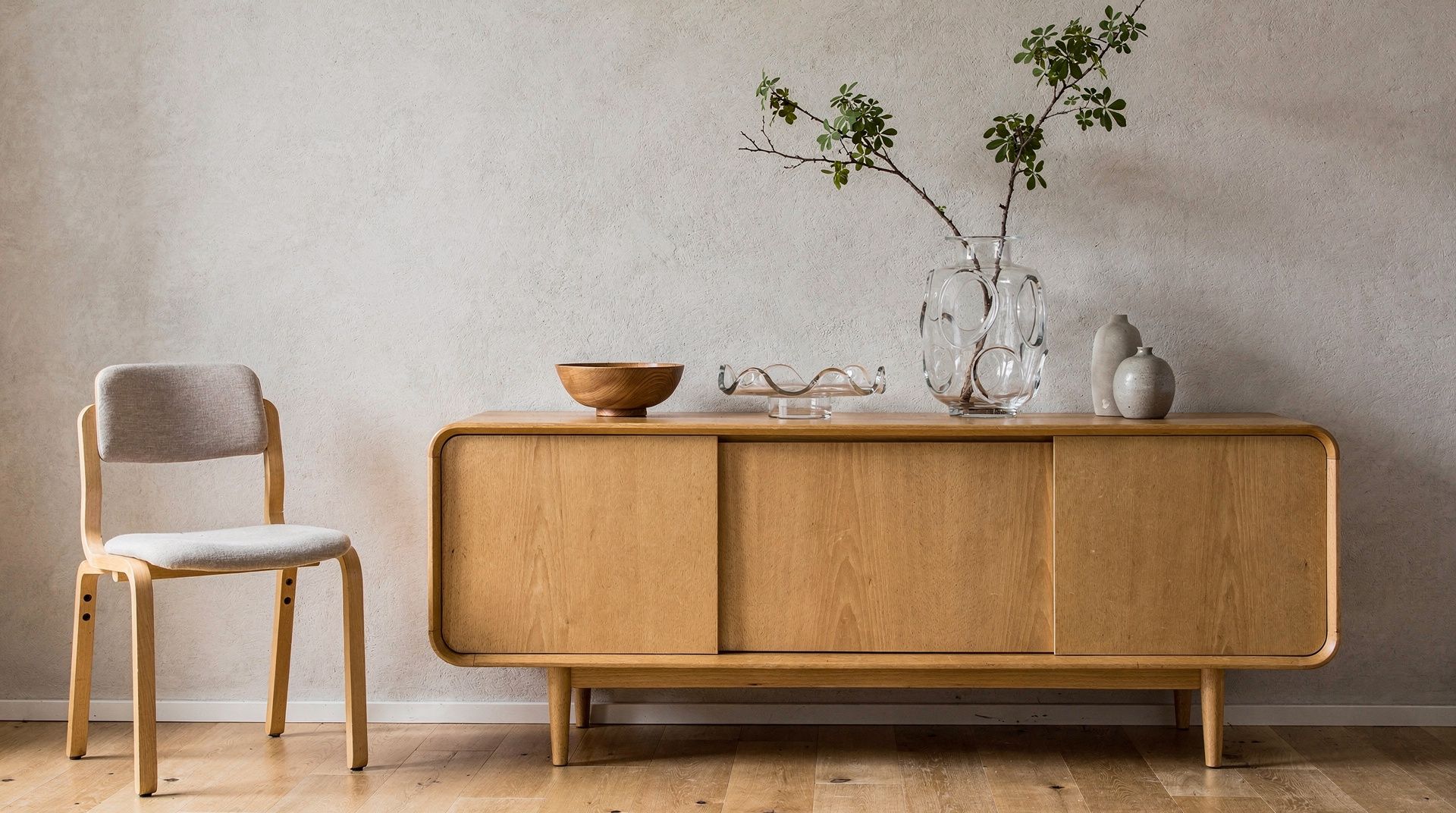
Alvar Aalto and the Humanist Modernism of the North
Alvar Aalto (1898 to 1976) is one of the few architects and designers who shaped an entire design language without ever raising their voice. While the Bauhaus in Germany placed its bets on tubular steel, right angles and industrial rationality, Aalto shifted the focus as early as the 1930s towards the human being, the climate and the materials of his homeland. From this attitude emerged a modernism that does not argue coolly but convinces through touch: bent birchwood instead of nickel-plated steel, soft organic contours instead of geometric rigour, warm light instead of technical reduction.
The break with orthodox modernism became manifest in 1933 in the Viipuri Library and the Paimio Sanatorium. The Paimio Chair (Model 41, 1932) and the cantilevered stools of the Series 60 (1933) are not furniture in the classical sense but built arguments for a way of thinking that brings together ergonomics, acoustics and regional resources. With the founding of Artek in 1935, together with Aino Aalto, Maire Gullichsen and Nils-Gustav Hahl, this attitude was institutionalised. Artek saw itself not as a furniture manufacturer but as a cultural project: furniture, art, exhibitions and publications as an interconnected ecosystem. Those who collect Aalto today are therefore always collecting a piece of Nordic cultural history in which functionalism and humanism are not opposites.
Materials: Birch, Bent Wood and Blown Glass
The central material in Aalto’s work is Finnish birch. From 1929 onwards, he developed a process together with the carpenter Otto Korhonen in Turku by which solid birchwood could be bent into L- and Y-shaped legs through sawing and laminating. The so-called L-leg of 1932 is the structural foundation of virtually all subsequent Artek furniture: Stool 60, Table 90, Armchair 66. The advantage over Thonet’s bentwood lies in the screwable, serially assembled connection to the seat surface, which simplified warehousing and shipping without abandoning the handcrafted appearance.
The solid wood construction is complemented by plywood. For the Paimio Chair and the cantilever chairs 31 and 42, thin birch veneers were cross-laminated and bent in a single piece. The springy quality of the material replaces the tubular steel spring that Marcel Breuer and Mart Stam had introduced shortly before. Upholstery was traditionally linen, webbing straps of the Zanotta type, or lacquered veneer surfaces in white, black and the later colour schemes.
In the field of glass, it is above all the Savoy Vase of 1936 that defines the era, designed for the Restaurant Savoy in Helsinki and awarded a prize in the Karhula-Iittala glassworks competition. Its asymmetric, wave-like contour is still mouth-blown at Iittala today; until the 1950s production used wooden moulds, which give the pieces an irregular inner wall and fine vertical streaks. From the 1950s onwards, cast-iron moulds were used. These details are crucial for dating.
Regional Schools and Context: Finland, Sweden, Denmark
Aalto’s work does not stand in isolation but in dialogue with Nordic functionalism as a whole. In Finland, Aino Aalto deserves mention as an independent designer whose pressed-glass series Bölgeblick (1932) translated the organic formal vocabulary into an industrial everyday language. Ilmari Tapiovaara developed the stackable birchwood furniture for international markets further with the Domus Chair (1946); Yrjö Kukkapuro and Eero Aarnio shifted the same organic sensibility into plastics and foam in the 1960s.
In Sweden, a parallel development emerged with Bruno Mathsson: his bent beechwood frames with jute webbing from the late 1930s share with Aalto the idea of a springy, ergonomic piece of furniture, yet pursue it with different proportions. In Denmark, Hans J. Wegner, Finn Juhl and Arne Jacobsen adopted the organic linearity but transposed it into teak, rosewood and elaborate mortise-and-tenon joints. The difference is revealing: where Copenhagen celebrates craftsmanship, Helsinki thinks in series and systems. Aalto’s furniture is conceived more democratically, with its construction openly visible and its choice of materials consciously plain.
For collectors, this yields a clear map: an Artek Stool 60 from the 1950s answers a different question than a Wegner armchair from the same period. Both are Mid-Century Modern, but they follow different cultural programmes.
Authenticity, Condition and Provenance
With Aalto furniture, attributing a piece to a specific production phase is decisive for its value and significance. Until 1954 many pieces were made at Huonekalu-ja Rakennustyötehdas in Turku, after which production shifted increasingly to Artek itself. Early pieces frequently bear paper labels reading “Aalto Design” or “Artek Helsinki”; later models carry branded marks. Labels alone are not proof, as they may be missing or have been added. More important are the structural characteristics: the number of laminates in the L-leg (early legs have five visible glue lines, later ones fewer), the type of fastening, the veneer thickness of the seat surfaces and the patina of the birch, which over the decades shifts from pale yellow to a golden honey tone.
For the Savoy Vase, the base signature, wall thickness and surface texture should be examined. Pre-war pieces are rare and frequently bear no mark or only an etched one; Iittala editions from the late 1950s onwards are sandblasted and signed. Reproductions from third-party manufacturers can be identified by overly uniform wall thicknesses and an excessively clear symmetry.
Regarding condition: original lacquer finishes, unrestored glue joints and documented previous owners are to be valued more highly than extensively reworked surfaces. Repainting, replaced webbing straps or substituted seat surfaces reduce the collector’s value, even when the piece looks visually convincing. Provenance from Finnish original purchasers, from documented architectural projects or from estates substantially increases both value and historical significance.
At mid-centurydesigns.com we curate Aalto furniture and selected objects from the Artek context with the aim of making every attribution traceable. We examine construction, labels, patina and origin, document interventions transparently and place each piece within its production-historical context. For collectors and designers seeking not merely a piece of furniture but a dateable testament to Nordic modernism.
This article was generated automatically by an AI system. Disclosure pursuant to Article 50 of the EU AI Act.