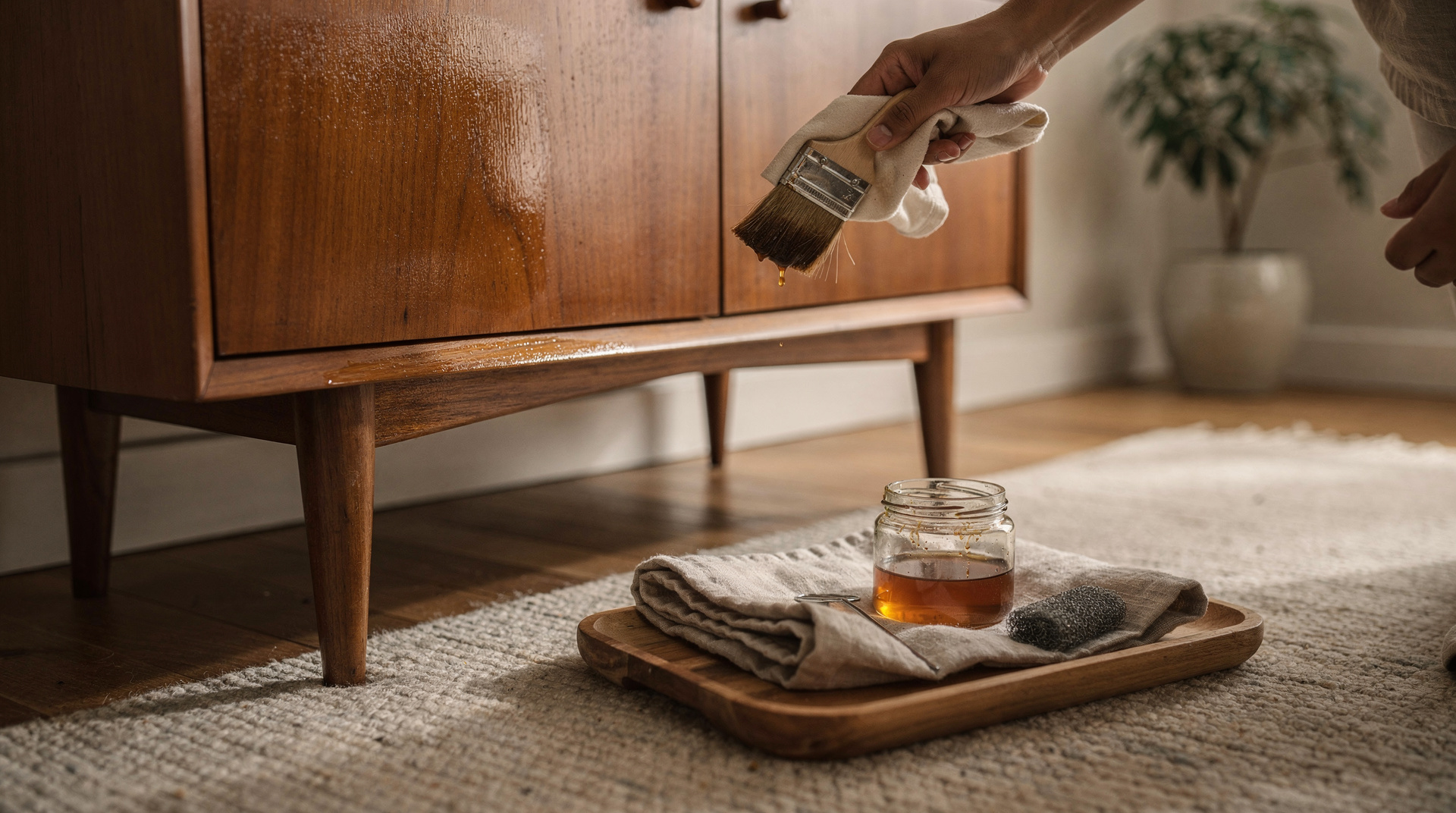
Shellac and French polish: the renaissance of a craft surface
Shellac is not a varnish in the industrial sense, but a natural resin obtained from the secretions of the lac beetle (Kerria lacca). Dissolved in alcohol, it produces one of the most elastic and visually deep surfaces known to European furniture craftsmanship. French polish, brought to perfection in France in the early 19th century, is the most demanding form of application: the thinnest layers are applied with a polishing pad (a tampon made from a wool core and a linen cover) in circular and figure-of-eight movements, with a drop of linseed oil serving as a lubricant.
Anyone caring for a Mid-Century piece with an original shellac surface is working with a historical material structure. That is the approach we recommend: understand first, then intervene. Because shellac is reversible. A new coat bonds with the old film, dull areas can be dissolved and brought back to a shine without the need for sanding. This reversibility is precisely what distinguishes classical polish from modern two-component lacquers and makes it the preferred surface for restorers.
The difference between “shellac polish” and “French polish” is fundamentally not a difference in material but a difference in technique. Both work with shellac in ethanol (mixtures of approximately 1:8 to 1:10, resin to alcohol, historically referred to as a “pound cut” are common). Standard shellac polish is often applied with a brush or pad in a few passes. French polish, on the other hand, consists of dozens, sometimes a hundred passes with the tampon, divided into priming (filling the grain, “fond”), building up (“corps”) and clarifying (“éclaircir”) with almost pure alcohol. The result is a mirror-like yet warm film just a few hundredths of a millimetre thick.
Materials, mixture and correct application
For refreshing, you need just a few precisely matched components. Shellac is available as flake or button stock, in shades ranging from pale “bleached” or “blond” through “lemon” and “orange” to dark “ruby” and “garnet”. For light woods such as maple, birch or bleached walnut, choose dewaxed, pale grades; for the dark rosewood and teak surfaces of the 1950s and 60s, “orange” or “ruby” are often a good match. The alcohol should be high-proof ethanol (at least 94 per cent, ideally denatured with ethanol-based denaturant — not methylated spirits containing methyl ethyl ketone or Bitrex additives, which can leave residues).
The traditional lubricant is cold-pressed linseed oil, used extremely sparingly: a single drop on the pad per pass is sufficient. Too much oil remains in the film, leading to later seeping and “oil rings” that break up the gloss. At the end of the polishing process the oil is drawn back out of the surface during the “éclaircir” pass — almost pure alcohol on a very dry pad. Anyone who skips this step will see the result weeks later in the form of dull hazes.
The application itself follows a clear sequence. First, degrease the surface with a cloth lightly dampened with ethanol, without dissolving the existing polish. Dull areas and fine scratches are then worked with the pad in circular movements; the pad is loaded with a dilute shellac solution (approximately 1:12) and dressed with a drop of linseed oil on the outside. The pad must never be left standing still — it lands on the surface in motion and lifts off in motion, otherwise pad marks will be left in the soft film. After each pass, allow 20 to 30 minutes of drying time before the next one. Deeper scratches are first filled with a fine brush dipped in polish (“retouching”); only then does the pad work follow across the entire surface.
Regional schools and references in the Mid-Century context
French polish may be named after its country of origin, but its spread in the 20th century took place through several regional schools that are relevant for collectors of Mid-Century furniture. In Denmark, hand polishing remained the standard well into the 1960s at workshops such as Rud. Rasmussen, A. J. Iversen and Fritz Hansen, when pieces by Kaare Klint, Ole Wanscher or Hans J. Wegner were executed in rosewood or walnut. The Danish tradition favours a rather matte, silky build-up, often combined with a subsequent wax coating, rather than the full high gloss of 19th-century French salon furniture.
The Italian school, formative for the work of Gio Ponti, Ico Parisi or Osvaldo Borsani, tended towards a deeper, more lustrous polish, frequently on walnut from the Piedmont region or on stained fruitwoods. German and Austrian workshops in the tradition of the Wiener Werkstätte and later furniture manufacturers such as Wilhelm Knoll or Walter Knoll were still working partly with shellac in the 1950s, but switched to nitrocellulose and later synthetic resin lacquers earlier than Scandinavia did. Among French éditeurs such as Steiner or works associated with ARP (Pierre Guariche, Michel Mortier, Joseph-André Motte), shellac is found primarily on exposed solid-wood elements, while veneered surfaces were lacquered by machine from an early stage.
These regional differences are not an academic detail. They determine which polish solution and which build-up technique you bring to a piece. A Wegner armchair from the early 1960s calls for a different treatment than a Ponti writing desk of the same period, even if both appear at first glance to be “oiled and polished”.
Authenticity, condition and safety
For collectors, the surface is a central marker of authenticity. An original shellac polish shows a characteristic orange to yellowish fluorescence under UV light; modern synthetic resin lacquers fluoresce bluish or not at all. A simple test on a concealed spot: a cotton swab moistened with ethanol will dissolve shellac within a few seconds and turn yellowish; synthetic resin remains unaffected. If an original shellac surface is found beneath a later coat of lacquer, this is curatorially an argument for professional stripping rather than further overcoating.
Condition assessment also means being able to read typical damage. White rings from glasses are usually confined to the uppermost film and can be polished away with the pad and a little alcohol. Black stains, however, indicate water that has been drawn through the film into the wood and require local bleaching. Craquelure — fine networks of cracks — develops when the build-up is too thick or when the piece is subjected to severe temperature fluctuations; this is the point at which a full repolish is preferable to refreshing.
On safety: ethanol is highly flammable, with a flash point of approximately 12 degrees Celsius. Work with windows open, without open flames, without smoking, and store the solution in tightly sealed metal or amber glass bottles. More critical are rags and pads soaked in linseed oil: linseed oil dries oxidatively and can spontaneously ignite in crumpled cloths through the heat released in the process. Soaked cloths should be spread out to dry in the open air or disposed of in a sealed metal container with water — never in a wastepaper basket.
Common beginner mistakes can be summarised in a few points: mixtures that are too thick, leaving pad marks; too much linseed oil, preventing later gloss; working in conditions that are too cold or too humid, causing the film to “cloud”; and attempting to leave the pad stationary. The polish rewards patience, not force.
At mid-centurydesigns.com we examine every surface according to exactly this system: material identification, UV and solubility testing, assessment of the original polish, subsequent reworkings and restoration traces. Pieces with a preserved or professionally refreshed shellac polish are noted as such in our descriptions, as are works where we have commissioned a full repolish, with the workshop and technique named. This ensures that you as a collector can trace exactly what you are buying and how to care for it going forward.
This article was generated automatically by an AI system. Disclosure pursuant to Article 50 of the EU AI Act.